







 Vietnam Mortgage Surge Pushes Homes Out of Reach
 Lithuanian Apartment Prices Accelerate Across Major Cities
 London Flats Lose Value Ahead of Leasehold Reform
 Construction of the Batumi–Sarpi Highway Begins in Georgia
 Baltic Property Investment Accelerates in 2026
 Hong Kong and Singapore Renew Their Expat Rivalry
Hormuz Blockade Drives Oil and Risk Higher
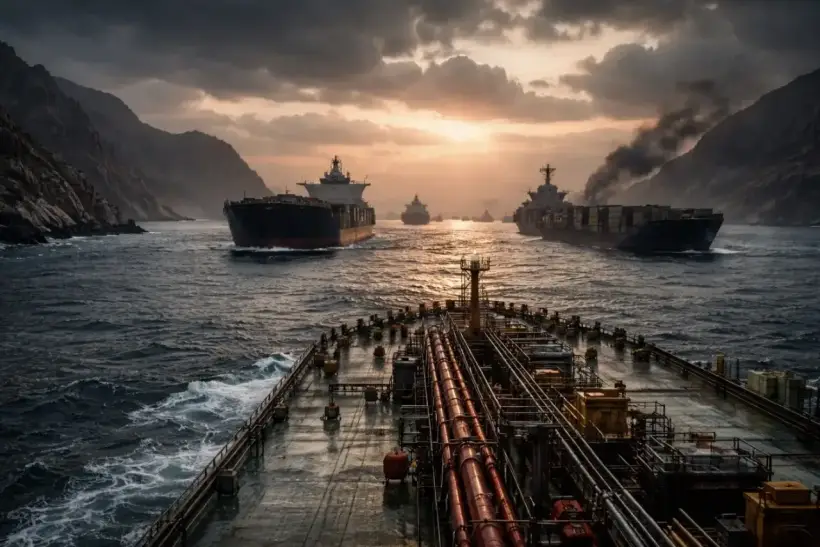
The United States moved to blockade Iranian ports after talks with Iran collapsed in Islamabad, intensifying pressure around the Strait of Hormuz, pushing oil back above $100 a barrel and weakening sentiment across global markets. After more than 21 hours of negotiations, the two sides failed to reach an agreement, placing an earlier two-week ceasefire under renewed strain. US Central Command said the blockade would apply to vessels entering and leaving Iranian ports, while transit through the Strait of Hormuz between non-Iranian ports would formally remain open.
US-Iran talks in Islamabad ended without agreement
The latest diplomatic round ended on April 12 without a breakthrough. According to the Associated Press, talks in Pakistan lasted more than 21 hours, but Washington and Tehran remained far apart on core demands. The United States pushed for an end to Iran’s nuclear and missile programs and broader regional concessions, while Iran demanded pressure relief, recognition of its conditions related to the Strait of Hormuz and compensation for war damage. The outcome cast doubt on the two-week ceasefire that had been due to run until April 22.
Soon after the talks ended, President Donald Trump moved to a harder line. AP reported that the blockade was scheduled to begin on Monday, April 13, with US forces saying it would apply to shipping linked to Iranian ports on the Persian Gulf and Gulf of Oman. The step marked the sharpest maritime escalation by Washington since the current phase of the war began in late February.
Why the Strait of Hormuz matters for oil and trade
The Strait of Hormuz remains one of the world’s most critical energy chokepoints. The US Energy Information Administration says flows through the waterway in 2024 and the first quarter of 2025 accounted for more than one-quarter of total global seaborne oil trade and about one-fifth of global oil and petroleum product consumption. Roughly one-fifth of global liquefied natural gas trade also passed through the strait, largely from Qatar. That means even a partial disruption quickly becomes a global pricing shock rather than a purely regional security issue.
Washington has stressed that it is not shutting the entire strait to all traffic, but even a limited military restriction in such a sensitive route changes behavior for shippers, insurers and commodity traders. AP reported that vessel traffic in the area dropped sharply after the blockade announcement, while separate reporting indicated that parts of the route had effectively halted. Britain’s maritime trade monitoring also signaled that traffic had not meaningfully recovered after the ceasefire and remained far below prewar levels.
Iran’s response raises the risk of wider escalation
Tehran’s response was immediate and severe. Iranian officials said the country retained control over the strait and warned that any military enforcement could trigger a forceful answer. AP reported that Iranian military and political figures threatened a strong response to the approach of military vessels and warned that maritime infrastructure across the region could also become targets if pressure on Iranian ports intensifies.
That has raised the prospect of the conflict spreading beyond Iranian export routes into a broader struggle over maritime security itself. While Reuters was not accessible in the retrieved results, AP and Bloomberg both framed the issue as a shift from pressure on Iran’s exports toward a contest over the wider security architecture of the Gulf shipping corridor. Bloomberg’s front page on April 13 highlighted the risk that the blockade could widen the war to the high seas, while markets sold off and Brent moved back above $100 a barrel.
Oil prices jump back above $100 a barrel
The oil market reacted almost immediately. AP reported that US crude rose about 8% to $104.24 a barrel, while Brent gained about 7% to $102.29. In another AP market update on April 13, US crude was shown up 7.4% at $103.69 and Brent at $102.24, after Brent had already traded above $119 earlier in the recent escalation cycle. Those levels underscored how quickly even partial disruption around Hormuz revives fears of tighter supply and more expensive energy for importing economies.
The broader oil story had already been tense before this latest move. Bloomberg had previously reported that Singapore, one of the world’s largest trading and bunkering hubs, was already feeling the war through higher marine fuel prices and supply-chain disruption. For Asia, the vulnerability is especially acute because a large share of the region’s energy flows depends on routes through the Gulf and the Strait of Hormuz.
Global markets turn defensive
Equity markets responded with a clear risk-off move. AP reported that in Europe, France’s CAC 40 and Germany’s DAX each fell around 1%, while Britain’s FTSE 100 slipped 0.4%. In the United States, futures for the Dow Jones Industrial Average and the S&P 500 were down roughly 0.5% and 0.6%. In Asia, Japan’s Nikkei 225 fell 0.7% and South Korea’s Kospi lost 0.9%, with transport and airline names among the worst performers.
Not every market in the region performed equally poorly. Bloomberg and The Straits Times had already noted that Singapore equities were holding up better than many neighboring markets in 2026 and remained close to record highs because investors increasingly viewed Singapore as a financial haven during the war and the wider period of volatility. On April 12, Bloomberg reported that Singapore stocks were near their record peak as haven demand supported local assets.
Why Singapore remains a key market to watch
Singapore is both exposed to the crisis and partly supported by it. On one side, Prime Minister Lawrence Wong had warned earlier that the war was disrupting energy supply, lifting inflation and threatening the country’s economic outlook. Bloomberg reported that Singapore unveiled about S$1 billion in support measures to cushion households and businesses from higher energy costs.
On the other side, the city-state’s reputation as a stable financial center has attracted defensive capital. Singapore Exchange said securities daily average value rose 45% year on year in February to S$2.1 billion, the highest since 2020. SGX also said the Straits Times Index gained 5.1% in the first quarter of 2026, with total return including dividends at 5.6%. That resilience has helped Singapore look stronger than many other Asian markets even as the Middle East crisis deepens.
Monetary policy is also part of the story. The Monetary Authority of Singapore runs an exchange-rate-based framework rather than relying mainly on a conventional benchmark rate. An official MAS paper says exchange-rate management has been the center of policy since 1981 because it is best suited to a small and open economy focused on price stability. As oil risks surged again, Singapore’s market began pricing in the possibility of a firmer policy stance, and Channel News Asia reported on April 13 that analysts expected a tighter setting at the next policy review.
As experts at International Investment report, the latest escalation around the Strait of Hormuz shows that the main risk is no longer limited to Iranian oil exports alone. It now touches the wider energy supply architecture for Asia, which means higher oil prices, renewed inflation pressure and deeper investor anxiety across markets. For Singapore, that creates a two-sided outcome: the economy faces stress through imported energy costs, while the financial market gains relative support as one of the region’s most trusted defensive destinations.
FAQ: Strait of Hormuz blockade and market impact
What happened on April 12–13, 2026?
After US-Iran talks in Islamabad collapsed, Washington announced a naval blockade of Iranian ports. US Central Command said the measure would target shipping to and from Iranian ports while formally allowing transit through the Strait of Hormuz between non-Iranian ports.
Why is the Strait of Hormuz so important?
The strait carries more than one-quarter of total global seaborne oil trade, about one-fifth of global oil and petroleum product consumption and roughly one-fifth of global liquefied natural gas trade. That makes it one of the most important energy routes in the world.
How did the blockade affect oil prices?
Oil prices quickly moved back above $100 a barrel. AP reported US crude near $104.24 and Brent near $102.29 after the blockade announcement, reflecting renewed fears over regional supply disruption.
How did stock markets react?
Most global equity markets fell. European indices such as the CAC 40 and DAX dropped around 1%, while Asian markets including Japan’s Nikkei and South Korea’s Kospi also moved lower. Singapore proved more resilient than many regional peers.
Why does Singapore feature so prominently in this story?
Singapore is highly exposed to global trade and energy flows, yet it is also seen as one of Asia’s most stable financial centers. That means the Iran war hurts the economy through fuel and inflation but can still support local financial assets through haven demand.