







 How Ukraine’s New-Build Housing Market Has Changed Over Four Years
 European Prime Rents Rise as Property Yields Turn Higher
 The Most Expensive Airlines in Europe in 2026
 Housing Prices in Italy Reach a Two-Year High
 Travellers Increasingly Choose Cooler Scandinavia
 Serbia Property Sales Decline as Transaction Value Rises
Construction in New Zealand rises for the third consecutive quarter
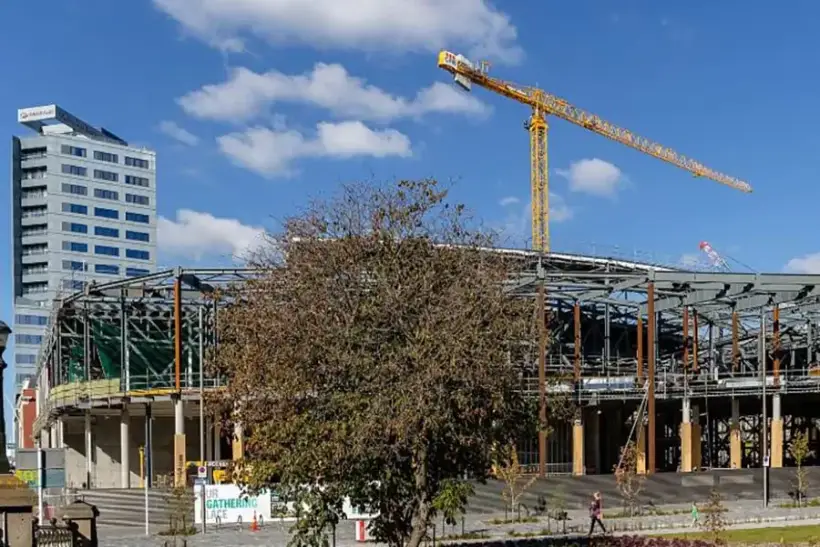
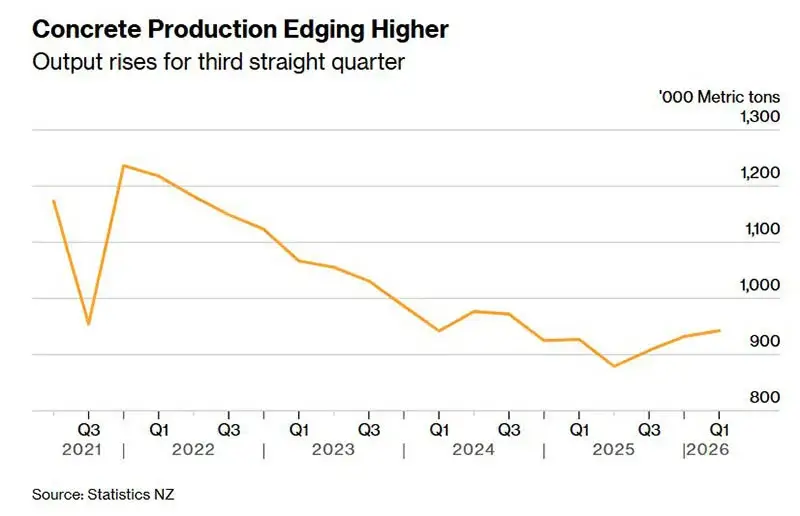
New Zealand’s construction sector is showing signs of recovery, with concrete production rising for the third consecutive quarter. At the start of 2026, output increased by 1.1% compared with October–December 2025, Bloomberg reported, citing data from Statistics New Zealand. An additional signal of improving activity came from building consents, which reached their highest level in several years.
Signals of recovery in New Zealand’s construction market
Concrete production in the second quarter of 2025 was at its lowest level in 11 years, excluding the sharp decline during the 2020 lockdown period, but conditions have since shifted markedly. In the fourth quarter of 2025, output rose by 2.7%, followed by a further 1.1% increase in the first three months of 2026 on a seasonally adjusted basis.
Analysts also pointed to growth in March 2026, when actual ready-mixed concrete production reached 869,652 cubic metres, 1.8% higher than in the same month of 2025. However, over the year ending in early spring, total output fell by 3.8% to 3.66 million cubic metres.
Building consents for new residential construction in New Zealand declined 1.3% compared with February, but rose 11% year-on-year to 37,800.
Risks to the New Zealand economy
The Organisation for Economic Co-operation and Development (OECD) notes that New Zealand’s economy is in the early stages of recovery after more than two years of weakness. A series of interest rate cuts by the Reserve Bank of New Zealand has already supported domestic demand. However, the recovery in construction and other sectors is increasingly facing new risks following the war in the Middle East, which has pushed up fuel prices and heightened uncertainty for businesses and investment.
Fuel-dependent segments such as earthmoving and demolition have already recorded a notable increase in costs in March and April, with pressure expected to spread further across the construction supply chain. Major materials supplier Fletcher Building Ltd. has begun raising prices in response to higher diesel costs and disruptions in the supply of resins and urea.
Possible slowdown in construction
Chief forecaster at Infometrics in Wellington, Gareth Kiernan, said that significant cost increases and uncertainty linked to the conflict involving Iran could lead to delays or suspension of some planned projects. This, in turn, may put additional downward pressure on concrete production over the coming year.
Economists expect New Zealand’s GDP to contract in the second quarter, mainly due to higher fuel prices, which are weighing on discretionary consumer spending and slowing investment in residential and commercial construction. For 2026 as a whole, growth is expected at up to 1.4%, rising to 2.3% in 2027. Support is expected to come from looser monetary policy, resilient exports, and recent reforms, including an investment boost programme allowing accelerated depreciation.
The Reserve Bank of New Zealand (RBNZ) has signalled readiness to act decisively if the short-term inflation spike becomes entrenched. This could lead to a tightening of monetary policy. Markets are already pricing in expectations of an official cash rate hike in July, according to swap data.
Conclusion
Analysts at International Investment note that the current data points to a recovery in New Zealand’s construction cycle, but one that remains uneven and reliant on a limited set of leading indicators. Growth in concrete production and rising building consents reflect the formation of future demand rather than a fully established expansion in activity.
At the same time, the recovery remains vulnerable to external conditions, including borrowing costs, energy price volatility and rising input costs across the construction chain. These factors prevent the emergence of a stable growth trend, with current developments better characterised as an early-stage rebound from a downturn rather than a sustained expansion phase.