










Serbian citizenship for Russians raises concerns in the European Commission
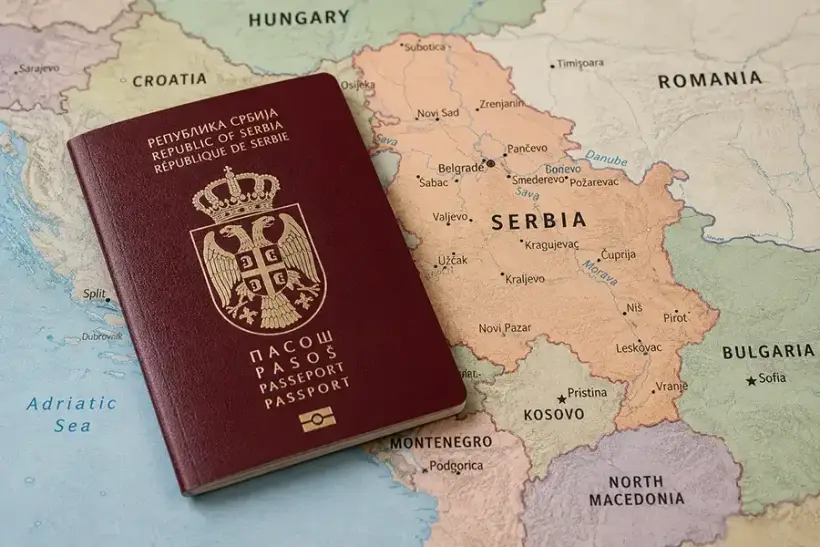
The growing number of Russians obtaining Serbian citizenship may pose additional security risks, the European Commission believes. Along with passports, such migrants gain visa-free access to the Schengen Area. As a result, authorities are advised to tighten scrutiny when reviewing applications.
Risks linked to Serbian passports
The European Commission assessed Serbia’s progress under Chapters 23 and 24 and noted an increase in the number of Russians acquiring citizenship. Brussels acknowledges Serbia’s sovereign right to shape its own policies but argues that this creates an additional channel of access to the EU’s visa-free regime and carries security risks.
Since 2022, Serbia has become one of the main destinations for Russian emigration, reflected in the dynamics of residence permits and naturalisation procedures. According to the Ministry of Interior, between 2020 and 2024 more than 104,000 Russians obtained residence permits, mostly based on employment, family reunification, and property purchases.
In 2023, 532 Russians obtained Serbian citizenship, while in 2024 the figure was 188. Some applications are linked to marriage, and the naturalisation process does not require renouncing Russian citizenship.
Who obtains Serbian citizenship
The “Important Stories” portal reports that between spring 2022 and April 2025, more than 330 people received Serbian citizenship under an expedited “in the interest of the republic” procedure, including 204 Russians. The mechanism provides simplified and accelerated processing.
This list includes Russian athletes and managers who used Serbian passports to continue international careers, as well as professionals from IT and corporate sectors.
A significant share of new citizens is linked to major Russian state corporations and the defence industry. The investigation mentions managers of enterprises associated with Rostec, as well as employees and executives in aviation, radio-electronics, and defence-related companies. There are also cases involving individuals connected to major political and business figures in Russia, as well as structures linked to security services.
Visa restrictions for Russians
Visa policy remains a key issue in the EU, where some member states are calling for stricter rules for Russian citizens. In 2025, nearly 480,000 Schengen visas were issued to Russians — the highest number since the start of the war in Ukraine in 2022 — increasing scrutiny of entry controls.
The European Commission notes that there is no unified strict visa restriction across the EU. Policy remains partially dependent on individual Schengen states, leading to differences in approval and refusal practices. As a result, so-called “alternative routes” through citizenship in third countries, including Serbia, are gaining importance.
President Aleksandar Vučić has stated that the country does not plan to introduce a visa regime for Russian citizens.
Visa-free regimes and EU requirements
Twelve countries currently maintain visa-free regimes with Serbia but are not part of the EU visa-free entry system. These include Armenia, Azerbaijan, Bahrain, Belarus, China, Indonesia, Jamaica, Kyrgyzstan, Kazakhstan, Russia, Suriname, and Turkey.
Under its reform agenda, Serbia has committed to introducing visa requirements for at least three of these countries. Some steps toward alignment have already been taken, but further progress has stalled. Since December 2024, the European Commission has noted a lack of significant progress in harmonising Serbia’s visa policy with the EU. Failure to meet conditions by the end of 2026 could result in Serbia losing more than €27.1 million under the Growth Plan.
Conclusion
Analysts at International Investment note that the number of Russians obtaining Serbian citizenship remains very small in absolute terms. Even at peak levels, naturalisation is measured in hundreds and does not represent a mass trend compared to over 100,000 residence permits issued. After 2023, the number of passports issued has declined further.
In this context, the European Commission’s concerns appear focused less on overall statistics and more on specific groups of recipients — primarily individuals linked to large business structures, state-affiliated organisations, and security-related sectors. This category shapes the main “risk narrative,” despite its limited scale.
At the same time, questions remain about the focus on Serbia specifically. Wealthy Russian nationals use a wide range of jurisdictions, including EU countries where residence and citizenship can also be obtained through investment or simplified schemes. Against this backdrop, the Serbian channel appears to be just one of many routes rather than an exception, making the EU’s emphasis politically sensitive and not fully explained by migration statistics alone.