







 Young Japanese Buyers Turn to 50-Year Mortgages
 Argentina Narrows Tourism Gap as Arrivals Rise
 Seattle Luxury Housing Loses Its Former Momentum
 The World’s Strongest Passports for Travel, Living and Investment
 Russian Developers’ Debt Nearly Doubled in a Year
 Young Icelanders Shift Into Rental Housing
Transport Revolution in Georgia: New Highways, Railways and Airports
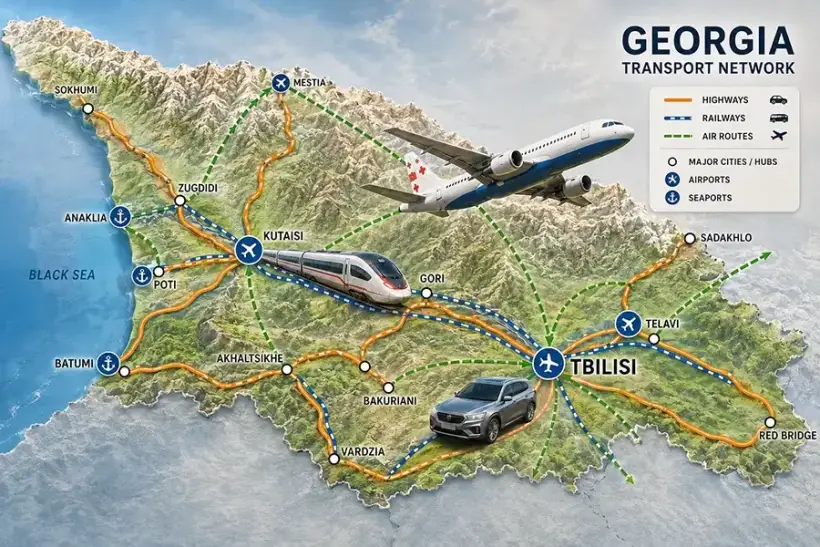
Major infrastructure projects are being implemented in Georgia, covering railways, civil aviation, and the road network, Prime Minister Irakli Kobakhidze said. The reforms are aimed at improving management efficiency, increasing capacity, and strengthening the country’s transit potential.
Railways in Georgia: Tbilisi to Batumi in 3.5 Hours
Georgian Railways has carried out optimization measures that generate an additional GEL 40 million ($15.2 million) annually. The company’s financial performance shows strong growth: net profit increased from GEL 68 million in 2024 to GEL 145 million in 2025, while the operating margin rose from 25% to 36%.
The development strategy предусматривает a significant expansion of railway capacity. Plans include the purchase of new locomotives and wagons, as well as the introduction of automated control systems. As a result, network capacity is expected to increase from 15 to 30 million tons of freight per year, effectively doubling the country’s logistics potential. In the passenger segment, major expansion is also expected: fleet renewal and infrastructure upgrades should increase passenger traffic from 2 to 5 million annually.
The railway network development includes the restoration of service through Kutaisi, the modernization of the Tbilisi–Batumi and Tbilisi–Akhaltsikhe lines, and the reduction of travel time on these routes by 1.5 hours and by half respectively. A new railway branch to Anaklia is also planned.
Aviation in Georgia: Rising Passenger Traffic and an Expanding Network
Civil aviation is also showing steady growth. As part of cost optimization in the airport system, savings of around GEL 70 million ($26.6 million) have been achieved. Agreements with international operators TAV Airports and ADP have been extended, generating a one-time income of $25 million and securing $150 million in investments.
Under the new agreement, the capacity of Tbilisi International Airport will increase by 53%, alongside higher state revenues from its operation. The number of airlines operating in Georgia has risen from 62 to 82, while the number of routes has increased from 109 to 125. New destinations have been added, and passenger transport grew by 14%, while cargo volumes increased by 54%. In 2025, the country reached a record 8.5 million passengers. Development of regional airports and planning of new infrastructure projects is ongoing.
A key long-term project remains the construction of a new international airport in Vaziani, designed to handle 20 million passengers annually. Its launch will help redistribute pressure on existing airports and support the expected growth in air traffic. The network of regional airports is also expanding: modernization of terminals in Telavi and Mestia is expected to strengthen internal connectivity and support tourism flows.
Road Network in Georgia: The Largest Infrastructure Program
The road sector remains one of the most capital-intensive areas of infrastructure policy. The completion of the Rikoti corridor marked a major milestone in east-west transit development. The 52 km section includes dozens of engineering structures and has significantly reduced travel distance and cut travel time by half on one of the country’s key transport routes.
Construction and modernization of dozens of national highways continues. The overall scale of the program is measured in billions of lari, with hundreds of tenders being implemented. A key strategic project remains the development of the Tbilisi bypass road, scheduled for completion by 2030.
Significant attention is being given to international transport corridors, including routes toward Batumi, Sadakhlo, and border crossings. Many projects are planned through 2031, effectively forming a long-term road architecture focused on transit flows and regional logistics integration.
Georgia’s outlook
Analysts at International Investment note that ongoing transport projects are forming a more efficient mobility system in Georgia. The development of roads, railways, and aviation infrastructure is gradually improving both domestic and international routes.
Travel time between regions is decreasing, access to key destinations is expanding, and travel logistics are becoming simpler and more convenient. This has a positive impact on tourism and the business environment. Changes are also strengthening Georgia’s investment appeal, increasing interest in the country and improving its regional competitiveness.