







 Foreign Investment in Indian Real Estate Rises 17%
 Finland Misses Residence Permit Processing Deadlines
 Europe Living Investment Reaches €44.6bn
 Urban Homes Cost 27% More Across OECD
 Adjara Overtakes Tbilisi: How Georgia's Regional Hotel Sector Structure Is Shifting
 Georgia to Boost Transit Potential with $7 Billion in Investments: Key Projects to Complete by 2031
IMF Does Not Rule Out Tighter Monetary Policy in Georgia
An International Monetary Fund (IMF) mission led by Alejandro Hajdenberg was in Georgia on a working visit on November 9-13. During the visit, the Fund's representatives assessed Georgia's economic state, inflation dynamics, monetary and fiscal policy, as well as the country's economic outlook. In a statement released following the mission, the IMF paid special attention to rising inflation.
What are the Monetary Fund's key messages regarding inflation?
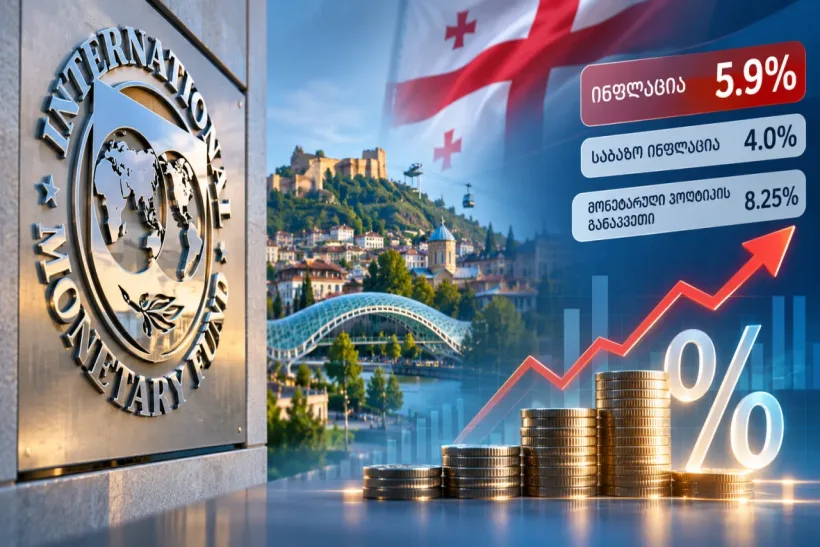
Annual inflation in Georgia in October 2026 stood at 5.9%, compared to the National Bank's target of 3%; core inflation reached 4% in October;
Inflationary pressure is no longer confined to rising energy prices alone, and price increases are spreading to broader categories.
According to the Fund's assessment, inflation should gradually decline, but will remain above target in the near term.
One of the most critical IMF warnings concerns monetary policy: as inflation has proven more persistent than expected, further monetary policy tightening may be needed to rein in price growth.
Currently, the National Bank of Georgia's monetary policy rate is 8.25%. The National Bank raised the rate in May and has kept it unchanged since.
What does the latest statistics show?
According to data from the National Statistics Office of Georgia (Geostat) dated November 3, consumer prices rose by 0.9% in October 2026 compared to the previous month, while annual inflation reached 5.9%.
Core inflation, which excludes several volatile components from the consumer basket, was 4% year-on-year. Core inflation excluding tobacco was 3.9%.
This indicates that price increases are no longer limited to individual products, and inflationary pressures are being felt across broader components of the economy.
According to the National Bank's assessment, a significant portion of inflation is tied to external factors
Natia Turnava, President of the National Bank of Georgia, spoke to media representatives on November 9 about the drivers of rising inflation.
According to her statement, of Georgia's existing 5.9% inflation, at least 2.2 percentage points are attributed to external factors. One of the main reasons cited is rising oil prices on international markets against the backdrop of conflict in the Middle East.
As Turnava explained, Georgia is a net importer of gasoline and diesel fuel, meaning price spikes on international energy markets pass through to the domestic economy.
At the same time, the President of the National Bank notes that core inflation and services price dynamics remain relatively stable and close to target.
The National Bank raised its monetary policy rate in May by 0.25 percentage points to 8.25%. According to Turnava, if inflationary pressure spills over into other sectors of the economy, the regulator is ready to tighten monetary policy further. In the opposite scenario, if the situation on global markets stabilizes, a rate cut is also possible.
What is the main economic risk?
Rising inflation poses an additional challenge for monetary policy. On the one hand, the National Bank's mandate is to ensure price stability, but on the other hand, higher interest rates make credit more expensive, increase financial costs for businesses and households, and may weigh on economic activity.
The composition of inflation warrants particular attention: when higher fuel and transport costs feed through to prices of other goods and services, the risk of so-called secondary inflation effects increases.
This is precisely the issue highlighted by the International Monetary Fund. According to its findings, the disinflation process will depend on how quickly the impact of high energy prices fades and to what extent price increases spread to other sectors of the economy.