







 Vietnam Mortgage Surge Pushes Homes Out of Reach
 Lithuanian Apartment Prices Accelerate Across Major Cities
 London Flats Lose Value Ahead of Leasehold Reform
 Construction of the Batumi–Sarpi Highway Begins in Georgia
 Baltic Property Investment Accelerates in 2026
 Hong Kong and Singapore Renew Their Expat Rivalry
Mumbai climbs upward as land runs out
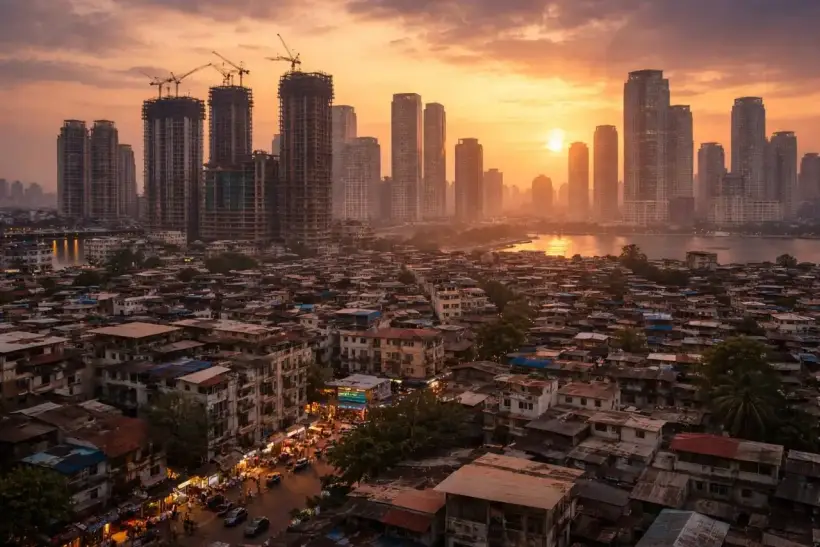
Mumbai is reshaping its skyline because land is scarce while demand for homes and offices remains strong. In 2025, office leasing in the city reached a six-year high of 11.59 million square feet, fourth-quarter leasing alone totalled 4.16 million square feet, and the redevelopment of ageing housing stock became one of the city’s main tools for urban renewal.
Why Mumbai is building higher
Mumbai is India’s financial capital and one of the country’s most land-constrained urban areas. Census data show that Mumbai City district covers 157 square kilometres and had a population of 3.085 million in 2011, implying density of about 19,652 people per square kilometre. In that environment, vertical construction has become more than a prestige project. It is a practical response to the shortage of usable land.
Knight Frank says in its redevelopment study that the shortage of land has made renewal of ageing buildings a structural necessity. The city can no longer rely on outward expansion in the traditional way, which is why it is increasingly replacing older low-rise stock with taller buildings that generate more usable floor space.
Office demand is intensifying the fight for space
The office market is adding to that pressure. JLL said Mumbai recorded 11.59 million square feet of office leasing in 2025, a six-year high and an all-time record in its data series. Leasing in the fourth quarter alone reached 4.16 million square feet, led by flexible workspace operators, technology occupiers and the banking, financial services and insurance sector.
JLL also said near-term Grade A supply remains constrained even as demand stays robust. New office completions in Mumbai totalled 5.1 million square feet in 2025, down 32% year on year mainly because of project delays. Even so, rents rose 1.1% quarter on quarter and about 4% year on year in the fourth quarter, showing how tight prime office conditions have become.
CBRE’s national data support that picture. The firm said India’s office sector set annual records in 2025 for both leasing activity and new supply, with demand driven by domestic corporate expansion and the growth of global capability centres. For Mumbai, that means continued competition for premium office space in business districts where banks, advisers and major corporations want to cluster.
Redevelopment of old housing is becoming the default model
The city’s vertical growth is not only about offices. It is also being driven by large-scale redevelopment of ageing residential buildings. Knight Frank says a 2017 audit by the municipal corporation found 159,834 buildings across Mumbai that were more than 30 years old. Of those, 44,830 were in the island city, 73,820 in the western suburbs and 41,184 in the eastern suburbs.
That ageing stock has become the foundation of the redevelopment wave. Knight Frank argues that renewal in Mumbai is no longer merely a market trend but a safety and planning imperative. Older buildings require structural audits, and redevelopment is increasingly being used to improve housing quality, create additional space and make better use of scarce urban land.
Industry reports citing Knight Frank said that more than 910 housing societies had initiated redevelopment between 2020 and mid-2025, unlocking over 326.8 acres of land. While that exact figure is cited in secondary coverage rather than the visible excerpt of the original PDF, it is consistent with the broader report’s conclusion that redevelopment has become the city’s core supply mechanism.
Why taller buildings do not solve the shortage quickly
Even with faster redevelopment, building upward does not solve the housing shortage overnight. Knight Frank notes that the full lifecycle of a redevelopment project, from initial intent to final possession, can take eight to eleven years. That makes the market both promising and difficult: residents expect larger homes and better amenities, but they often face legal, financial and execution delays.
The report also gives concrete examples. One case in Kandivali West showed a housing society replacing a five-storey structure with a 14-storey tower and increasing apartment size from 418 square feet to 705 square feet. Another case in Mulund showed how self-redevelopment stalled because of bridge-financing gaps, internal disagreement and execution challenges, eventually forcing residents to bring in a private developer.
Policy is helping push the skyline higher
Mumbai’s vertical expansion is being shaped not only by market demand but also by regulation. Knight Frank says the DCPR 2034 framework and related floor space index incentives have made many redevelopment projects financially viable. On plots facing roads wider than 18 metres, floor space index can rise to 5.4, while plots on 12 to 18 metre roads can reach 4.05, subject to physical and regulatory limits.
At the same time, the Maharashtra government said in March 2026 that it was redeveloping more than 1,000 acres of ageing housing layouts across Mumbai, underlining how central housing renewal has become to urban policy. In April, local reporting also pointed to a new cluster redevelopment scheme for large slum areas that officials said could affect hundreds of thousands of residents. That shows how the struggle for space in Mumbai now spans luxury towers, commercial districts, older middle-class housing and vast informal settlements at the same time.
As International Investment experts report, Mumbai’s changing skyline is not just a story about iconic towers. It is the result of three forces working together: acute land scarcity, strong demand for high-quality office space, and the need to replace a vast stock of ageing residential buildings. For investors, that points to continued interest in redevelopment and premium commercial assets. For residents, it means competition for space is likely to remain intense even as the city keeps building higher.
FAQ
Why is Mumbai growing upward instead of outward?
Because land is highly constrained, density is already very high, and the city cannot keep expanding horizontally in a conventional way. Taller and denser redevelopment has become the main path forward.
What does redevelopment mean in Mumbai real estate?
It generally means replacing ageing residential buildings with new, taller projects that provide upgraded homes for existing residents while also creating saleable inventory for developers.
Why do bankers and corporations matter for the skyline?
Because demand for prime office space is strong. Mumbai recorded 11.59 million square feet of office leasing in 2025, which increases pressure to develop more efficient vertical commercial projects.
How many old buildings are part of the problem?
A municipal audit cited by Knight Frank found 159,834 buildings in Mumbai that were more than 30 years old. That scale helps explain why redevelopment has become so important.
Will vertical construction solve the housing shortage quickly?
Not necessarily. Knight Frank says redevelopment projects can take eight to eleven years from initial decision to final possession, which means supply is slow to arrive even when activity is high.