







 Australia’s Spring Auctions Rise but Remain Well Below 2025
 Number of Foreigners Holding Turkish Residence Permits Exceeds 1.27 Million
 Demand from Russian Tourists for Holidays in Georgia Rises by 20–25%
 Montenegro Property Buying Costs in 2026
 Four in Ten Companies Would Not Choose Slovakia
 Gulf Countries Prepare Unified Tourist Visa
Riviera Buyers Move Off-Market
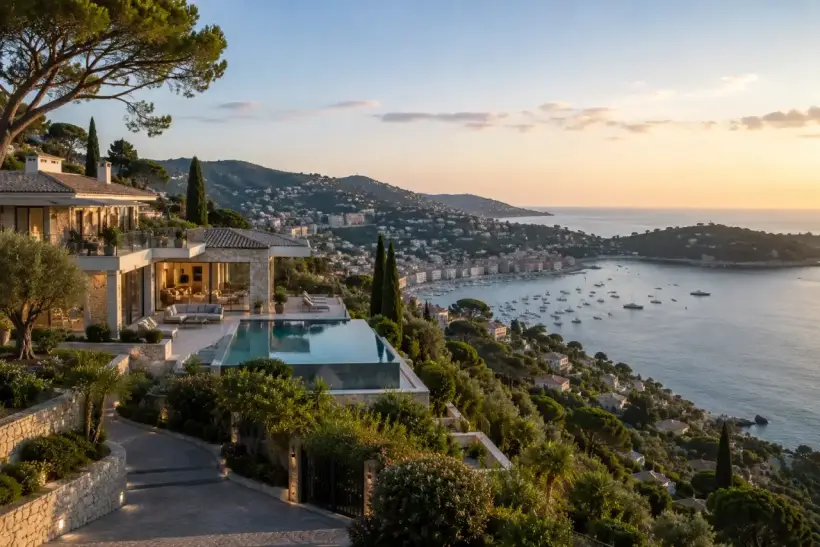
The Côte d’Azur luxury property market remains resilient in 2026, but it is becoming more private and selective: buyers are prioritizing turnkey villas with sea views, energy efficiency and privacy, while owners of rare assets increasingly avoid public listings and sell through discreet off-market channels.
The eastern Riviera is gaining from Monaco-linked demand
The French Riviera enters 2026 not as a broad overheated market, but as a collection of narrow micro-markets where pricing depends on land scarcity, sea views, proximity to Monaco, property condition and privacy. Polarius International Real Estate says demand is particularly visible in the eastern Riviera, including Cap-d’Ail, Villefranche-sur-Mer, Beaulieu-sur-Mer and Saint-Jean-Cap-Ferrat, where international buyers are seeking security, privacy and a ready-to-use Mediterranean lifestyle. The firm estimates that after the slowdown of 2023 and early 2024, total transactions rose by about 5.8% in 2025, while resale activity increased by roughly 17.5%.
Off-market sales are transactions conducted without broad public advertising on property portals. In the ultra-prime segment, this structure is important not only for seller confidentiality but also for scarcity: the best villas, penthouses and seafront homes are often shown to a limited buyer pool before they ever reach the open market.
Prices are stable, but rare villas are outperforming
The broader southern French market is moving more moderately. MeilleursAgents estimates as of May 1, 2026, show apartment prices in Provence-Alpes-Côte d’Azur up 0.2% over one year and 10.7% over five years, while houses rose 0.9% over one year and 7.1% over five years. The methodology combines agency transaction data, listings, public notary information and national statistical data, meaning it reflects the broader market rather than only the highest-end segment.
In luxury property, however, performance is more segmented. Prime villas and seafront homes with panoramic views can outperform the regional average. Polarius estimates that top villas and coastal properties with open sea views are seeing price growth of about 3% to 5%, while secondary locations are more stable.
That means buyer power has not disappeared on the Côte d’Azur, but it has become more professional. Buyers will pay a premium for rarity and quality, but they are less willing to accept outdated layouts, weak energy performance, poor access, limited privacy or an inflated asking price based only on a famous address.
Cap-d’Ail and Villefranche benefit from scarcity
Cap-d’Ail benefits directly from its proximity to Monaco. For buyers working or doing business in the Principality, it offers access to Monaco’s infrastructure while providing more space and a wider range of homes. Penthouses and villas with terraces, parking, sea views and quick border access are particularly sought after.
Villefranche-sur-Mer remains one of the most stable eastern Riviera markets because of its bay, limited supply and strong international recognition. Here, value depends not only on the view but also on orientation, noise exposure, access, renovation potential and the legal status of the plot.
Saint-Jean-Cap-Ferrat and Beaulieu-sur-Mer occupy an even narrower niche: these are capital-preservation markets, where buyers focus less on yield and more on security, status and long-term value. Côte d’Azur Sotheby’s International Realty says that in 2026, prices in Saint-Jean-Cap-Ferrat range from about €35,000 to €80,000 per square meter, with the highest premiums attached to waterfront villas and properties on the western slope of the peninsula.
Saint-Tropez remains a trophy-asset market
The western Riviera follows a different logic. Saint-Tropez, Ramatuelle and Pampelonne remain trophy markets where privacy, land size, beach access and the ability to create a long-term family estate are decisive. Côte d’Azur Sotheby’s International Realty reported that scarce inventory in central Saint-Tropez has pushed demand toward nearby areas such as Ramatuelle and Pampelonne; one of the most visible recent transactions was Ken Griffin’s €85.5 million purchase in 2024 of the former estate of photographer Gunter Sachs.
Such deals do not define average market pricing, but they show the level of competition for exceptional assets. For ultra-high-net-worth buyers, the French Riviera competes not just with the domestic French market, but with Monaco, Switzerland, London, Dubai, Miami, Sardinia and the Balearic Islands.
Nice airport keeps international demand liquid
Infrastructure remains one of the strongest drivers of liquidity. Nice Côte d’Azur Airport closed 2025 with a record 15.23 million passengers, up 3.2% from 2024, with growth mainly driven by long-haul and international routes; new boarding areas and check-in systems are scheduled to be operational by summer 2026.
For the villa market, this is not a secondary detail. Buyers from the United States, the Middle East, the United Kingdom, Switzerland and Northern Europe assess not only the property but also accessibility. Direct flights, short transfer times to Monaco, Cannes or Saint-Tropez and the ability to visit for short stays increase the value of second homes.
France’s housing market is emerging from pause
The national backdrop has become less negative than in 2023 and 2024. Le Monde, citing the LPI-IAD barometer, reported that prices resumed growth in many large French cities in 2025, while resort locations continued to be supported by year-round residents, foreign buyers and expatriates; at the same time, second-home purchases have declined since 2022 because of interest rates and political uncertainty.
For the Côte d’Azur, the effect is mixed. Improved confidence supports transactions. But buyers are also more cautious, asking more often for technical surveys, tax planning, maintenance-cost analysis, urban-planning checks and a clear resale scenario.
Energy performance is now part of pricing
The French energy performance diagnosis, known as DPE, is becoming a pricing factor even in the luxury market. Consultants Immobilier notes that homes rated G have been banned from rental since January 1, 2025, with F-rated homes due to be affected from 2028 and E-rated properties from 2034.
For expensive villas, this issue is more complex than for standard apartments. Older mansions, Belle Époque properties, large homes with pools and panoramic glazing can require costly modernization, including insulation, new engineering systems, heat pumps, window upgrades and energy-management controls. A ready-to-use home with a strong energy rating therefore has additional liquidity.
Buyers are paying for readiness and privacy
In 2026, the premium is no longer paid simply for a “French Riviera” address. The most resilient assets combine sea views, privacy, rare land, modern technical infrastructure, parking, security, energy efficiency and clean legal status. Buyers increasingly want a home they can use immediately or quickly place under professional management.
Turnkey property means more than furniture and interior design. On the Côte d’Azur, it also means reliable engineering systems, predictable running costs, no disputed alterations, valid permits and the ability to use the property without a long cycle of approvals and works.
Risks remain in overpriced secondary assets
The main market risk is not a disappearance of demand, but incorrect pricing for secondary stock. Older villas requiring renovation, homes with poor access, plots without views, apartments in outdated residences, properties with high running costs and homes without a clear rental or resale strategy may take longer to sell and require discounts.
The off-market segment carries an additional risk: limited price transparency. If a property is not publicly listed, buyers have fewer visible comparables. That increases the role of an independent adviser, notary, technical expert and tax lawyer. In France, the notary verifies the legal side of the transaction, but does not replace technical due diligence, market valuation or investment analysis.
As experts at International Investment report, the critical conclusion is that the Côte d’Azur remains one of Europe’s most defensive prime property markets, but its resilience does not apply to every asset. In 2026, the winners are not buyers of “any villa on the Riviera,” but buyers of rare, legally clean and energy-efficient homes with clear liquidity. Off-market access can unlock the best supply, but it also increases the risk of overpaying if the buyer does not independently verify price, technical condition, planning limits and future costs.
FAQ: Côte d’Azur Property in 2026
What is happening in the Côte d’Azur luxury property market in 2026?
The market remains resilient but more selective. Demand is concentrated in turnkey villas and penthouses with sea views, privacy, energy efficiency and proximity to Monaco or key resort destinations.
What is an off-market property sale?
It is a sale conducted without broad public advertising. In the luxury segment, this format is used by owners who value confidentiality and by sellers of rare assets that do not need mass-market exposure.
Which Côte d’Azur areas are most in demand?
In the eastern market, Cap-d’Ail, Villefranche-sur-Mer, Beaulieu-sur-Mer and Saint-Jean-Cap-Ferrat stand out. On the western Riviera, Saint-Tropez, Ramatuelle, Pampelonne, Cannes and selected areas around Antibes remain strong.
Why does energy performance matter for luxury villas?
French rules are gradually restricting rentals of homes with poor energy ratings. For prime homes, energy performance also affects running costs, comfort, resale liquidity and future renovation budgets.
Is 2026 a good time to buy on the French Riviera?
It can be, but only selectively. A purchase is more defensible when the property is rare, correctly priced, legally clean, technically verified and free from unpredictable renovation costs.