







 Australia’s Spring Auctions Rise but Remain Well Below 2025
 Number of Foreigners Holding Turkish Residence Permits Exceeds 1.27 Million
 Demand from Russian Tourists for Holidays in Georgia Rises by 20–25%
 Montenegro Property Buying Costs in 2026
 Four in Ten Companies Would Not Choose Slovakia
 Gulf Countries Prepare Unified Tourist Visa
Spain Housing Market 2026: Falling Prices and Slowing Rental Growth

Unsplash
Housing prices in Spain have declined in more than 20 cities. The most notable drops were recorded in Valladolid and Santa Cruz de Tenerife. Home sales have slowed, selling times have increased, and around 14% of owners have entered the market with discounts. In the rental segment, price growth in May reached 4% year-on-year — the lowest level since June 2022.
Where housing in Spain became cheaper
In April 2026, housing prices in several Spanish cities recorded noticeable declines. The sharpest drop was seen in Valladolid — 12.01% — and in Santa Cruz de Tenerife (–7.03%). Cities with negative dynamics also included Zamora (–6.07%), Almería (–5.92%) and Soria (–5.65%).
In Lugo and León, housing prices fell by 4.61%, in Ourense by 4.26%, and in Burgos and Palencia by 3.70%. Declines also affected Girona (–3.53%), Tarragona (–3.30%), Albacete (–3.23%), Guadalajara (–3.18%), Badajoz (–2.25%) and Cáceres (–2.12%). The smallest decrease was recorded in Segovia (–0.22%).
Price growth in the same period was led by Teruel (+6.92%), Ciudad Real (+6.82%) and Toledo (+6.61%). In Madrid, prices increased by 4.25%, in Santander by 3.31%, and in Palma by 3.21%. Positive dynamics were also recorded in Pamplona (+3.02%), Pontevedra (+2.56%) and Vitoria (+1.76%). Barcelona saw only minimal growth — 1.60%.
Discounts on housing in Spain
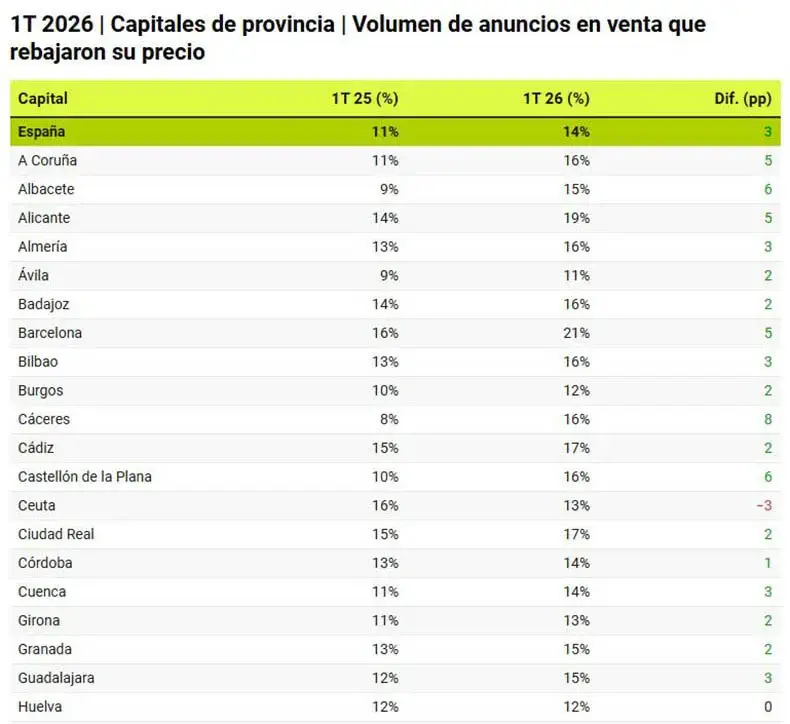
The share of property listings with price reductions increased in Spain from 11% in Q1 2025 to 14% in January–March 2026, according to Idealista.
Price reductions in major cities
Barcelona and Teruel lead, where the share of discounted listings reached 21%. High figures were also recorded in Madrid (20%), Alicante (19%), while Málaga, Seville, Valencia and Zaragoza stood at 18%.
Notable levels were also observed in Segovia (19%), as well as Málaga, Seville, Valencia and Zaragoza (18%). In these cities, sellers are more frequently adjusting expectations in response to slower deal closures.
Among major markets, Palma (14%), Bilbao (16%) and San Sebastián (17%) show relatively greater stability, with lower discount shares compared to the most affected cities.
Discounts in provinces
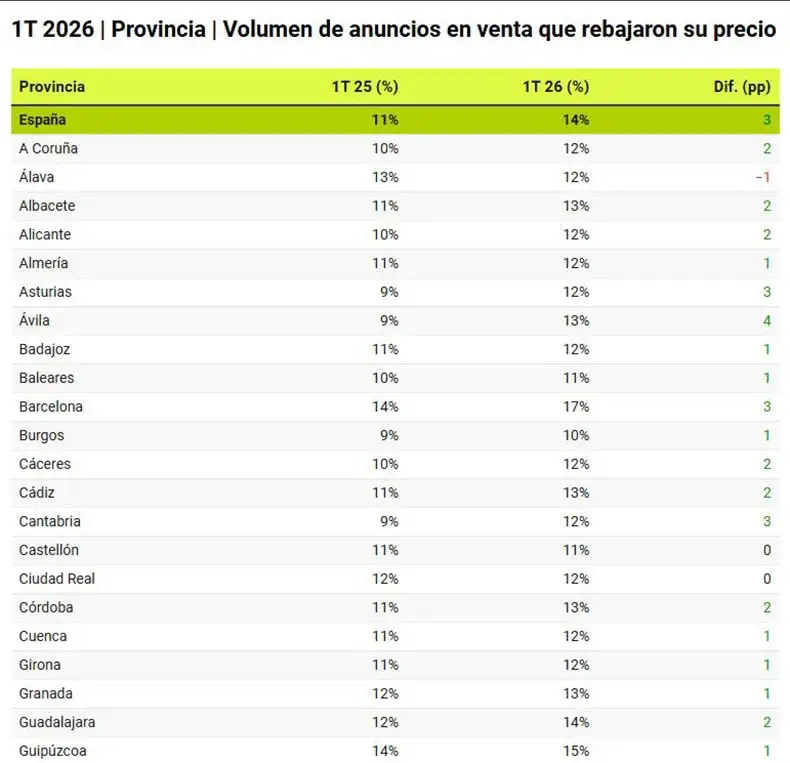
Among provinces, Madrid leads with 18% of listings showing price reductions, followed by Barcelona and Zaragoza (17% each). Above-average levels were also recorded in Seville (16%), Santa Cruz de Tenerife and Gipuzkoa (15%).
At 14% are Valencia, Segovia, Guadalajara, Tarragona, Valladolid, Biscay and Toledo.
At 13%: Asturias, Albacete, Cádiz, Castellón, Córdoba, Granada, Las Palmas, Murcia, Navarra, Salamanca, Málaga and Alicante.
At 12%: A Coruña, Badajoz, Álava, Almería, Cáceres, Girona and La Rioja.
Balearic Islands and Ciudad Real recorded 11%. León, Lleida, Lugo, Pontevedra, Burgos, Zamora and Palencia stand at 10%. The lowest figure was in Ourense (8%).
Rental market in Spain: slowing growth
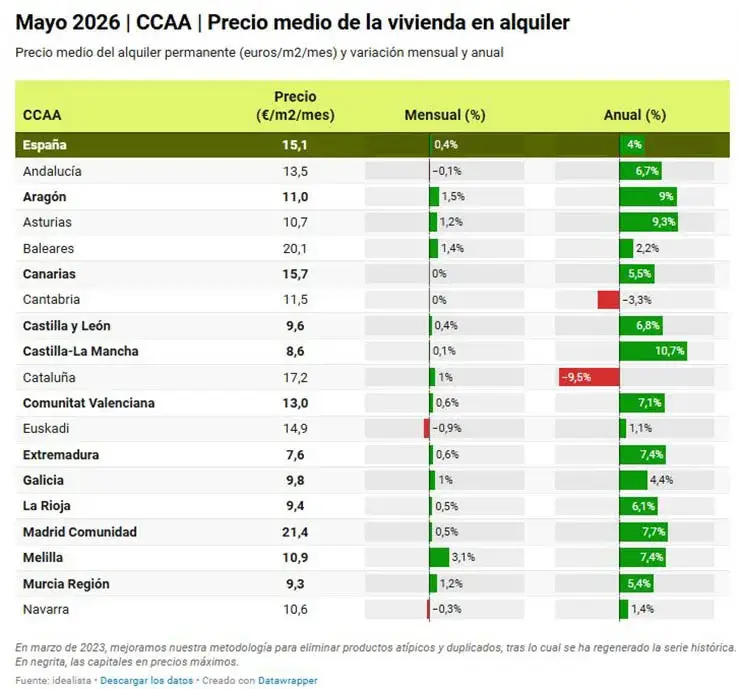
In May 2026, rental prices in Spain rose by 4% year-on-year, reaching €15.1 per sq m per month. This is the highest level on record. At the same time, growth has slowed to its weakest pace since June 2022, indicating a gradual cooling of the market. Over recent months, dynamics have remained subdued, with quarterly growth of around 0.3%.
Major Spanish cities
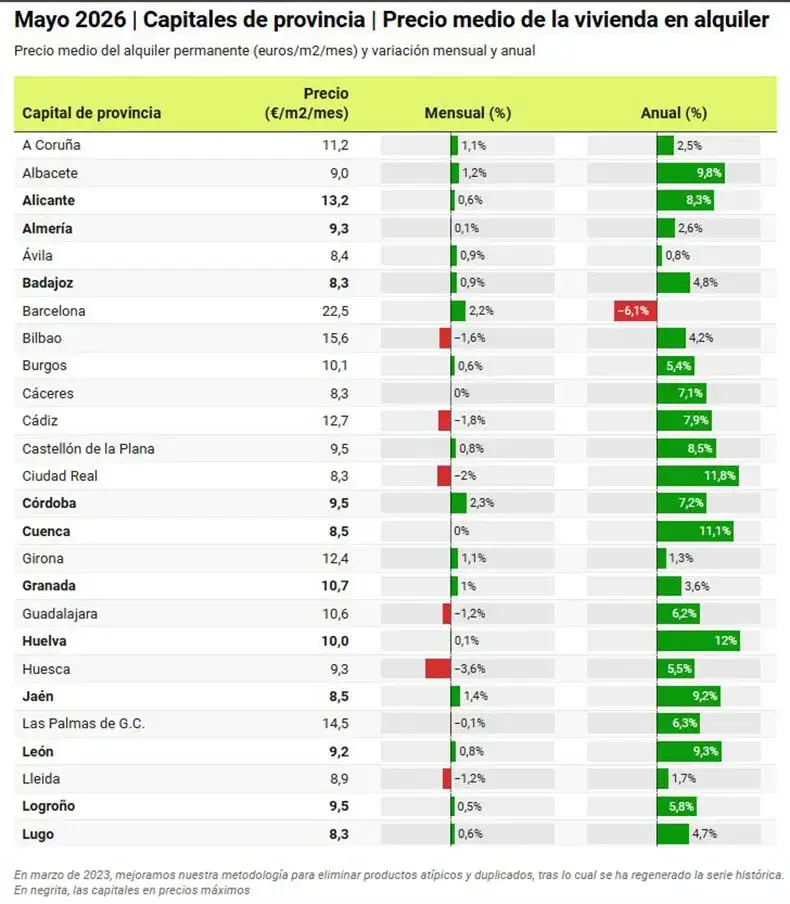
Among key markets, Huelva leads with growth of 12%, reaching €10 per sq m. Ciudad Real follows with +11.8% (€8.3) and Cuenca with +11.1% (€8.5). León recorded +9.3% (€9.2), and Jaén +9.2% (€8.5).
Significant increases were also observed in Castellón de la Plana (+8.5%, €9.5), Alicante (+8.3%, €13.2) and Cádiz (+7.9%, €12.7). Madrid rose by 7.8% and remains the most expensive city at €23.4 per sq m. Barcelona was the only city with a negative trend — –6.1%, despite a high level of €22.5 per sq m.
Provinces of Spain
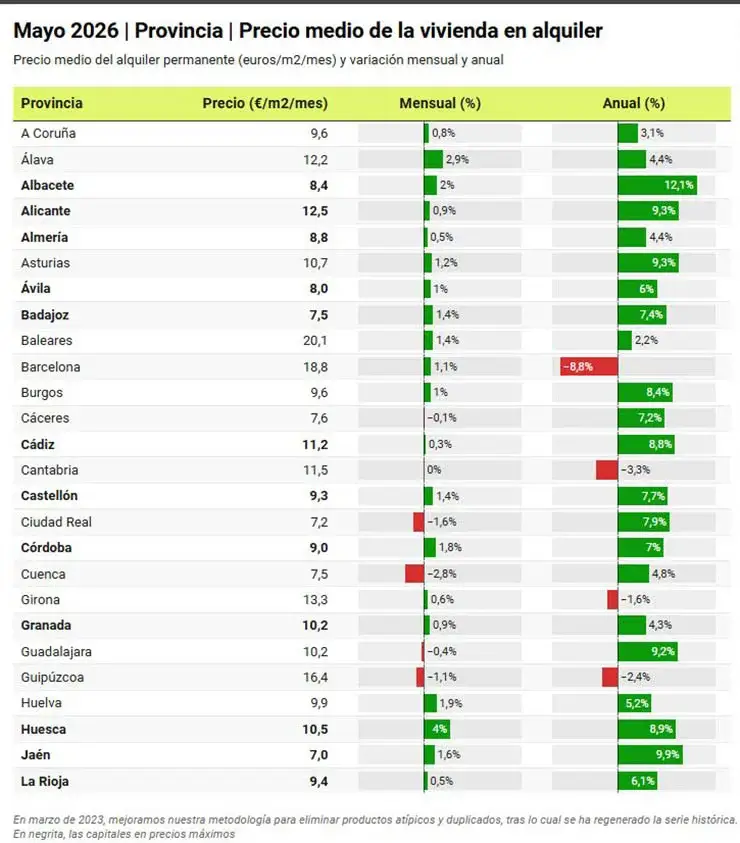
The rental market shows growth in 46 out of 50 provinces. The leaders are Toledo (+12.4%), Albacete (+12.1%), followed by Palencia (+11.5%), Lleida (+10%) and Jaén (+9.9%). The sharpest decline was recorded in Barcelona province (–8.8%). Declines were also seen in Cantabria (–3.3%), Gipuzkoa (–2.4%) and Girona (–1.6%). All other provinces recorded positive dynamics, including Madrid, where growth reached 7.7%.
Madrid remains the most expensive province at €21.4 per sq m. It is followed by the Balearic Islands (€20.1), Barcelona (€18.8), Málaga (€17.1), Gipuzkoa (€16.4), Las Palmas (€15.9) and Santa Cruz de Tenerife (€15.5). The most affordable provinces are Jaén (€7) and Ciudad Real (€7.2).
Autonomous communities
Price growth is recorded in almost all regions except Catalonia (–9.5%) and Cantabria (–3.3%). Castilla-La Mancha leads with +10.7%, followed by Asturias (+9.3%), Aragon (+9%), Madrid (+7.7%), Extremadura (+7.4%) and Valencia (+7.1%).
Below-average growth is seen in the Balearic Islands (+2.2%), Navarre (+1.4%) and the Basque Country (+1.1%).
Madrid remains the most expensive region at €21.4 per sq m, followed by the Balearic Islands (€20.1), Catalonia (€17.2), the Canary Islands (€15.7) and the Basque Country (€14.9). The most affordable regions are Extremadura (€7.6) and Castilla-La Mancha (€8.6).
Conclusion
Analysts at International Investment note that Spain’s housing market is gradually shifting after a period of significant regulatory restructuring. Authorities have tightened control over the rental sector in recent years, introducing restrictions in selected cities and regions, along with additional administrative requirements for owners and investors.
As a result, holding costs are increasing, while strategic flexibility for both private and institutional players is declining. Additional pressure comes from stricter rental rules, limitations on lease conditions, and a growing regulatory burden. The market is therefore entering a phase of more complex balancing between housing affordability, tenant demand and supply-side economics.