







 Covivio Hotels Revenue Grows 4.7% as European Markets Split
 Lithuanian Apartment Prices Accelerate Across Major Cities
 Georgia's Tourism Revenue Hits Record High
 Norway's Sovereign Fund Commits €1.5bn to European Warehouses
 Market Rout of October 2026: Can Branded Hotels Protect Capital?
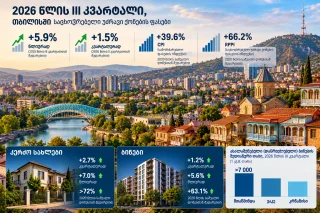 Residential Property Prices in Tbilisi Rise by 5.9% Year-on-Year
Long-Term Renting Gains Ground Across Europe

High house prices and a widening gap between property values and household incomes are keeping Europeans in rented homes for longer. A new Forever Renter Global Index ranks Denmark second worldwide for entrenched renting and gives Switzerland the highest renter share among the 39 OECD countries examined. The index, however, does not track how long individual households remain tenants and cannot establish that Europe is moving en masse towards “renting for life.” It is a composite measure combining tenure, housing costs, overcrowding and house-price-to-income indicators drawn from different reference years.
The Index Compares 39 OECD Countries
The Forever Renter Global Index was produced by Australian retailer Luxo Living rather than the OECD itself. Its authors combined the latest available housing indicators, with reference years ranging from 2017 to 2024.
The score incorporates renter and homeownership shares, renters' housing costs relative to disposable income, housing-cost overburden, overcrowding, rooms per person and the change in house-price-to-income ratios since 2015.
Colombia ranks first globally with a score of 71.4 out of 100, followed by Denmark at 67.2 and Chile at 64.2. Luxembourg and Switzerland share fourth place at 59.7. Germany ranks 12th, Portugal 14th, the United States 16th and the Netherlands 17th.
The authors themselves caution that the score measures how entrenched renting is rather than housing affordability alone. A country may rank highly because it has a deep and mature rental sector without necessarily having the most severe housing crisis.
Switzerland and Germany Remain Renter-Heavy Markets
The index gives Switzerland a renter share of 61.2%, the highest among the countries examined. Germany follows at 55.4%, while Austria is at 43.7%, the Netherlands at 41.2% and Sweden at 38.9%.
Those numbers should not be mixed directly with figures from other datasets because reference years and units of measurement can differ. Some statistics refer to households, while others measure the share of people living in owner-occupied or rented homes.
Eurostat's latest comparable EU data show that 68% of the population lived in owner-occupied housing in 2024 and roughly 32% in rented accommodation. Germany was the only EU country where renting remained more common than ownership, with 53% of the population living as tenants. Austria followed at 46% and Denmark at 39%.
At the other end of the spectrum, Romania had a 94% homeownership rate, Slovakia 93% and Hungary 92%.
Europe therefore does not have a single tenure model. Germany and Switzerland have had large rental sectors for decades, shaped partly by institutions and regulation, while ownership remains overwhelmingly dominant across much of Central and Eastern Europe.
House Prices Are Making the Move Into Ownership Harder
What many markets increasingly have in common is the cost of buying.
EU house prices rose 5.1% year on year in the first quarter of 2026, compared with a 3.0% increase in rents. Quarter on quarter, house prices gained another 1.2%, while rents rose 0.7%.
Portugal, Bulgaria and Slovakia recorded some of the strongest increases. Compared with the 2025 annual average, first-quarter house prices were up 10.3%, 9.4% and 9.1%, respectively.
The longer-term divergence is even more significant. Between 2015 and the third quarter of 2025, EU house prices increased by almost 65%, while rents rose by about 22%. Portugal recorded a roughly 180% rise in house prices over the period, Lithuania 168% and Bulgaria 157%.
For a household renting while saving for a deposit, this creates pressure on both sides of the balance sheet: rent absorbs current income while the price of the asset it hopes to buy keeps rising.
Portugal Shows the Limits of High Homeownership
Portugal illustrates why a high ownership rate does not necessarily mean housing is easy to access.
The Forever Renter Index puts homeownership at 72.1% and the renter share at only 18.5%. Yet its house-price-to-income index stands at 148.8 against a 2015 base of 100, the highest figure among countries in the ranking with comparable data.
The OECD has separately concluded that resurging demand and structural supply constraints have severely weakened affordability in Portugal. Young people are disproportionately affected, facing difficulties both in buying and finding suitable rental housing. The organisation argues that Portugal needs more supply, a stronger rental sector and greater investment in social and affordable housing.
A country can therefore retain a large stock of owner-occupied housing while access for a new generation of buyers deteriorates sharply.
Young Europeans Face the Highest Entry Barriers
Housing affordability is particularly difficult for younger households, prompting the European Commission to make youth housing a distinct policy focus in 2026.
In 2024, about 27% of people aged 15–29 in the EU lived in overcrowded housing, compared with 17% of the total population. Among young people at risk of poverty, the rate reached 42%.
More than one in ten Europeans aged 20–29 lived in households where total housing costs exceeded 40% of income. For many, the result is a later move out of the parental home, shared renting or a longer period spent accumulating a deposit.
The OECD also reports that in more than half of its member countries, a majority of 20–29-year-olds live with their parents. Around two in five low-income tenants spend more than 40% of disposable income on rent.
Longer renting periods are therefore partly a consequence of a delayed transition into ownership, although renting remains a deliberate long-term housing choice for some households.
High Homeownership Does Not Guarantee Better Housing
Central and Eastern Europe reveal the other side of the tenure debate.
Ownership is widespread, but the ability to move into larger or more suitable homes can remain limited. In 2024, 40.7% of Romania's population lived in overcrowded households. Latvia recorded 39.3%, Bulgaria 33.8%, Poland 33.7% and Croatia 31.7%.
The EU average was 16.9%.
Ownership should therefore not be treated as a proxy for housing security or quality. A household may own its home outright while several generations share limited space because moving is too expensive.
The reverse is also true. A high renter share does not automatically signal financial distress. Switzerland combines a very large rental sector with relatively low overcrowding, reflecting a system where renting is an established form of tenure rather than merely a temporary stage before ownership.
“Renting for Life” Remains an Imperfect Label
The main limitation of the Forever Renter Index lies in its name.
The study does not follow the same households over decades and cannot show how many current renters will never become homeowners. Instead, it combines several cross-sectional indicators from different years into one composite score.
Similar scores can therefore emerge from very different housing systems.
In Germany, long-term renting has been common for decades. In Portugal, the central problem is the rapid deterioration of purchase affordability. Across parts of Eastern Europe, the rental sector remains small because young adults may remain in family homes for longer rather than forming independent renter households.
The claim that Europe as a whole is shifting from ownership to lifelong renting is therefore stronger than the available evidence.
Housing Has Become an Economic Issue for the EU
The affordability problem itself is no longer disputed. In 2026, the European Commission added a dedicated housing annex to its European Semester country analysis for the first time.
The Commission identifies insufficient supply, slow permitting, shortages of social housing, underused existing homes and worsening affordability for young and middle-income households among the key structural challenges. Housing costs are increasingly being treated as an issue affecting labour mobility, urban competitiveness and social cohesion.
That shift also has implications for property investment. If households remain renters for longer before making a first purchase, demand for professionally managed rental housing can remain stronger for longer.
This supports interest in purpose-built rental apartments, student housing and other managed residential formats. Yet the investment case depends heavily on local rent regulation, land costs, taxes and tenants' ability to absorb market rents. Strong rental demand and affordable housing are not the same thing.
As International Investment experts report, the evidence supports the conclusion that barriers to moving from renting into ownership are increasing, particularly for younger buyers, but the “forever renter” label runs ahead of the statistics. Two-thirds of EU residents still live in owner-occupied housing, while high renter shares in Germany or Switzerland largely reflect long-established housing systems. For investors, the more consequential change is that the period between leaving the parental home and making a first purchase is becoming longer, increasing demand for stable, professionally managed rental housing. Without a corresponding increase in supply, the same trend can support rental investment while further worsening affordability.
FAQ: Long-Term Renting in Europe
Do most Europeans rent or own their homes?
Ownership remains dominant in the European Union. In 2024, 68% of the population lived in owner-occupied housing and roughly 32% lived in rented homes.
Which European countries have the highest renter shares?
Within the EU, Germany has the largest renter majority, with about 53% of the population living as tenants. Austria and Denmark also have large rental sectors. Switzerland stands out when the wider European market is included.
Why are younger Europeans renting for longer?
Rapid house-price growth, larger deposit requirements, mortgage costs and current rent payments all make it harder to accumulate enough capital for a first purchase.
Is Europe really moving towards lifelong renting?
The evidence is not sufficient to make that conclusion for Europe as a whole. The Forever Renter Index does not measure the duration of individual tenancies or the share of renters who will never buy a home.
Where is homeownership highest?
Among EU countries, Romania recorded 94% ownership in 2024, followed by Slovakia at 93% and Hungary at 92%.
Why does high homeownership not always mean housing is affordable?
Many existing owners bought homes under earlier market conditions or live in inherited family property. New entrants may face much higher prices. High ownership can also coexist with overcrowding and limited residential mobility.
How fast are European house prices rising?
EU house prices rose 5.1% year on year in the first quarter of 2026, compared with a 3% increase in rents. Over the previous decade, property prices rose substantially faster than rents.