







 Covivio Hotels Revenue Grows 4.7% as European Markets Split
 Lithuanian Apartment Prices Accelerate Across Major Cities
 Georgia's Tourism Revenue Hits Record High
 Norway's Sovereign Fund Commits €1.5bn to European Warehouses
 Market Rout of October 2026: Can Branded Hotels Protect Capital?
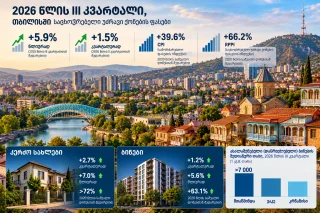 Residential Property Prices in Tbilisi Rise by 5.9% Year-on-Year
Bulgaria Property 2026: Prices Rise, Sales Fall
Wikimedia
Bulgaria entered the autumn with a widening gap between property prices and buyer activity. A total of 45,312 real estate sales were registered in the third quarter of 2026, down 22.1% from a year earlier and the lowest third-quarter result in the available series going back to at least 2005. The latest official house-price data, which still cover the second quarter, show annual growth of 15.5%. Prices have not yet followed transactions lower, but liquidity — the ability to sell an asset quickly without a large discount — has deteriorated.
Transactions fall to 45,000 in one quarter
The official Property Registry report records 45,312 real estate sales between July and September, compared with 58,184 a year earlier. That is a 22.1% decline.
The weakness extends beyond the unusually strong 2025 base. Third-quarter transactions totalled 55,103 in 2019, 56,675 in 2020, 54,277 in 2023 and 54,138 in 2024. A long-series comparison by Economic.bg identifies the 2026 figure as the lowest third-quarter total since at least 2005.
January–September sales reached 129,431, down 18.8% year on year. Nine-month activity has now fallen below both 2019 and pandemic-year 2020.
The slowdown therefore cannot be explained solely as normalisation after a rush of purchases ahead of euro adoption.
Prices are still moving in the opposite direction
The latest official price figures lag the registry data by one quarter. Bulgarian house prices rose 15.5% year on year in the second quarter and 4.5% from the previous three months. New dwellings gained 12.3%, while existing homes rose 17.6%.
The National Statistical Institute’s house-price index covers dwellings purchased by households. Property Registry data cover a broader group of registered real estate transactions. The two series are not identical, but together they show a clear split: market activity is falling much faster than completed-sale prices.
A previous second-quarter analysis had already identified the divergence. Residential transaction numbers fell 18.1% year on year while their value declined 5.8%. Third-quarter registry data show that the contraction in activity continued.
Why prices can rise when sales fall
Real estate markets do not have to adjust through prices and transaction volumes at the same time.
A buyer can walk away from an expensive property. An owner who is not under pressure to sell can keep the price unchanged. The transaction simply does not happen. House-price indices then capture only properties on which both sides eventually agreed.
The mix of completed sales can also change. Better-quality or well-located homes may continue to sell while overpriced properties stay on the market, supporting the measured price level even as the buyer pool shrinks.
Agency data suggest bargaining is already becoming more common. BurgasMedia, citing Address Real Estate, reports that 55% of monitored Sofia transactions, 59% in Varna and 45% in Burgas closed below the original asking price in the third quarter. In Burgas, the average marketing period in the agency sample increased from 36 to 68 days. This is not official market-wide data, but it provides a useful indicator of buyers gaining negotiating power.
Sofia slows but remains above older levels
Sofia recorded 7,282 sales in the third quarter, down 21.2% from 9,238 a year earlier and 17.9% from the second quarter.
The historical comparison needs qualification. Activity is below 2024 but remains about 4% above 2023, 4.5% above 2020 and 5.9% above 2019. The capital has cooled sharply after two strong years, but it has not returned to pre-pandemic transaction volumes.
Second-quarter house prices in Sofia were still 13.2% higher than a year earlier. New dwellings rose 12.6% and existing homes 13.7%.
For investors, the gap makes time-to-sale increasingly important. A property that has appreciated on paper may still be a weaker asset if it requires a long marketing period or a substantial discount to exit.
Coastal markets cool faster
The contraction is deeper in several Black Sea markets.
Nesebar, whose registry area includes much of the Sunny Beach market, recorded 1,857 sales, down 37.1% from 2,951 a year earlier. Varna fell 26.3% to 2,853 transactions. Burgas recorded 2,047 sales, down 14.3%.
Other coastal markets, including Balchik, Tsarevo and Kavarna, also posted double-digit declines. Resort property is more exposed to second-home, investment and discretionary demand, where buyers can postpone a purchase rather than accept a price they consider too high.
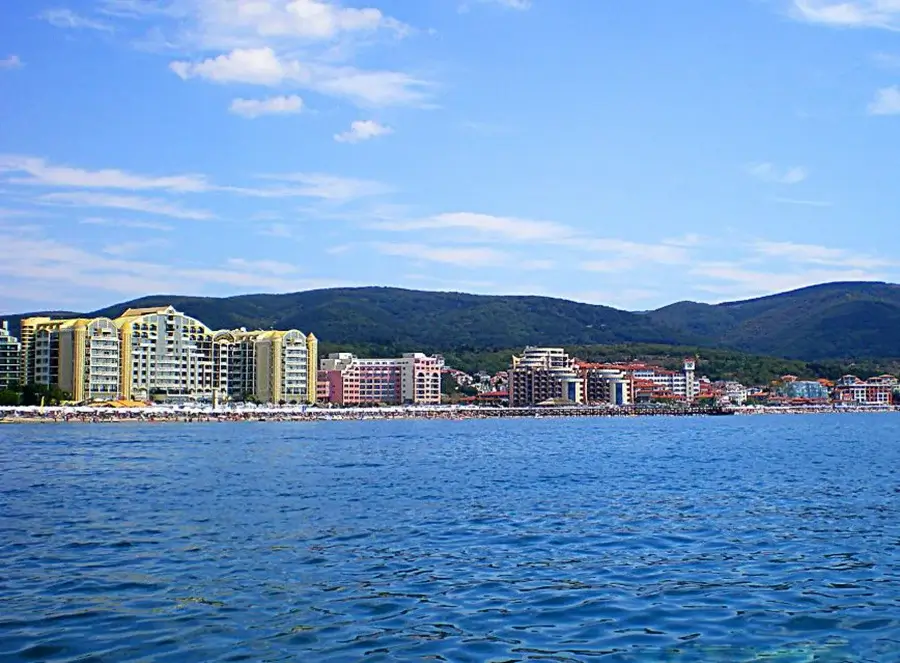
Sunny Beach on Bulgaria’s Black Sea coast. Resort markets have seen some of the sharpest declines in transaction activity. Photo: Ilya Otkalo, Wikimedia Commons, CC BY 3.0.

Prices have not followed transaction volumes down at the same pace. Varna house prices were 14.3% higher year on year in the second quarter and Burgas prices 9.1% higher. Burgas did record a 1.5% quarterly decline, an early local sign of price pressure rather than evidence of a national correction.
Mortgage lending keeps solvent demand in the market
Credit remains strong. Outstanding housing loans reached €19.33 billion at the end of August, up 25.2% from a year earlier. Total household credit increased 20.8%.
The average interest rate on new housing loans was 2.42% in August, while the annual percentage rate of charge was 2.81%. Financing therefore remains inexpensive for a market still recording double-digit house-price growth.
The Bulgarian National Bank limits loan-to-value ratios to 85%, debt-service payments to 50% of monthly income and contractual maturities to 30 years for most new housing-backed loans. Banks can exceed the thresholds only for a limited share of new business.
Cheap mortgages help liquid properties hold their price, but they cannot remove the affordability problem created when purchase prices rise faster than household capacity and required deposits.
New supply is still coming
Municipal authorities issued permits for 11,499 dwellings in the second quarter, 14% more than a year earlier. Construction started on 8,913 homes.
Quarter-on-quarter figures are less expansionary: the number of dwellings covered by new permits fell 15.2% from the first quarter. Developers have not stopped building, but the signal from demand is becoming weaker.
Sofia, Plovdiv, Burgas and Varna remain among the main centres of planned residential construction. These are also markets where transaction activity is now falling. Continued completions with weak sales would increase competition between sellers.
The euro explains part of the 2025 boom
Bulgaria adopted the euro at the start of 2026. Expectations around the currency change influenced the market during 2025, when some households and investors moved savings into real estate before the transition.
That makes the year-on-year comparison unusually demanding, but it does not explain the whole downturn. Third-quarter 2026 transactions are also below 2019, 2020, 2023 and 2024 at national level.
For euro-based foreign investors, the currency change removes some friction when comparing Bulgaria with other euro-area markets. It does not remove liquidity risk. A resort apartment can continue to appreciate in an index while taking longer to sell and requiring a larger discount.
Price per square metre is no longer enough
Market quality is becoming more important than the national average.
In Sofia, buyers may still accept high prices for new housing in districts with infrastructure and durable domestic demand. On the coast, investors are more exposed to seasonality, second-home demand and the depth of the resale market.
Two properties with the same price per square metre can therefore produce very different investment outcomes. One may sell quickly and close close to asking price; another may remain listed for months.
As International Investment experts report, Bulgaria’s property market is currently adjusting mainly through transaction volumes and time-to-sale rather than a broad fall in prices. Sellers remain anchored to several years of rapid appreciation, mortgage costs are low and bank lending continues to expand. But 45,312 quarterly sales are increasingly difficult to explain by the pre-euro 2025 base alone. If weak activity persists while new supply continues to arrive, market segmentation is likely to become sharper: strong properties in liquid locations may retain pricing power, while overpriced homes will have to compete through discounts and longer marketing periods. For investors in 2026, the key question is no longer simply whether Bulgarian property prices are rising, but whether a specific asset can actually be sold quickly at that price.
FAQ: Bulgaria Property Market 2026
How many real estate sales were registered in Q3 2026?
The Property Registry recorded 45,312 sales, down 22.1% from a year earlier.
Is that really a multi-year low?
A comparison of the published quarterly series identifies it as the lowest third-quarter result since at least 2005. It is also below third-quarter levels in 2019, 2020, 2023 and 2024.
How fast are Bulgarian house prices rising?
The latest official figures cover the second quarter, when house prices rose 15.5% year on year. New dwellings gained 12.3% and existing homes 17.6%.
Why can prices rise while transactions fall?
Buyers can walk away from overpriced properties while owners who do not need to sell immediately keep their asking prices. Transaction volume can therefore fall before completed-sale prices do.
What is happening in Sofia?
Sofia recorded 7,282 sales in the third quarter, down 21.2% year on year. The latest house-price data show annual growth of 13.2%.
What is happening on the Bulgarian coast?
Nesebar sales fell 37.1%, Varna 26.3% and Burgas 14.3%. Resort markets are cooling faster than Sofia.
Are Burgas prices falling?
They were still 9.1% higher year on year in the second quarter, but fell 1.5% from the previous quarter.
Is mortgage lending still growing?
Yes. Outstanding housing loans reached €19.33 billion at the end of August, up 25.2% year on year.
Is Bulgaria still building new homes?
Yes. Permits covering 11,499 dwellings were issued in the second quarter and construction started on 8,913 homes.
What does the slowdown mean for foreign investors?
A rising national index does not guarantee a quick resale of an individual property. Local demand, time on market, new supply and the discount required to exit are becoming more important.