







 Covivio Hotels Revenue Grows 4.7% as European Markets Split
 Lithuanian Apartment Prices Accelerate Across Major Cities
 Georgia's Tourism Revenue Hits Record High
 Norway's Sovereign Fund Commits €1.5bn to European Warehouses
 Market Rout of October 2026: Can Branded Hotels Protect Capital?
 Residential Property Prices in Tbilisi Rise by 5.9% Year-on-Year
Portugal property demand moves beyond Lisbon and Porto
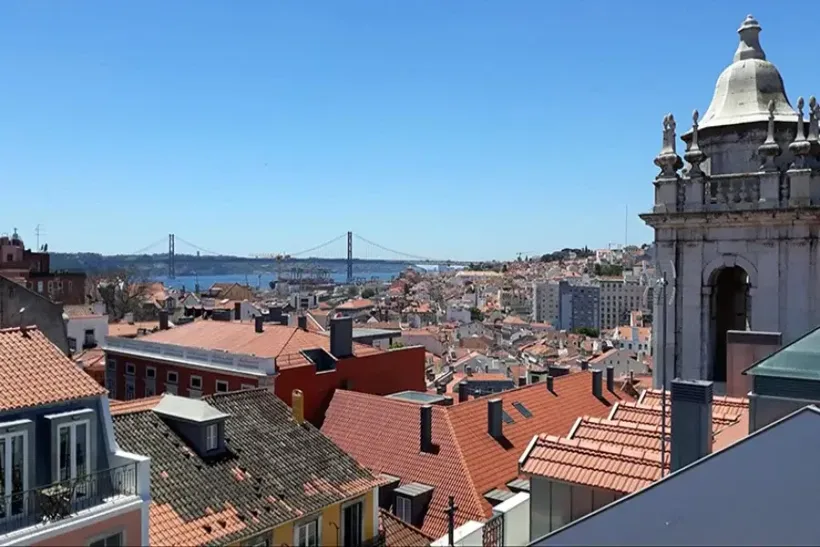
Portugal's housing market is still becoming more expensive, but buyers are turning more cautious. In the second quarter of 2026, 40,142 homes were sold, down 6.4% from a year earlier. Transactions declined for a third consecutive quarter, while the average purchase price reached a record €266,475. Demand from buyers resident abroad also weakened: they bought 1,890 homes, 10.3% fewer than a year earlier.
The slowdown in transactions has not produced lower prices. Portugal's official House Price Index rose 16.5% year on year in the second quarter, while idealista's median asking price reached €3,228 per square metre in September, up 7.9% over 12 months. Prices and transaction volumes are increasingly moving in different directions.
Why demand is moving beyond Lisbon and Porto
Lisbon and Porto remain Portugal's deepest and most recognisable property markets, but their prices are changing buyer behaviour. Lisbon's median asking price reached €6,256 per square metre in September. For a growing share of buyers, the decision is no longer between districts within the capital but between Lisbon and another city.
At idealista's September congress, market participants linked this shift to high prices and limited housing supply. Smaller cities, the Oeste region and the Alentejo coast were repeatedly identified as areas attracting more attention. This is not a broad retreat from Lisbon and Porto. It is an expansion of the search area towards markets where entry prices are lower but rental demand, transport links and local economic activity still exist.
Where the next demand is moving
The comparison below uses idealista asking-price and asking-rent data for September 2026. It is designed to compare markets rather than calculate the return of a specific property.
|
Market |
Sale / rent €/m² |
Transport and demand |
Liquidity / key risk |
|
Torres Vedras |
2,486 / 11.2 |
Lisbon; families, commuter demand |
medium-high; rapid repricing |
|
Caldas da Rainha |
2,339 / 9.8 |
Lisbon; local demand, Oeste, tourism |
medium; smaller market |
|
Braga |
2,396 / 10.7 |
Porto; universities, business |
high; entry prices rising |
|
Coimbra |
2,499 / 12.8 |
Porto; university, healthcare |
high; student exposure in some districts |
|
Leiria |
1,980 / 9.5 |
between Lisbon and Porto; business, families |
medium-high; less international demand |
|
Setubal |
3,214 / 13.7 |
Lisbon; metro demand, tourism |
high; price gap has narrowed |
|
Evora |
2,688 / 12.6 |
Lisbon; university, tourism |
medium; historic centre and AL rules |
The largest discounts to Lisbon remain in Leiria, Braga, Caldas da Rainha and Torres Vedras. Lower prices, however, do not automatically mean a better investment. Rental depth, transport connections, universities, employment and local short-term rental rules all matter.
Oeste is becoming an extension of the Lisbon market
Torres Vedras and Caldas da Rainha stand out because they remain far cheaper than Lisbon while retaining access to the capital. Median asking prices were €2,486 per square metre in Torres Vedras and €2,339 in Caldas da Rainha in September, with asking rents at about €11.2 and €9.8 respectively.
Torres Vedras is no longer an overlooked market. Asking prices rose 16.9% over the year. That illustrates one risk of buying into a cheaper market near Lisbon: the price gap can narrow quickly.
Braga and Coimbra have their own demand
Braga and Coimbra depend less on Lisbon. Braga is supported by universities, local employment and links to the Porto metropolitan economy. Coimbra has a deep student and healthcare-related rental market.
Median asking prices stood at €2,396 per square metre in Braga and €2,499 in Coimbra municipality in September. Asking rents were €10.7 and €12.8 per square metre respectively.
Leiria remains one of the lower-cost options
Leiria's median asking price was €1,980 per square metre, with rents at €9.5. The city remains substantially cheaper than Lisbon, Porto and Setubal and its investment case is not built solely around tourism.
Asking prices rose 17.6% over the year, however, showing how quickly the lower-cost segment is repricing.
Setubal is no longer a cheap Lisbon alternative
Setubal retains strong links to Lisbon, but its price advantage has narrowed. Asking prices reached €3,214 per square metre in September and rents €13.7. It remains cheaper than the capital, but the gap is much smaller than in Oeste or central Portugal.
Evora and Alentejo require a more precise strategy
Evora is a standalone university and tourism market. Asking prices reached €2,688 per square metre in September and rents €12.6. The Alentejo coast should not be treated as a uniformly cheap alternative to Lisbon, as prime coastal locations have developed their own high-price market.
Rents are rising faster than transactions
Official data show rental pressure spreading well beyond the largest cities. The median rent on new contracts reached €10.17 per square metre nationally in the second quarter, up 10.2% year on year, while the number of new contracts increased only 0.4%.
Lisbon remained the most expensive large municipality at €17.79 per square metre. Strong rental growth was also recorded elsewhere, including a 20.7% annual increase in Guimaraes.
Short-term rentals need a separate regulatory check
Investors targeting tourism rentals need to assess more than purchase prices and visitor numbers. In 2026, municipalities with more than 1,000 registered Alojamento Local units received an additional period to adopt or update local regulations. Municipal authorities can also extend or introduce temporary suspensions of new registrations while those rules are being prepared.
The legal position therefore needs to be checked for the specific municipality and address before a purchase.
What this changes for investors
Portugal's 2026 housing story is not falling prices but a changing map of demand. Lisbon and Porto remain the country's main investment hubs, yet high entry prices are forcing buyers to compare them with markets that were previously considered secondary.
Oeste benefits from its connection to Lisbon, Braga and Coimbra from their own economies and rental demand, and Leiria from a lower entry price. Setubal remains liquid but has already repriced, while Alentejo requires a clear distinction between inland cities and premium coastal locations.
The market is becoming less uniform. For investors, choosing the right city and demand model matters more than simply choosing Portugal.
FAQ
Are Portuguese house prices still rising in 2026?
Yes. Portugal's official House Price Index rose 16.5% year on year in the second quarter, while idealista asking prices rose 7.9% in September.
Why are transactions falling?
Home sales fell 6.4% year on year in the second quarter. High house prices and financing costs are excluding part of the demand even as prices continue to rise.
Which cities are alternatives to Lisbon?
Torres Vedras, Caldas da Rainha and Setubal offer links to the capital. Braga, Coimbra, Leiria and Evora are more independent markets with their own sources of rental demand.
Is Alentejo still a cheap alternative?
Not uniformly. Inland cities and the Alentejo coast are very different markets, and prime coastal locations can be expensive.
What should investors check before buying for short-term rental?
They should verify current Alojamento Local rules in the municipality, whether new registrations are permitted in the area and the status of any existing licence attached to the property.