







 Covivio Hotels Revenue Grows 4.7% as European Markets Split
 Lithuanian Apartment Prices Accelerate Across Major Cities
 Georgia's Tourism Revenue Hits Record High
 Norway's Sovereign Fund Commits €1.5bn to European Warehouses
 Market Rout of October 2026: Can Branded Hotels Protect Capital?
 Residential Property Prices in Tbilisi Rise by 5.9% Year-on-Year
Ageing Europe Creates a New Real Estate Class
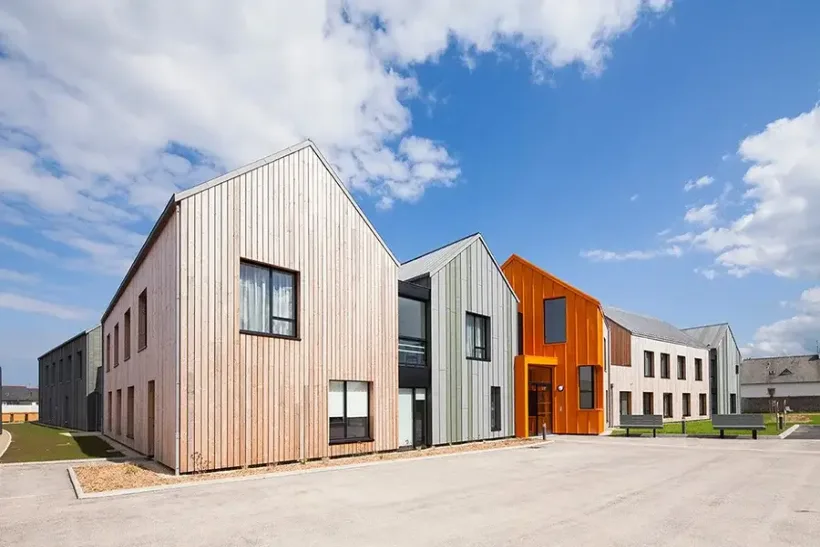
Capital is moving into care homes, clinics and senior housing
European healthcare real estate is moving out of a specialist niche. Investment reached a record €23.2 billion in 2025, while transaction volumes rose another 27% year on year in the first half of 2026. Cross-border investors accounted for half of the capital deployed.
The structural driver sits outside the normal property cycle. CBRE expects Europe to have another 31.3 million people aged 65 or older by 2034. That demand is spreading across care homes, senior living, hospitals, clinics and rehabilitation facilities.
Healthcare real estate is becoming a distinct market
Healthcare property is often grouped into a single category, but the investment models differ sharply.
A care home depends on occupancy, staffing and operator strength. Senior living is closer to service-led residential real estate. Hospitals require greater capital expenditure and are more exposed to regulation. Clinics and rehabilitation assets can be more flexible but depend on patient flows and reimbursement.
The sector therefore cannot be reduced to a simple assumption that an ageing Europe makes every healthcare asset more valuable.
Ageing is already visible in the data
On 1 January 2025, the EU had 99 million people aged 65 or older, representing 22% of the population. The 80+ cohort reached 6%. Italy was close to 8%, while Germany, Greece and Portugal were around 7%.
International Investment has already examined the EU's long-term demographic shift, with the elderly population increasing as the working-age population contracts. For real estate, that supports demand for care, adapted housing, diagnostics and rehabilitation.
Demographics only matter when they meet viable supply. A market with many elderly residents is not automatically attractive if reimbursement is weak, staffing is constrained or operators cannot support sustainable rents.
Care homes remain the largest segment
European care-home investment rose 165% in 2025 to around €14.4 billion. The sector attracted major U.S. capital and several large portfolio transactions.
For institutional investors, the model is familiar: the property is often separated from the operating business and leased to a care provider on a long contract.
The main risk therefore shifts to the operator. Wage inflation, staff shortages, reimbursement limits and weak operating efficiency can undermine rent coverage even when occupancy is high.
The trend is already visible in wider European investment data. Living sectors, including care homes and senior housing, accounted for 29% of European investment in the first half of 2026.
Senior living behaves more like residential property
Senior living mainly targets older residents who remain independent but want adapted housing, services, communal space and access to additional support.
Its investment logic is closer to residential real estate. Location, affordability, service quality and competition with conventional rental housing play a larger role.
Savills reports a marked increase in investor interest in senior living and care homes. Respondents to its 2026 survey plan to deploy around €45 billion into European operational real estate over three years, with care homes ranking second for expected capital inflows after student housing.
Italy already provides a visible example. International Investment has covered the country's emerging silver-housing market, where independent senior housing combines apartments, services and elements of healthcare support.
Hospitals are becoming more accessible to private capital
Hospitals remain the most complex healthcare property segment. They require heavy capital expenditure, specialist infrastructure and close integration with national healthcare systems.
Care delivery is changing, however. More procedures are moving from inpatient settings into outpatient and day-case formats. Rehabilitation, mental health, diagnostics and specialist clinics are becoming stand-alone facilities that are easier to separate from a large acute hospital.
Savills argues that the investable hospital universe is expanding mainly through outpatient centres, rehabilitation, mental health and other specialist assets. Access to acute hospital real estate still varies sharply by country and ownership rules.

Clinics and rehabilitation are growing faster
The second quarter of 2026 showed how quickly the investment mix is changing. JLL says special-purpose healthcare accounted for 53% of healthcare investment, compared with a five-year average of 11%.
Germany was the largest market in the quarter, with around €650 million invested. The biggest deal was a €360 million recapitalisation of 20 rehabilitation clinics.
Healthcare real estate is therefore no longer synonymous with care homes. Capital is moving into properties serving different stages of treatment, from diagnostics and outpatient procedures to rehabilitation and specialist care.
|
Segment |
What supports demand |
Main risk |
|
Care homes |
growth of the 80+ population, long-term care |
operator, staffing and reimbursement |
|
Senior living |
ageing active population |
affordability and service quality |
|
Hospitals |
capacity constraints and complex care |
regulation and capital expenditure |
|
Clinics |
shift toward outpatient care |
patient flow and competition |
|
Rehabilitation |
earlier hospital discharge |
reimbursement and referral systems |
Why CBRE and JLL show different growth rates
The first-half 2026 statistics appear to diverge. CBRE records 27% year-on-year growth in European healthcare transactions. JLL reports €7.8 billion of investment and a 59% increase.
One reason for the difference is methodology around large corporate transactions. JLL includes the roughly €3.7 billion Aedifica-Cofinimmo merger, which represented about half of its first-half total.
This is also a market signal. Growth increasingly comes through platforms and international portfolios rather than one building at a time. Large funds can gain scale and multi-country exposure through a single transaction.
Yields depend on country and operator
There is no single European healthcare real estate yield.
JLL estimated the blended European care-home yield at about 5.16% in Q2 2026. CBRE reported a 5.50% prime elderly-care yield in Finland.
Those numbers cannot be compared directly with ordinary housing. Healthcare yields incorporate operator risk, lease structure, reimbursement systems and the limited ability to repurpose specialist assets quickly.
After repricing in 2022–2023, prime healthcare yields have largely stabilised. CBRE sees improving financing conditions as supportive of possible compression, but national differences remain substantial.
Government remains the hidden counterparty
In ordinary residential property, the key question is whether the tenant can pay.
In healthcare real estate, investors also need to understand who ultimately pays for the service: government, municipality, insurer, patient or a combination of them.
CBRE identifies funding structures as a central valuation variable because reimbursement directly affects operator profitability and rent affordability.
Two similar care homes in Germany, Spain and Finland can therefore carry very different investment risk.
Strong demographics cannot rescue an asset if operators run on thin margins, staffing is unavailable or reimbursement is too restrictive.
Southern Europe gains another structural driver
Southern Europe combines several trends: rapidly ageing populations, limited specialist supply and stronger cross-border investment.
International Investment has already highlighted senior living and healthcare as expanding parts of the region's real estate market. Italy is the clearest demographic case, but similar logic is strengthening in Spain, Portugal and Greece.
Investors need to look beyond the pace of ageing. Existing bed supply, operator quality, reimbursement and the ability to build a scalable portfolio matter just as much.
Defensive does not mean risk-free
Healthcare real estate attracts capital because demand for care, diagnostics and rehabilitation is less cyclical than demand for offices, retail or some hospitality assets.
But defensive does not mean risk-free.
Risk simply moves from the general property cycle toward operator strength, public funding, staffing and regulation.
The strongest assets are therefore not just in places with older populations. They are in markets where structural demand is matched by sustainable reimbursement and strong operators.
The next phase extends beyond care homes
Care homes will remain the largest segment, but new capital is already moving further.
Outpatient clinics, rehabilitation centres, mental-health facilities and private hospitals are expanding the investable universe. This reflects a wider shift in European healthcare toward shorter hospital stays and more treatment in specialised settings.
For International Investment, the cluster can logically expand into country-level pages on Germany, Italy, Spain and Northern Europe, as well as dedicated comparisons of senior living, care homes and clinics.
This is where demographics become an investment theme: ageing can be forecast decades in advance, while high-quality assets and scalable operators remain scarce in many markets today.
FAQ
What is healthcare real estate?
It includes properties used for healthcare or care services, such as care homes, senior living, hospitals, clinics and rehabilitation centres.
Why are funds investing in healthcare property?
The main drivers are ageing populations, limited specialist supply and relatively resilient demand for healthcare and care services.
What are healthcare property yields in Europe?
There is no single yield. JLL estimated the blended European care-home yield at about 5.16% in Q2 2026, with individual countries and asset types varying.
What is the difference between a care home and senior living?
Care homes serve residents who need ongoing assistance or medical supervision. Senior living generally targets more independent older residents and operates more like service-led housing.
Which is riskier, a hospital or a care home?
They carry different risks. Care homes depend more on operators, staffing and care funding. Hospitals require greater capital expenditure and are more exposed to regulation and medical reimbursement systems.
Which European countries are ageing fastest?
Italy has one of the oldest population structures in the EU. Germany, Greece and Portugal also have high shares of residents aged 80 or over.
What is the biggest healthcare real estate risk?
For many assets, it is operator strength. A strong building can still become a weak investment if the provider cannot maintain occupancy, staff the facility and pay rent.