Vietnam Mortgage Surge Pushes Homes Out of Reach
 Lithuanian Apartment Prices Accelerate Across Major Cities
 London Flats Lose Value Ahead of Leasehold Reform
 Construction of the Batumi–Sarpi Highway Begins in Georgia
 Baltic Property Investment Accelerates in 2026
 Hong Kong and Singapore Renew Their Expat Rivalry
EU population to shrink by 50 million: over 30% of residents will be aged 65+
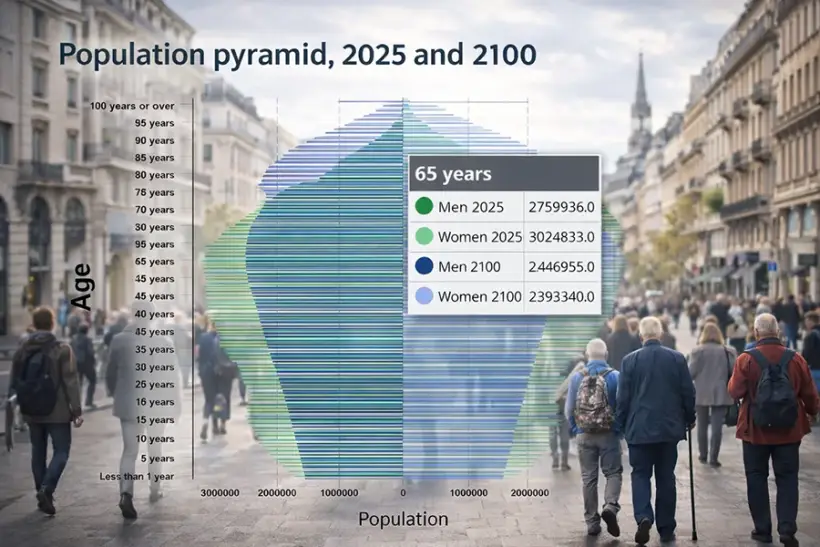
The population of the European Union and European Free Trade Association countries could decline by nearly 50 million people by the end of the century. The structure of society will also change significantly — around one-third of residents will be over the age of 65. Short-term prospects are more positive, but analysts forecast a long-term demographic downturn, Eurostat reports.
Population in Europe: 75-year dynamics
The EUROPOP2025 projection covers the period from 2025 to 2100 for 30 European countries: all EU member states, as well as Iceland, Norway, and Switzerland. The baseline is population data as of 1 January 2025.
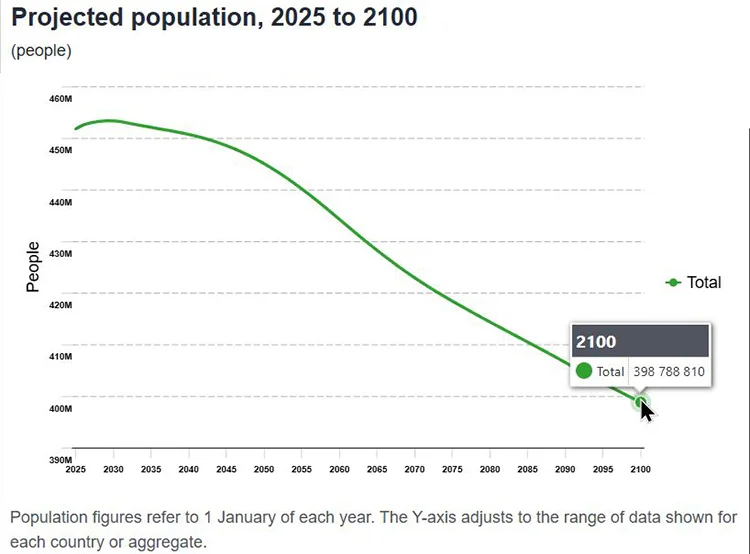
The EU population is expected to increase slightly from 2025 to 2029 — from 451.8 million to 453.3 million under the baseline scenario. This represents a symbolic growth of just 0.3%. After that, a reversal begins, with the figure falling to 445 million by mid-century. A faster decline is then expected. By 2100, the EU population is projected at around 398.8 million, which is 53 million (11.7%) lower than at the start of the period. A short phase of growth will thus be replaced by a prolonged demographic decline lasting until the end of the century.
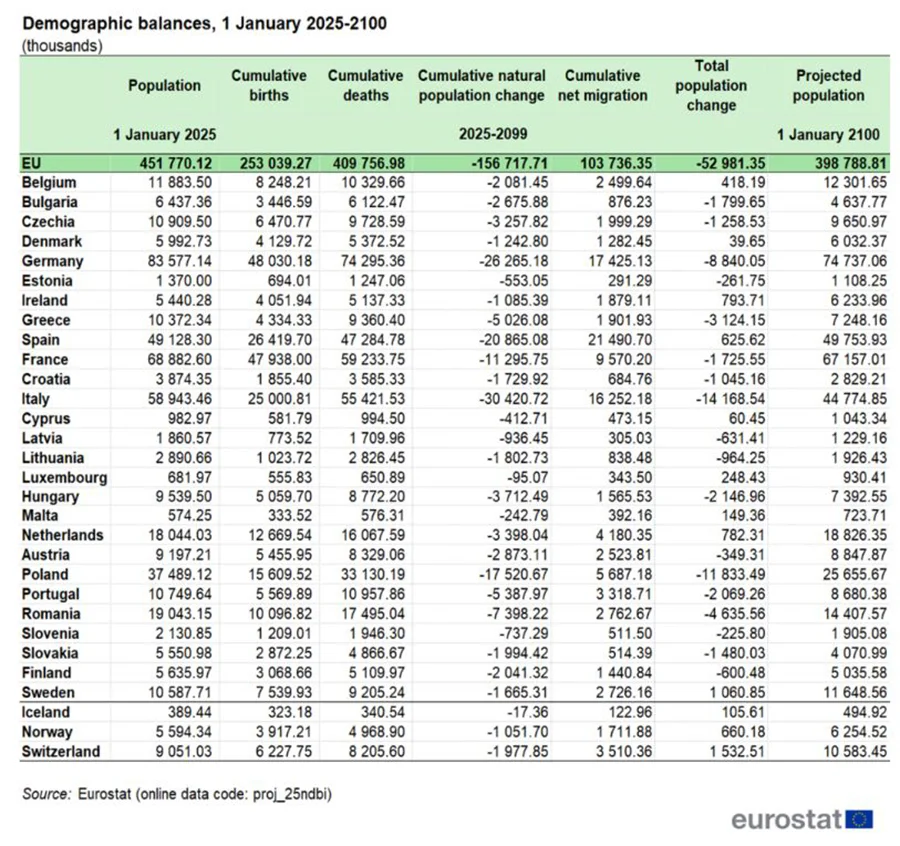
Population leaders and laggards in EU countries
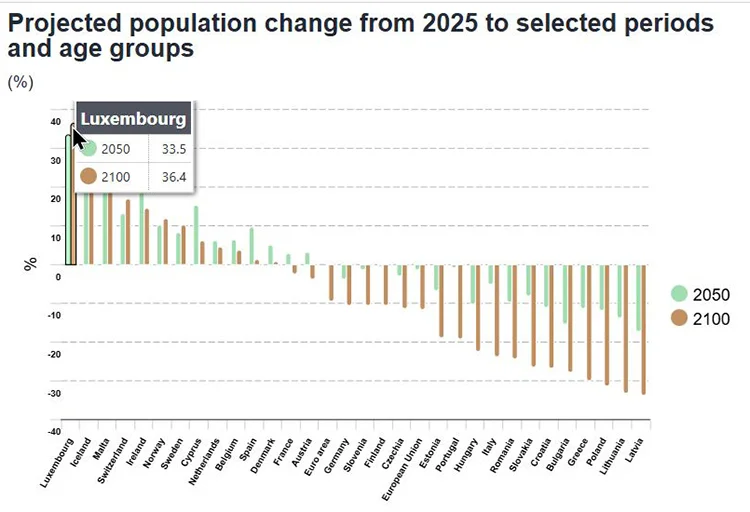
A population decline is projected in 18 EU countries. The smallest decreases are expected in France and Austria, below 5%. Germany, Slovenia, Finland, and the Czech Republic are forecast to see a drop of around 10%. Finland and Slovenia are also among the countries with fewer residents. The steepest declines are expected in Poland (–31.6%), Lithuania (–33.4%), and Latvia (–33.9%).
Germany will remain the most populous EU country, although its population is projected to fall from 83.6 million in 2025 to 74.7 million by 2100. France will also retain a strong position, with a slight decrease from 68.8 million to 67.2 million.
Growth is expected in nine EU countries and all three European Free Trade Association states. Luxembourg is projected to grow by 36.4%, Malta by 26%. Ireland and Sweden are expected to see increases between +10% and +20%. Spain’s population is forecast to rise from 49.1 million in 2025 to 49.8 million in 2100.
Drivers of change: fertility, mortality, and migration
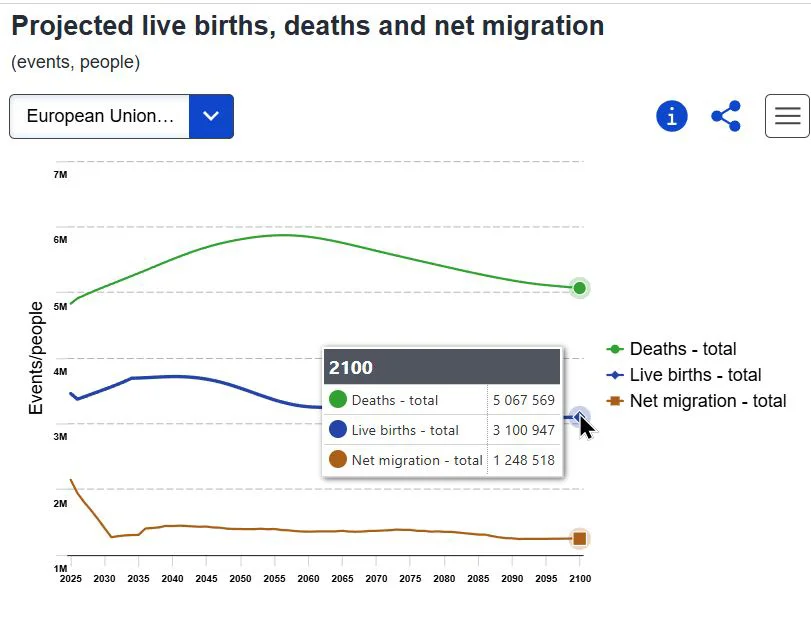
The main driver of long-term population decline in the EU is a persistent demographic imbalance between births and deaths. Between 2025 and 2100, around 253 million births and more than 409.8 million deaths are expected. This creates a natural population decrease of approximately 156.7 million people.
Throughout the entire projection period, deaths are expected to exceed births. The gap will be most pronounced in the middle of the century, when the demographic balance turns especially negative and natural population loss reaches peak levels.
Migration partially offsets this decline. According to Eurostat estimates, net migration into the EU over the same period will total around 103.7 million people. However, this is not enough to compensate for natural decrease. The overall balance remains negative — a loss of 53 million people by 2100.
Ageing population in Europe
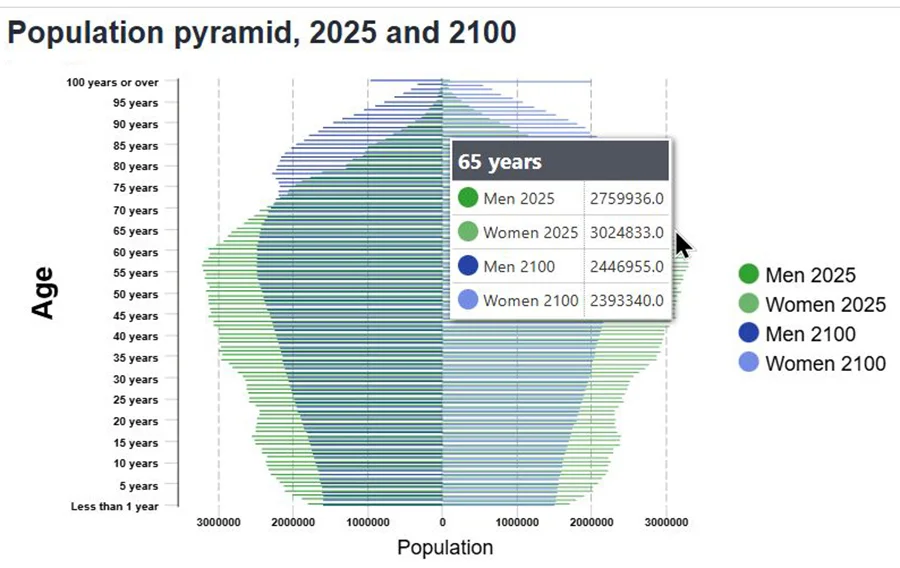
Eurostat’s long-term forecast shows steady population ageing across all EU and EFTA countries. This affects not only total population size but also age structure: the share of children and working-age people is shrinking, while the number of older people is rising.
A key indicator is the median age. Between 2025 and 2100, it is expected to increase by 6.6 years, reaching 51.5 years. The rise will be observed in all countries, with the largest increases — over 10 years — in Malta, Cyprus, Ireland, Luxembourg, Lithuania, and Poland. The smallest changes — under 6 years — are expected in Bulgaria, Germany, Hungary, Italy, Greece, Slovenia, and the Czech Republic.
By the end of the century, the “youngest” populations will remain in Bulgaria, the Netherlands, and Germany, where median age will stay slightly below 50. In several countries it will exceed 53 years, including Italy, Spain, Portugal, Poland, Lithuania, Cyprus, and Malta.
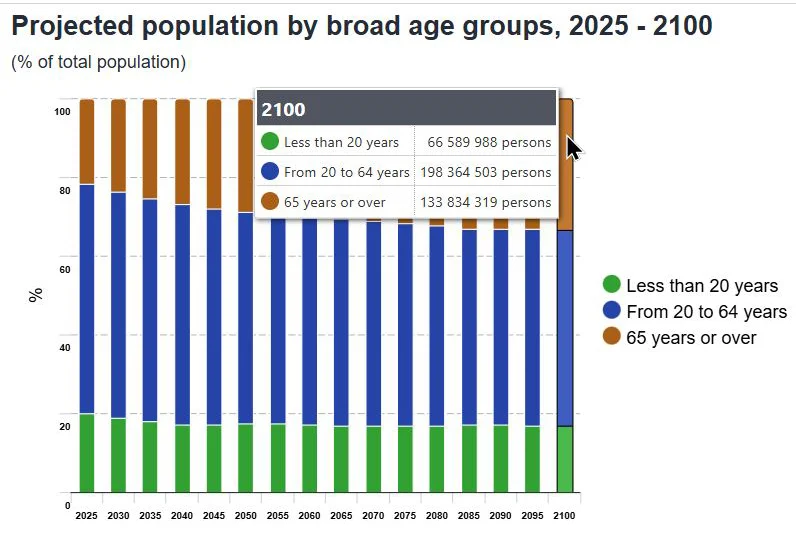
The share of people under 20 will fall from 23.3% (99.4 million) to 16.7% (66.6 million). The working-age population (20–64) will decline from 262 million to 198.4 million (–49.7%). The only growing group will be those aged 65 and over — from 67.9 million to 133.8 million, increasing their share from 12.4% to 33.6%.
In 2025, there are roughly three working-age people per one person aged 65+, but by the end of the century this ratio may shrink to 2:3.
Conclusion
Analysts at International Investment note that EU governments previously responded more actively to demographic forecasts, developing large-scale migration programs and workforce expansion policies in Germany and other countries. In 2026, the approach has shifted. Only Spain continues similar measures, still running legalization programs for hundreds of thousands of migrants. Overall, the EU is tightening rules, focusing more on deportations and restrictions.
In the future, research suggests these demographic changes may lead to a sharp population decline and ageing trend. This will increase pressure on social systems, including pensions and healthcare, and limit long-term economic growth across EU countries.