







 Covivio Hotels Revenue Grows 4.7% as European Markets Split
 Lithuanian Apartment Prices Accelerate Across Major Cities
 Georgia's Tourism Revenue Hits Record High
 Norway's Sovereign Fund Commits €1.5bn to European Warehouses
 Market Rout of October 2026: Can Branded Hotels Protect Capital?
 Residential Property Prices in Tbilisi Rise by 5.9% Year-on-Year
EU Housing Prices Rise 4.7%: Where Prices Are Growing Fastest

EU house prices rose 4.7% in the second quarter of 2026 compared with the same period of 2025. Rents increased by 3%. Differences between national markets remain substantial.
What changed in the second quarter of 2026
Eurostat reported on 1 October that euro-area prices rose 4% annually in the second quarter. Its first-quarter figure was revised from 4.7% to 4.6%; the EU figure remained at 5.1%.
In the second quarter, Portugal (+16.5%), Bulgaria (+15.5%) and Lithuania (+14.3%) lead annual growth. Prices fell in Finland (−2.7%), Luxembourg (−2.2%) and France (−0.8%).
Over the quarter, EU house prices rose 1.2% and rents 0.7%. Slower annual growth has yet to become a decline in prices.
How the market entered 2026
In the first quarter of 2022, the market was at the peak of its growth cycle: house prices increased by 10.7% in the EU and 10% in the euro area compared with the same period a year earlier. Higher interest rates and tighter lending conditions subsequently cooled demand. By the fourth quarter of 2023, annual price growth in the EU had slowed to 0.2%, while property values in the euro area declined by 1.2%.
The market turned in 2024. In January–March, housing prices increased by 1.3% in the EU but declined by 0.4% in the euro area; by the fourth quarter, the respective annual rates had reached 4.9% and 4.2%. At the beginning of 2025, prices rose by 5.8% in the EU and 5.5% in the euro area. By the fourth quarter, the figures had eased to 5.4% and 5.1%, and in the first quarter of 2026 to 5.1% and a revised 4.6%. Between January and March 2026, property prices increased by 1.1% and 0.9% respectively.
Rents in Europe are rising more slowly than housing prices. In the first quarter of 2026, EU rents were 3% higher than in the same period of 2025, compared with a 5.1% increase in property prices. Compared with October–December, rents rose by 0.7% and housing prices by a revised 1.1%. Housing prices therefore outpaced rents both over 12 months and on a quarterly basis.
First quarter: Eurostat’s July estimates
The following figures refer to the first quarter and the estimates published on 2 July.
In January–March 2026, housing prices increased in 25 EU countries for which Eurostat had data. Portugal recorded the strongest annual increase, at 17.8%, along with quarterly growth of 3.8%. In Bulgaria, prices rose by 14.8% over 12 months and by 6.2% during the quarter, the highest quarterly increase in the European Union. Slovakia recorded gains of 14.4% and 3.6% respectively, while Croatia posted increases of 14.3% and 3.3%.
In Spain, housing prices increased by 12.8% year on year and by 3.5% over three months. Lithuania recorded corresponding increases of 11.9% and 3.3%. Estonia did not enter the group of countries with double-digit annual growth, but prices there rose by 3.4% between January and March. In Hungary, housing was 11.2% more expensive than a year earlier but prices declined by 0.5% during the first quarter. Annual growth reached 10.9% in Latvia and 10% in Czechia.
Growth was considerably weaker in the largest Western European markets. Germany recorded an annual increase of 1.4%. In France, prices rose by just 0.1% over 12 months and declined by 0.6% between January and March. Italy and the Netherlands both recorded annual growth of 5.2%, while Austria posted 4.2%. Belgium saw a quarterly decline of 0.8%. Finland was the only EU country where housing was cheaper than a year earlier, with prices down 2%. They fell by another 0.8% between January and March.
Price levels in early 2026
In France, the average price stood at €3,124 per sq. m as of March 1, 2026. In Paris, it reached €9,739, more than three times the national level. In Slovakia, the asking price averaged €3,005 per sq. m in the first quarter. Apartments reached €3,378, compared with €2,118 for houses. In Finland, existing homes sold for €2,483 per sq. m in January–March, with prices reaching €2,710 in apartment buildings and €2,056 for terraced houses.
In Spain, registered transactions averaged €2,429 per sq. m. New-build properties cost €2,655, compared with €2,366 for existing homes. In Portugal, the median transaction price reached €2,337 per sq. m in the first quarter. In Italy, asking prices stood at €2,179 per sq. m. Property was considerably more expensive in major cities: €5,645 in Milan, €4,733 in Florence and €3,758 in Rome. In Milan, the price per square metre was 2.6 times the national level.
The figures highlight substantial price gaps within individual markets. In Paris, the price per square metre was more than three times the French average, while in Milan it was 2.6 times the national level. Differences were also pronounced between property segments: new builds in Spain cost 12.2% more than existing homes, while apartments in Slovakia were almost 60% more expensive than houses.
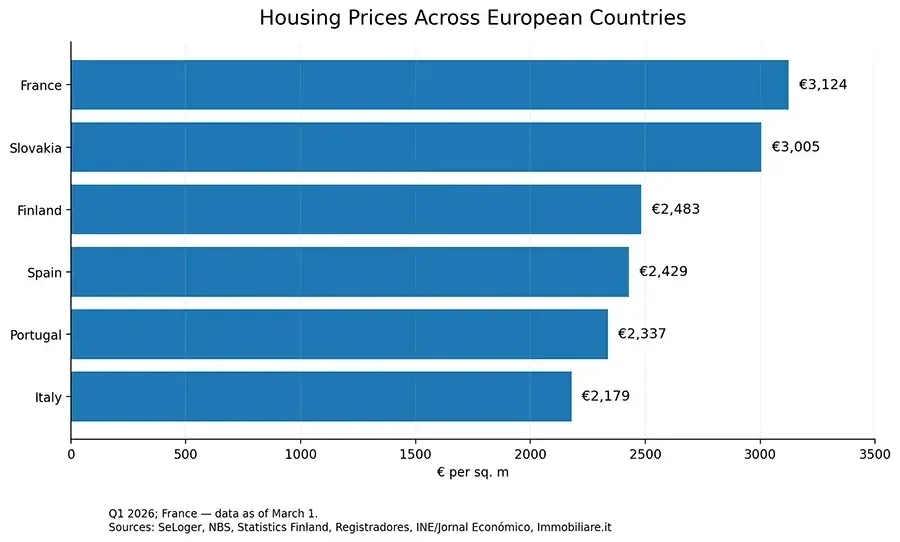
Prices per square metre in the first quarter of 2026; France as of 1 March. The figures mix asking prices, average transaction prices and medians, so their methods differ.
What This Means for Investors
European housing remains an expensive asset with a relatively high entry threshold. With prices running into several thousand euros per sq. m, buying a property requires substantial capital, while rental yields remain moderate in many countries. In figures reported on 29 September 2026, Global Property Guide put gross yields at 3.31% in Austria, 3.37% in Czechia, 4.21% in Croatia and 4.27% in Bulgaria. The figure reached 4.29% in Portugal, 4.84% in France and 5.54% in Spain. The calculation does not include taxes, property maintenance and other ownership costs. Net yields depend on actual expenses and financing terms.
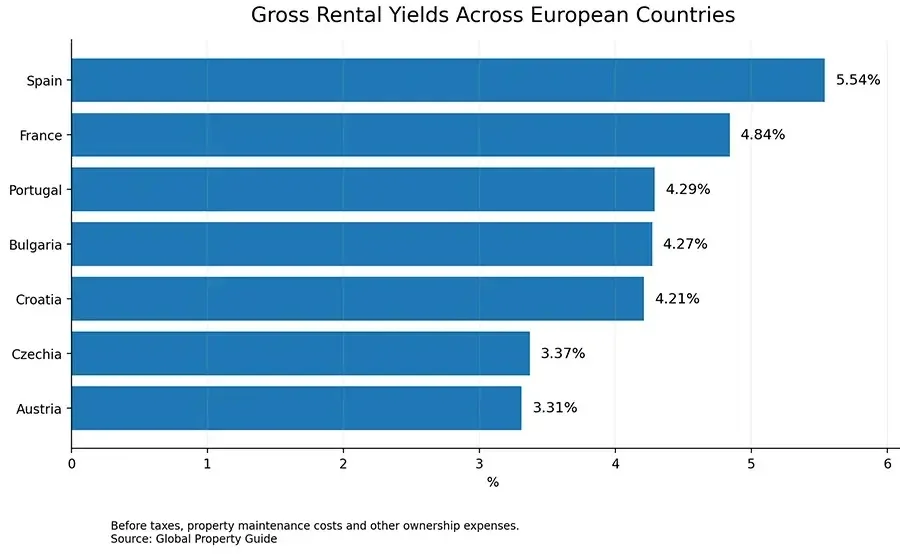
Gross rental yields: figures reported on 29 September 2026, before taxes and ownership expenses.
The sector’s outlook is closely linked to constrained supply. New construction remains insufficient, supporting demand for both existing housing and rental properties. CBRE raised its forecast for 2026 rental growth in Europe’s multifamily sector from 2.4% to 3.9%. However, increases in market rents do not always translate fully into higher income for property owners because of regulation and contractual terms.
High interest rates remain a major constraint. CBRE expects current income to play a more significant role in European real estate investment performance in 2026. The scope for rapid asset appreciation driven by cheaper financing remains limited. In the first half of the year, the living sector attracted €29.9 billion in investment, up 17% compared with the same period of 2025.
International Investment analysts note that Europe’s housing market remains highly uneven for investors in 2026: rapid price increases in Portugal, Bulgaria and Central European countries contrast with weaker dynamics in the largest Western European markets. With high acquisition costs and expensive financing, a property’s ability to generate stable rental income is becoming increasingly important. Limited construction continues to create potential for further rent increases and supports investor interest in the residential sector.
FAQ
How much did housing prices rise in Q2 2026?
Prices rose 4.7% annually in the EU and 4% in the euro area.
Where are housing prices rising fastest?
Portugal leads annual growth at 16.5%.
Are rents rising faster than house prices?
EU rents increased 3% annually, more slowly than house prices.
Does price growth guarantee a high rental yield?
No. Yields depend on the purchase price, rent received, financing, taxes and property expenses.