







 Covivio Hotels Revenue Grows 4.7% as European Markets Split
 Lithuanian Apartment Prices Accelerate Across Major Cities
 Georgia's Tourism Revenue Hits Record High
 Norway's Sovereign Fund Commits €1.5bn to European Warehouses
 Market Rout of October 2026: Can Branded Hotels Protect Capital?
 Residential Property Prices in Tbilisi Rise by 5.9% Year-on-Year
Ireland’s Housing Costs Rise Twice as Fast as Inflation

Ireland’s annual consumer inflation rate reached 4.1% in September 2026, its highest level since January 2024. The bills that determine the cost of living in a home rose much faster. Housing, water, electricity, gas and other fuels increased by 9.5% year on year, approximately 2.3 times the overall CPI rate. The divergence matters for tenants and homeowners even as the annual pace of residential property price growth shows signs of easing.
Housing Expenses Set the Inflation Pace
The Central Statistics Office reported a 4.1% annual rise in consumer prices in September, up from 3.7% in August. Monthly CPI increased 0.2%, while the housing and utilities division rose 1.2%. The division combines rental payments, mortgage interest, energy and other household expenses. It does not measure the change in the purchase price of a house or the market rent quoted for a newly advertised apartment.
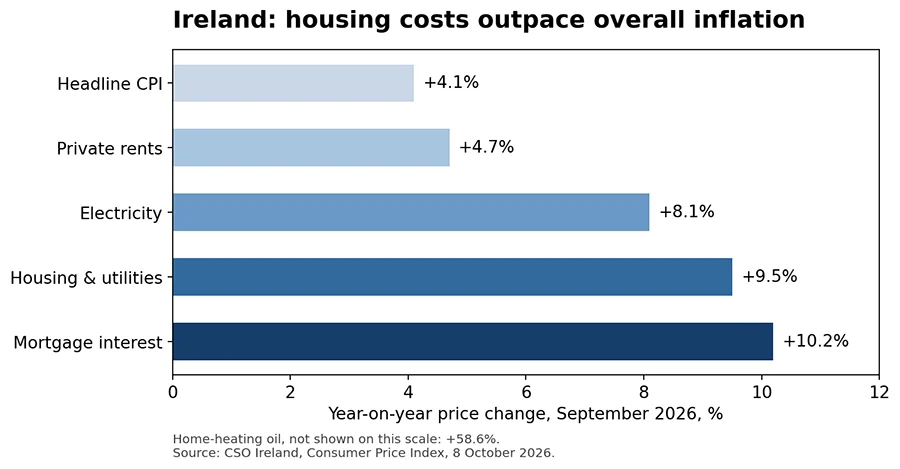
Chart: annual changes in selected Irish consumer prices, September 2026. Source: CSO Ireland; International Investment visualization. The heating-oil figure of +58.6% is noted separately.
Private rents rose 4.7% over the year and local-authority rents 12.7%. Mortgage interest increased 10.2%, electricity 8.1%, natural gas 2.2% and home-heating oil 58.6%. These are individual price indices with different expenditure weights. Adding their percentage changes would produce a meaningless figure because the overall 9.5% housing component already represents their combined weighted effect.
Heating Oil Is a Major Source of Pressure
A separate CSO analysis shows that the price of home-heating oil climbed 7.2% from August to September and 58.6% year on year. Heating oil alone contributed 0.45 percentage points to annual CPI inflation, with diesel and petrol contributing 0.34 and 0.26 points respectively. Actual energy bills vary by heating system, home size, usage and tariffs, so none of those national changes should be presented as the cost increase for every household.
The mortgage-interest index needs equally careful interpretation. It reflects interest costs measured in the consumption basket, not a uniform percentage increase in rates on every new mortgage. Fixed-rate borrowers, variable-rate borrowers and households nearing refinancing dates face different conditions. The purchasing decision also depends on the property price, deposit, maintenance and expected future borrowing costs.
Home Prices Slow but Affordability Remains Strained
The August Residential Property Price Index, published on 13 October, recorded annual national growth of 5.1%, compared with 5.4% in July. Dublin prices were up 3.9%, while the rest of Ireland increased 6.2%. The median transaction price over the 12 months to August reached €400,000. Property purchase-price inflation is a different statistic from the housing division of the consumer price index, and their reference months also differ.
International Investment has previously examined an ESRI estimate that Irish homes were approximately 17% above levels implied by selected economic fundamentals. That figure is not a forecast of a 17% price decline. September’s cost-of-living data add another dimension: even when purchase-price appreciation slows, the recurring expense of occupying a home may still rise faster than incomes.
Why New-Tenancy Rent Data Differ
The CPI measure of private rents is not interchangeable with the rents reported for newly signed leases. One series tracks price changes paid by households in a statistical basket; the other can capture the price faced by someone entering a tenancy or moving house. A 4.7% CPI rise in private rents therefore does not rule out substantially faster increases for new tenancies. The distinction is particularly important when interpreting rental affordability and prospective landlord income.
Investors need to assess regulatory limits on rent reviews, tenant turnover, local demand and the running cost of a property. For tenants, an existing lease may provide a very different financial position from the market cost of moving. Earlier International Investment coverage of Irish rent pressures illustrates why mixing those concepts can distort an otherwise useful comparison.
The Next Affordability Test
September’s figures underline that Ireland’s housing challenge is not just a question of sale prices. Mortgage servicing and energy costs can offset the benefit of slower property price inflation, while rent dynamics differ between existing and new contracts. Future data on housing completions, borrowing costs, rent registrations and household income will be needed to determine whether affordability is improving.
Frequently Asked Questions (FAQ)
What was Ireland’s inflation rate in September 2026? CPI increased 4.1% year on year and 0.2% month on month.
How quickly did housing and utility costs rise? The CPI housing and utilities division increased by 9.5% from September 2025.
Why is mortgage interest included in CPI? Ireland’s domestic CPI includes mortgage-interest costs, while the EU-harmonised HICP excludes them.
What was the median residential purchase price? €400,000 over the 12 months to August 2026, a separate indicator from consumer housing costs.