







 Covivio Hotels Revenue Grows 4.7% as European Markets Split
 Lithuanian Apartment Prices Accelerate Across Major Cities
 Georgia's Tourism Revenue Hits Record High
 Norway's Sovereign Fund Commits €1.5bn to European Warehouses
 Market Rout of October 2026: Can Branded Hotels Protect Capital?
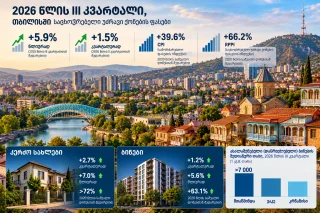 Residential Property Prices in Tbilisi Rise by 5.9% Year-on-Year
Property Taxes in Bulgaria Could Double
Bulgaria is preparing major changes to its property taxation system. By 2029, property tax assessments could double, according to Forbes Bulgaria. This would increase homeowners’ annual payments and could raise the cost of buying apartments and houses.
How Property Tax Assessments Will Increase
On September 23, Bulgaria’s Ministry of Finance presented a draft law to revise property tax assessments. The proposal concerns the base values used to calculate the assessed value of buildings, land plots and other properties. The reform is planned in three stages: a 30% increase in 2027, a cumulative 65% in 2028 and 100% by 2029, all relative to 2026. Municipal tax rates would remain unchanged.
On October 12, Konstantin Prodanov, chair of the parliamentary Budget and Finance Committee, confirmed plans to include higher property tax assessments in the 2027 budget programme. The phased approach is intended to prevent a sharp increase in homeowners’ payments.
Public consultation on the proposal ended on October 23. On the same day, the National Council for Tripartite Cooperation reviewed changes to Bulgaria’s tax system, but no agreement was reached on the full package of amendments. The proposals are next expected to be considered by the government and parliament. The new rules are scheduled to take effect on January 1, 2027, although their final provisions could still change.
Why Bulgaria Is Revising the System
The property tax assessment rules have largely remained unchanged since 2008. Base values for buildings and plots within settlements have not been revised since 1997, and those for agricultural land since 2009, according to the National Association of Municipalities in the Republic of Bulgaria. The association supported the Finance Ministry’s proposal.
In the second quarter of 2026, property prices in Bulgaria rose 15.5% year on year and 4.5% quarter on quarter. Over the quarter, housing prices increased by 5.8% in Plovdiv, 2.8% in Varna and 2.4% in Sofia, according to the National Statistical Institute.
The market value of real estate in Bulgaria is considerably higher than its tax-assessed value: by approximately 3.5–4 times in Sofia and 2.5–3 times in other cities, according to a March 2026 World Bank report. The outdated assessment system limits revenue for municipal budgets.
How Much More Will Homeowners Pay?
Municipalities set property tax rates in Bulgaria at 0.01–0.45% of a property’s assessed value. If the existing rates remain unchanged, revising the assessment base will increase annual costs. The final amount also depends on the property’s characteristics and available tax relief.
For example, an apartment assessed at €50,000 with a tax rate of 0.2% currently incurs an annual payment of €100. This could rise to €130 in 2027, €165 in 2028 and €200 in 2029. The figures are illustrative and assume that all other factors remain unchanged.
Property tax relief in Bulgaria can halve the amount due for a primary residence. In this example, the owner would pay €50 instead of €100, rising to €100 by 2029. The reduction does not automatically apply to second homes or rental properties.
A separate waste collection fee applies in Bulgaria. The draft law rules out an automatic increase in this charge following reassessments in 2027–2029. However, local authorities may adjust the fee to reflect the cost of providing services. Total property ownership expenses would therefore not necessarily double.
How the Reform Could Affect Property Transactions
The property purchase tax in Bulgaria ranges from 0.1% to 3%, depending on the municipality. It is calculated using whichever amount is higher: the price stated in the contract or the property’s tax-assessed value. Revising the assessment base could increase transaction costs even if the apartment’s sale price does not rise.
For example, an apartment sells for €80,000 while its current tax assessment is €50,000. At a rate of 3%, the buyer pays €2,400. If the assessed value reaches €100,000 by 2029 while the contract price stays the same, the tax would increase to €3,000. The additional cost would be €600.
The reform could also affect notary fees, which depend on property value. It may change calculations for gifts and inheritance, although separate rules and exemptions apply in those cases. Tax on income from property sales is governed by different legislation and is not directly linked to higher local charges.
What This Means for Investors
According to International Investment analysts, the reform could make Bulgaria’s real estate market more selective. For investors seeking a quick resale, the purchase price will become especially important: additional costs reduce potential profits. For long-term rentals, the key consideration will be consistent demand rather than returns advertised in promotional materials.
Over time, differences between urban housing and resort apartments could become more pronounced. Rental income is easier to forecast in areas with year-round demand, while seasonal properties require larger financial reserves. The tax reform alone, however, does not justify forecasts of a nationwide decline in property prices. Market prospects will depend mainly on access to credit, the pace of construction and buyers’ purchasing power.
FAQ — Questions and Answers
When are property taxes in Bulgaria expected to increase?
The first stage is planned for January 1, 2027, followed by further stages in 2028 and 2029. As of October 28, 2026, the final legislation had not yet been adopted.
How much could annual property tax payments rise?
The proposal would raise the base assessment values by 30% in 2027, 65% in 2028 and 100% by 2029, relative to 2026. The amount payable for an individual property depends on the local tax rate and any relief.
Who sets property tax rates?
Municipal councils. In Bulgaria, they may set rates within a range of 0.01–0.45% of the property’s tax-assessed value.
Are tax reliefs available for a primary residence?
Yes. Tax on a qualifying primary residence is reduced by 50%. This reduction does not automatically apply to a second home.
Could buying an apartment become more expensive?
Yes, if the revised tax-assessed value exceeds the price stated in the contract. In that case, the property purchase tax would be calculated on the higher amount.
Will the waste collection fee increase?
The draft law does not provide for an automatic increase as a result of the new assessments. Municipalities may adjust the charge on other grounds.