







read also
 China Nears a Decision on Fresh Stimulus
 Fines for Illegal Rentals in Spain Reach €800,000
 Australia’s Spring Auctions Rise but Remain Well Below 2025
 Number of Foreigners Holding Turkish Residence Permits Exceeds 1.27 Million
 Demand from Russian Tourists for Holidays in Georgia Rises by 20–25%
 Montenegro Property Buying Costs in 2026
Built-Up Land Outpaces Population
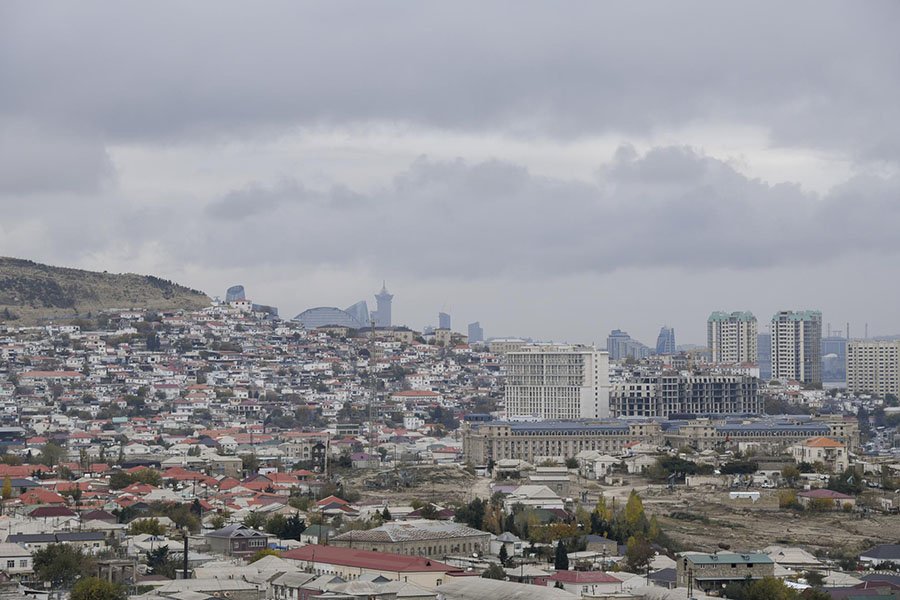
Photo: Joint-research-centre
Global urbanization has entered a new phase in which the physical expansion of built-up areas is far outstripping population growth. According to the UN’s World Urbanization Prospects 2025, the world’s constructed land has grown almost twice as fast as the global population since 1975, reshaping how and where people live.
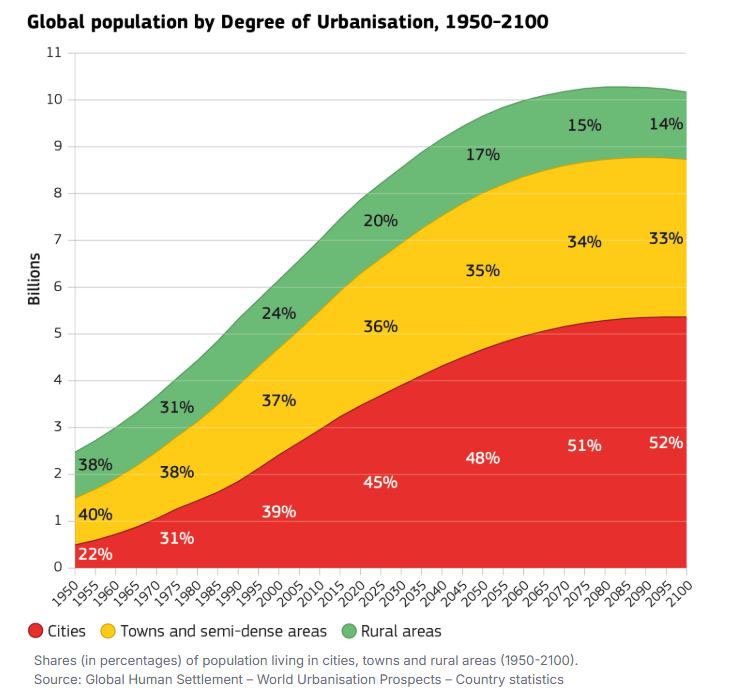
A predominantly urban world
In 1950, only around 20% of the world’s population lived in cities. Today, cities are home to 45% of more than 8.2 billion people, while the rural share has fallen to roughly 20%. Urban areas have become the dominant settlement pattern worldwide.
The latest report introduces a harmonized framework that distinguishes cities, towns and rural areas based on population size and density, offering a consistent global picture of urbanization.
Satellite data reveals hidden dynamics
A major innovation of the report is the integration of satellite imagery with census data. Methodologies developed by the EU’s Joint Research Centre allow researchers to track population distribution since 1950 and the expansion of built-up land since 1975 with unprecedented spatial detail.
The analysis covers more than 12,000 cities with at least 50,000 inhabitants across 237 countries and territories.
Where future growth will concentrate
By 2050, nearly two-thirds of global population growth is expected to occur in cities. More than half of new urban residents will be added in just seven countries, including India, Nigeria, Pakistan, Egypt and Ethiopia. Africa is set to experience the largest relative growth in cities and towns.
At the same time, megacities will continue to reshape the global urban hierarchy. Dhaka is projected to become the world’s largest city by mid-century, while new megacities are expected to emerge across Africa and Southeast Asia.
More land, not always more people
One of the most striking findings is that built-up land is expanding even in regions with slow or declining population growth. Globally, built-up land per person has increased from 44 to 63 square meters. In rural areas, built-up land has doubled since 1975 despite stagnant or shrinking populations, highlighting significant land-use inefficiencies.
In Europe, North America, Australia and New Zealand, rural population decline driven by aging and youth migration contrasts sharply with continued spatial expansion.
The cost of unmanaged expansion
Rapid urban expansion is encroaching on farmland and natural ecosystems, raising concerns about long-term sustainability. In sub-Saharan Africa and Southeast Asia, fast-paced urbanization will require massive infrastructure investment, making the form and density of development critical to economic efficiency.
How cities expand will have profound implications for infrastructure costs, environmental impact and development outcomes.
Data-driven planning for sustainability
The report emphasizes that open data platforms such as the Global Human Settlement Layer are essential for evidence-based urban planning. Compact development, stronger urban–rural linkages and better planning in smaller towns are seen as key strategies to curb sprawl and protect natural resources.
As International Investment experts report, the rapid expansion of built-up land is emerging as a defining structural trend for global investment and development. Countries that manage urban growth efficiently through compact planning will reduce infrastructure costs and climate risks, while those that fail to do so may face mounting fiscal, environmental and social pressures.