







 China Nears a Decision on Fresh Stimulus
 Fines for Illegal Rentals in Spain Reach €800,000
 Australia’s Spring Auctions Rise but Remain Well Below 2025
 Number of Foreigners Holding Turkish Residence Permits Exceeds 1.27 Million
 Demand from Russian Tourists for Holidays in Georgia Rises by 20–25%
 Montenegro Property Buying Costs in 2026
Dubai suspends foreign airlines’ flights after drone attack
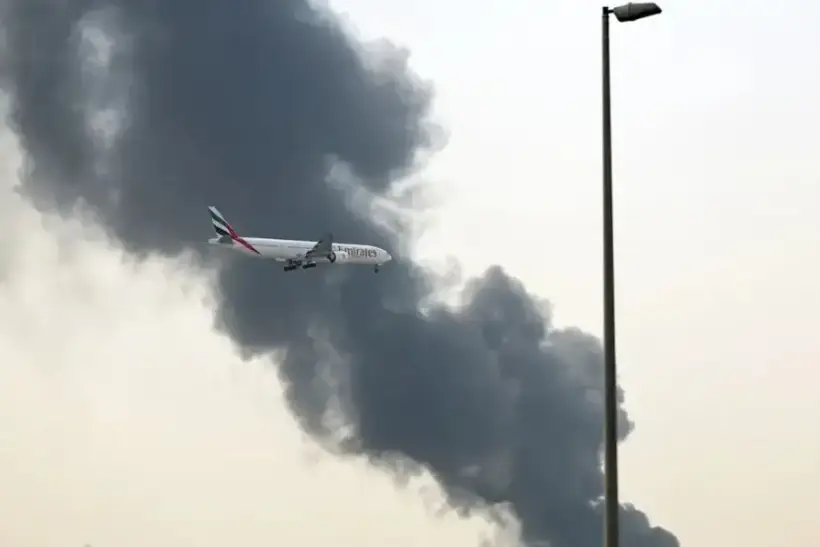
A fire broke out near the airport
Dubai authorities on March 16 introduced unprecedented restrictions on the operation of the international aviation hub following a series of attacks that disrupted air traffic and caused a fire at a fuel tank. Flights by foreign airlines have been suspended, The Times of India reports. The restrictions affect both the main airport, DXB, and the backup Al Maktoum (DWC), effectively isolating the emirate from a significant share of international air traffic. The decision is expected to hit Indian airlines the hardest, as Dubai is one of their key destinations.
Flight restrictions in Dubai: details
Operations at Dubai airport were disrupted from Monday morning. After the fire broke out, the situation worsened: 65 flights were diverted to 34 airports across Europe, Asia, and Africa, while 22 aircraft returned to their departure airports, according to Flightradar24.
Passengers on a flight from Paris spent around 11 hours in the air. An Airbus A380 operated by Emirates departed from Charles de Gaulle Airport at about 22:15 on Sunday evening. Nearly five hours later, the aircraft turned around over Saudi Arabia and returned to Paris shortly before 9 a.m.
A notice suspending landing permits was sent to foreign operators, including Indian carriers. The document states that the measure was introduced due to the current situation in the region and in the interest of the safety of airlines, crews, passengers, staff, and the general public.
The decision to restrict specifically foreign airlines may be linked to the need for tighter control over airspace and simpler coordination during a crisis. In such situations, priority is often given to national carriers, allowing authorities to manage traffic more efficiently and respond more quickly to changing conditions.
Resumption of operations after the incident
Dubai remains one of the world’s key transit hubs, connecting routes between Europe, Asia, and Africa. The restrictions have led to flight cancellations, missed connections, and a growing number of stranded passengers. Routes linking the UAE with South Asia have been particularly affected, including one of the busiest corridors between India and the Gulf.
Reuters reports that the fire at the fuel tank has been extinguished, and cooling operations are ongoing. Dubai’s Civil Aviation Authority announced a gradual resumption of arrivals and departures on selected routes.
Emirates and its subsidiary flydubai have begun restoring their schedules after a temporary suspension, although some flights remain canceled. Indian carriers Air India and Air India Express suspended flights to Dubai for the entire day on Monday. Polish carrier LOT Polish Airlines has extended cancellations not only to Dubai but also to Riyadh, Tel Aviv, and Beirut, citing recommendations from the European Union Aviation Safety Agency.
Escalation of tensions in the Middle East
Analysts at International Investment note that the incident comes amid ongoing escalation in the region. Since late February, the Middle East has been experiencing регулярные attacks involving drones and missiles, directly affecting the safety of civil aviation. Airports and transport infrastructure are increasingly at risk, as they play a critical role in the economy and logistics while also being located near potential military targets. In such conditions, even local incidents can quickly escalate into large-scale disruptions.
The current crisis is already putting pressure on the global aviation industry, for which the Gulf remains a key transit hub. The volume of commercial flights in the region has dropped by roughly half compared to normal levels. Airspace restrictions and route changes are increasing airline costs, which is reflected in ticket prices and cargo tariffs. On some routes, air freight rates have risen by up to 70%.
The consequences extend beyond aviation. The region’s tourism sector, valued at around $367 billion annually, is facing declining demand and booking cancellations. Disruptions to air traffic are also affecting supply chains, including the delivery of critical goods such as medicines.
Against this backdrop, the recovery of operations at Dubai International Airport remains only a partial sign of stabilization. The situation in the region continues to depend on security conditions and the risk of further attacks, leaving a high level of uncertainty for both airlines and passengers in the near term.