







 Vietnam Mortgage Surge Pushes Homes Out of Reach
 Lithuanian Apartment Prices Accelerate Across Major Cities
 London Flats Lose Value Ahead of Leasehold Reform
 Construction of the Batumi–Sarpi Highway Begins in Georgia
 Baltic Property Investment Accelerates in 2026
 Hong Kong and Singapore Renew Their Expat Rivalry
Singapore Stocks Near Records Again
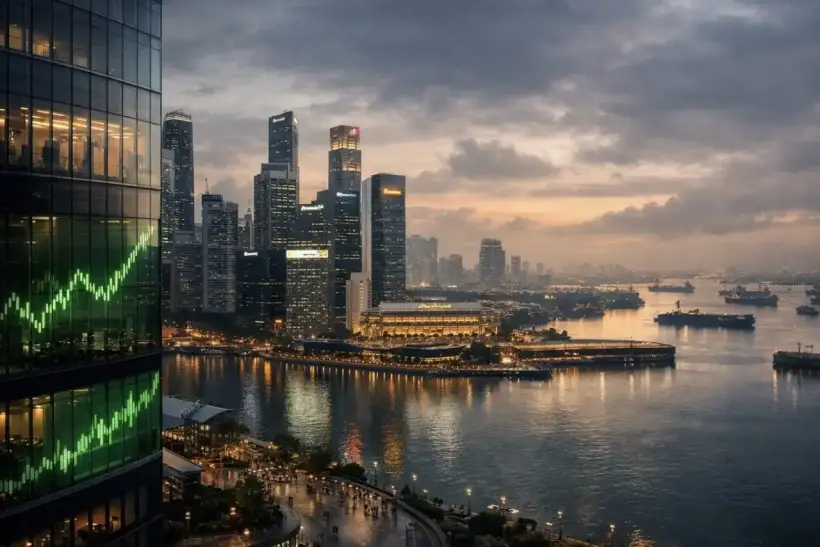
Singapore equities approach historic highs as investors seek haven assets
Singapore’s stock market has moved back toward record territory as investors rotate into haven assets amid the war involving Iran and wider volatility across global markets. Bloomberg and The Straits Times reported that Singapore equities have suffered the least among major Asian markets since the conflict broke out on February 28, putting the city-state on the verge of becoming one of the first major markets in Asia to return to fresh highs. On April 13, the Straits Times Index was trading near 4,968 points, still close to the 2026 peak above 5,041.
Why Singapore is attracting defensive flows
The main driver has been Singapore’s role as a regional financial haven. As oil prices surged, currencies swung and many Asian markets came under pressure, investors shifted toward assets seen as more liquid and more predictable. Bloomberg previously reported that Singapore sovereign bonds have also outperformed regional peers in 2026, with fund managers pointing to strong domestic liquidity, top-tier sovereign credit quality and a resilient currency as reasons to stay overweight Singapore assets.
The structure of the local equity market has amplified that move. The Straits Times Index tracks 30 of the largest listed companies in Singapore, and banks carry exceptional weight in the benchmark. When the index first closed above 5,000 in February, The Straits Times said the advance was driven largely by the three major banks, which account for about half of the benchmark by index weight. That leaves the market highly responsive to capital inflows, bank earnings expectations and confidence in the Singapore dollar.
How the Singapore dollar supports the market
Singapore’s monetary system is unusual among advanced economies. The Monetary Authority of Singapore manages policy primarily through the exchange rate rather than a standard policy rate. Under its framework, the Singapore dollar is allowed to move within a policy band against a trade-weighted basket of currencies. The central bank uses that framework because exchange-rate management is an effective way to contain imported inflation in a highly open economy.
That makes the currency central to the equity story. The Business Times and The Straits Times reported that analysts had seen a stronger case for tighter Monetary Authority of Singapore policy as the Iran war raised oil-related inflation risks. Even where the Singapore dollar softened against the US dollar, it still outperformed several Southeast Asian peers, reinforcing the market’s defensive appeal.
Exchange data show stronger market activity
The rally has been backed by a sharp rise in trading activity. Singapore Exchange data show that securities daily average value rose 45% year on year in February to S$2.1 billion, the highest since 2020, while total securities turnover reached S$38.5 billion. Momentum accelerated in March, when total securities turnover rose 78% from a year earlier to S$52.8 billion and securities daily average value climbed to S$2.4 billion. SGX directly linked that strength to investor demand for risk-management tools and access to a trusted marketplace during volatile conditions.
The market had already entered the latest geopolitical shock with strong underlying momentum. According to SGX, the Straits Times Index rose 5.1% in the first quarter of 2026, while total return including dividends reached 5.6%. The Straits Times said that performance was helped by reforms aimed at the local equity market and renewed investor interest in Singapore stocks even before the latest escalation in the Middle East.
How close the market is to a fresh high
The benchmark has already set a record in this cycle. SGX and The Straits Times reported that on February 12 the index closed above 5,000 for the first time in history, finishing at 5,016.76. SGX data point to a 52-week high of 5,041.33. By April 13 the market was trading below that level but remained within reach of its peak, a stronger position than many neighboring markets that were hit harder by oil-price shocks and weaker sentiment.
That relative resilience matters in a regional context. Bloomberg and The Straits Times both said Singapore stocks have declined less than other major Asian markets since the conflict began on February 28. That has strengthened the view of Singapore not only as a dividend market, but also as a place for investors to park capital during periods of regional stress.
As experts at International Investment report, the current move suggests that in 2026 Singapore is being priced by global investors not simply as another Southeast Asian equity market, but as a rare combination of defensive currency, bank-heavy benchmark and deep exchange liquidity. As long as oil prices and geopolitical risks remain elevated, that haven premium may persist, although a sustained move to fresh highs will still depend on corporate earnings resilience and domestic inflation trends.
FAQ: Singapore stocks and the Straits Times Index
What is the Straits Times Index?
The Straits Times Index is Singapore’s main equity benchmark. It tracks 30 of the largest listed companies on Singapore Exchange and is widely used as the key gauge of the local stock market.
Why are Singapore stocks seen as a haven trade?
In 2026, investors have increasingly treated Singapore equities and bonds as haven assets because of the country’s stable financial system, high sovereign credit quality, resilient currency and strong market liquidity, especially after the Iran conflict began.
Why does the Singapore dollar matter for the stock market?
Singapore runs exchange-rate-based monetary policy rather than relying mainly on a benchmark interest rate. A firmer Singapore dollar helps limit imported inflation and supports confidence in domestic financial assets.
Which companies matter most for the index?
Large banks are the biggest force inside the benchmark. The Straits Times reported that the three major Singapore banks account for around half of the index by weight, making them crucial for overall market direction.
Did the index make a record high in 2026?
Yes. The benchmark first closed above 5,000 on February 12, 2026, and SGX data show a 52-week high of 5,041.33. By mid-April it was still trading near those levels.