







 Vietnam Mortgage Surge Pushes Homes Out of Reach
 Lithuanian Apartment Prices Accelerate Across Major Cities
 London Flats Lose Value Ahead of Leasehold Reform
 Construction of the Batumi–Sarpi Highway Begins in Georgia
 Baltic Property Investment Accelerates in 2026
 Hong Kong and Singapore Renew Their Expat Rivalry
Middle East War Shifts Global Tourism Demand

Security perception drops across Gulf destinations
The escalating conflict in the Middle East is already reshaping global tourism flows. New travel intelligence data from Mabrian shows a sharp deterioration in security perception across Gulf destinations, raising the likelihood that international travel demand may shift toward Europe, Asia and other regions.
The analysis examines traveller behaviour and sentiment across five major outbound markets — the United Kingdom, Germany, France, Italy and the United States — which represent key sources of international visitors for Gulf countries and nearby destinations such as Egypt, Jordan and Türkiye.
Security perception index plunges in several countries
According to Mabrian’s Perception of Security Index (PSI), travellers’ safety sentiment toward several Gulf destinations has deteriorated significantly over the past month.
Bahrain experienced the steepest decline, losing 81 points on the index and falling to a low level of 9.6 out of 100. Oman recorded a drop of 56.7 points to 24.8, while Qatar declined by 54.9 points to 18.4.
Despite the overall decline, the United Arab Emirates and Saudi Arabia have demonstrated greater resilience. The UAE recorded a drop of 48.3 points, reaching a low of 51.9, while Saudi Arabia declined by only 13.6 points, maintaining a comparatively high score of 85.3.
Neighboring destinations face spillover effects
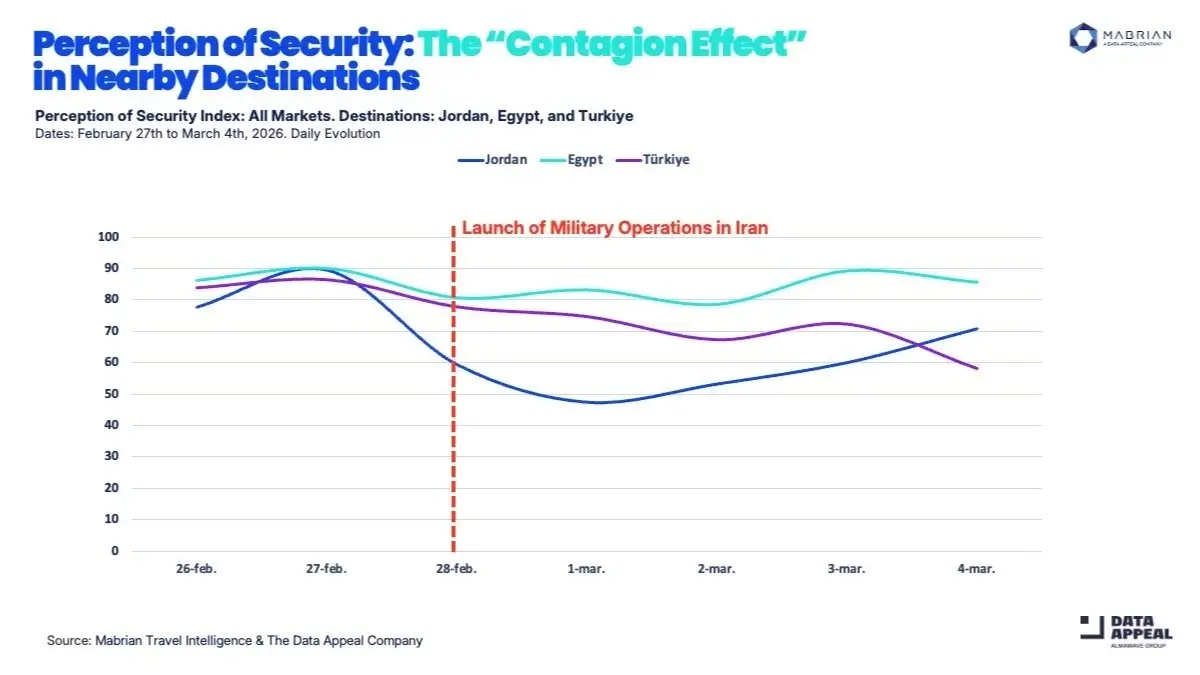
Countries located near the conflict zone are also experiencing a spillover effect in travellers’ perceptions of safety.
Jordan’s security perception index dropped by 30.3 points, although early signs of recovery have begun to appear. Türkiye experienced a decline of 25.8 points, but its trend currently shows limited signs of rebound.
Egypt has been the least affected among the three, with a decline of only 7.6 points, though stable recovery has not yet been confirmed.
US travellers react more strongly to geopolitical risks
The analysis highlights a particularly strong reaction among US travellers compared with other long-haul markets.
Security perception among American travellers declined sharply for several destinations. Kuwait recorded a drop of 87.3 points, the UAE fell by 79.2 points, and Saudi Arabia declined by 17.8 points.
Egypt also experienced a significant reaction among US travellers, with a 32.6-point drop in perceived security and an uncertain recovery outlook.
Early signs of travel demand diversion
At the same time, the data indicates early signals that international travel demand may begin shifting toward alternative destinations.
Many European travellers are showing a growing preference for destinations closer to home. German tourists are increasingly considering Morocco and Greece, while Italian travellers are exploring options such as Croatia, the Czech Republic, Norway and Spain.
British travellers are displaying similar behaviour, with Malta, Morocco and Montenegro gaining popularity as alternative holiday destinations.
Asia remains a strong tourism alternative
Demand for Asian destinations remains robust despite geopolitical tensions. Destinations such as Japan, Thailand, Vietnam, Cambodia and the Philippines continue to attract strong interest from international travellers.
However, the realisation of this demand will depend heavily on air connectivity and ticket pricing as airlines adjust flight routes and operational costs increase.
Long-haul destinations attract new interest
Some travellers are also turning toward long-haul destinations as substitutes for Middle Eastern travel.
British travellers are showing growing interest in South Africa and the Maldives, while Latin American destinations are gaining attention among French, Italian, German and US travellers.
Peru and Brazil in particular are emerging as aspirational destinations for travellers seeking long-distance experiences.
Egypt remains attractive but vulnerable
Egypt continues to maintain strong appeal among German, Italian and French travellers. However, tourism demand remains highly sensitive to developments in the Middle East conflict.
Travel advisories, disruptions in connectivity or restrictions affecting tourism zones could quickly alter travellers’ perceptions and reduce demand for the destination.
As International Investment experts report, Mabrian’s data illustrates how fragile security perception can be as a strategic asset for tourism destinations. Even short-term geopolitical crises can rapidly alter traveller sentiment and redirect global tourism demand toward alternative regions.