







 Vietnam Mortgage Surge Pushes Homes Out of Reach
 Lithuanian Apartment Prices Accelerate Across Major Cities
 London Flats Lose Value Ahead of Leasehold Reform
 Construction of the Batumi–Sarpi Highway Begins in Georgia
 Baltic Property Investment Accelerates in 2026
 Hong Kong and Singapore Renew Their Expat Rivalry
Philippines Declares an Energy Emergency
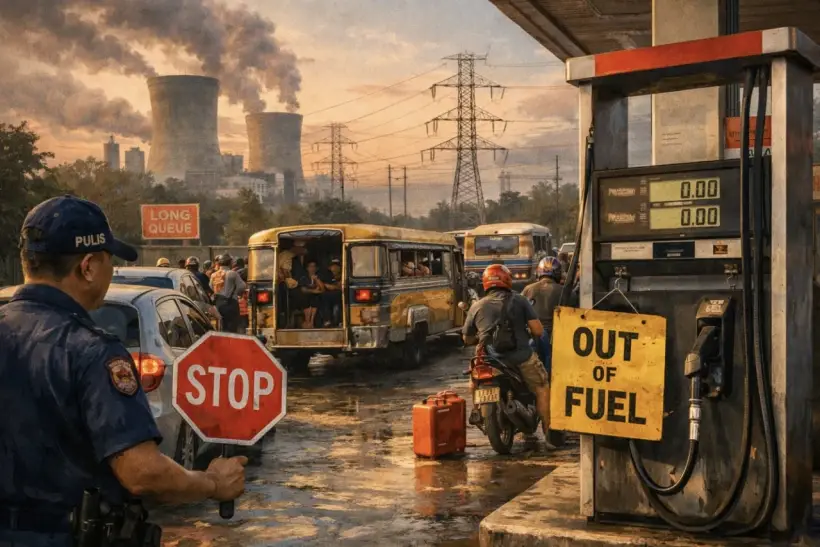
Philippines Enters an Energy Emergency
The Philippines has declared a national energy emergency as fuel supplies tighten and oil prices rise sharply in the fallout from the Middle East war. President Ferdinand Marcos Jr. said the country faces “an imminent danger of a critically low energy supply,” and the emergency framework is meant to protect supply stability, continuity of economic activity and the delivery of essential services. According to the Associated Press, the declaration is initially set to last for one year.
The move goes beyond the fuel market alone. Under the emergency setup, the government will run a contingency structure tasked with ensuring the availability and orderly distribution of fuel, food, medicine, agricultural products and other basic goods. Authorities have also been instructed to act against hoarding, profiteering and manipulation in the petroleum supply chain.
Why the Philippines Faces a Fuel Supply Crunch
The core problem is structural. The Philippines is a net energy importer, and the International Energy Agency, or IEA, describes imported fossil fuels as an important part of the country’s energy supply. World Bank data sourced from the IEA shows the Philippines’ net energy imports at 54% of energy use in the latest comparable year, underscoring how exposed the economy is to external oil and fuel disruptions.
That vulnerability became more visible as the Middle East conflict intensified. Early in March, President Marcos said the country had roughly 50 to 60 days of supply for gasoline, fuel oil and kerosene, and he released more detailed inventory figures showing 50.5 days for diesel, 51.5 days for gasoline, 67.5 days for kerosene, 58 days for jet fuel and 29 days for LPG, meaning liquefied petroleum gas. By March 24, however, Energy Secretary Sharon Garin told senators that the worst case was that the country could “run dry,” adding that the Philippines had only about a month to a month and a half to prepare if the crisis deepened further.
That shift in official messaging is central to understanding the emergency declaration. Within weeks, the narrative moved from relative reassurance to a more explicit acknowledgment that physical shortages had become a realistic scenario if regional conflict further disrupted global oil trade. Garin also said the government was seeking alternative suppliers, including the United States and India, while negotiating for additional gasoline and diesel volumes from private-sector players.
What the Government Has Already Put in Place
The emergency declaration follows a series of conservation and market-intervention measures introduced earlier in March. A four-day onsite work arrangement for parts of the government began on March 9 as part of the effort to reduce fuel use and electricity consumption. The government’s Memorandum Circular No. 114 requires public institutions to follow strict conservation protocols, while the Department of Energy says local and national entities are expected to reduce fuel and electricity use by 10% to 20% by year-end. The rules include keeping air-conditioning at no lower than 24 degrees Celsius, turning off non-essential equipment and using fuel-saving practices for government vehicles.
The government also intervened directly in fuel pricing. On March 9, the Department of Energy imposed nationwide price ceilings on petroleum products and warned oil firms and stations that any unauthorized increases above the approved ranges could trigger administrative and criminal penalties. The agency said it had mobilized field offices and requested assistance from the police and the interior department to intensify pump monitoring.
By March 23, the energy department had added another contingency measure, issuing a circular that temporarily authorizes the controlled introduction of Euro II petroleum products for selected transport and industrial uses. In practice, that signals the government is widening the range of usable fuel products to reduce the risk of outright shortages.
How the Energy Crisis Is Hitting Transport and Consumers
The shock is already visible in retail prices and household costs. GMA News, citing Department of Energy data, reported that by March 24 the price range for RON 95 gasoline had climbed to 83.10 to 109.78 pesos per liter, diesel to 107 to 134.30 pesos per liter and kerosene to 111.99 to 165.79 pesos per liter. Garin said that even if the country avoids physically exhausting its stocks, the more likely near-term problem is that prices could become extremely high.
That is why transport relief has become a central part of the state response. AP reported that the government has begun providing 5,000 pesos each to large numbers of motorcycle taxi drivers and other public transport workers, while free bus rides have been arranged for workers and students in selected cities. Government news releases also describe broader fuel subsidy and cash-aid programs for public utility vehicle drivers, alongside temporary toll discounts for buses, freight services and other transport operators.
For the wider economy, the impact goes beyond transport. Fuel costs feed into logistics, public fares, food distribution, industrial production and inflation. In an import-dependent system, even a short-lived disruption in energy supply can quickly become a broader economic problem. That helps explain why Manila is treating the issue not as a narrow fuel-market disturbance but as a whole-of-government emergency response.
Why the Philippines Matters for Asia’s Energy Outlook
The Philippines has become one of the clearest examples of how the Iran-linked energy shock is affecting Asian importing economies. The Guardian reported that several Southeast Asian governments were already racing to conserve energy as oil prices surged and supply chains tightened. The Philippines stands out because it moved beyond conservation steps and formally declared a national energy emergency.
The crisis is also beginning to reshape the region’s short-term fuel mix. Associated Press reported that several Asian countries, including the Philippines, are increasing coal use as oil and LNG, meaning liquefied natural gas, become harder to secure. That suggests the immediate response to a supply crisis may delay parts of the energy transition, as governments prioritize availability and system resilience over long-term decarbonization goals.
As International Investment experts report, Manila’s decision matters well beyond the Philippines itself. It shows how quickly an external oil shock can turn into a broader inflation, transport and policy crisis in an economy with high import dependence and limited room for disruption. For Asian energy-importing markets, the Philippine case is a reminder that energy security is no longer only about price. It is also about physical access, emergency governance and the resilience of essential services.
FAQ
What exactly did the Philippines declare
President Ferdinand Marcos Jr. declared a national energy emergency on March 24, 2026, citing “an imminent danger of a critically low energy supply.” The declaration is initially set to last for one year.
Why is the country at risk of fuel shortages
The Philippines depends heavily on imported energy and is vulnerable to disruptions in global oil flows, especially those linked to the Middle East conflict and risks around the Strait of Hormuz.
How much fuel did the country have in reserve
On March 4, officials said the Philippines had about 50 to 60 days of supply for major fuels, but by March 24 the energy secretary said the worst case could be depletion and that authorities had only about one to one and a half months to prepare.
What measures are already in effect
The government has imposed conservation rules, introduced a four-day workweek for parts of the public sector, capped fuel prices, rolled out transport subsidies and temporarily allowed controlled use of selected Euro II fuel products.
What do LNG and LPG mean
LNG stands for liquefied natural gas. LPG stands for liquefied petroleum gas, a fuel commonly used by households and some transport segments.