







 Vietnam Mortgage Surge Pushes Homes Out of Reach
 Lithuanian Apartment Prices Accelerate Across Major Cities
 London Flats Lose Value Ahead of Leasehold Reform
 Construction of the Batumi–Sarpi Highway Begins in Georgia
 Baltic Property Investment Accelerates in 2026
 Hong Kong and Singapore Renew Their Expat Rivalry
Leisure assets take center stage
Hospitality shifts toward scale and scarcity
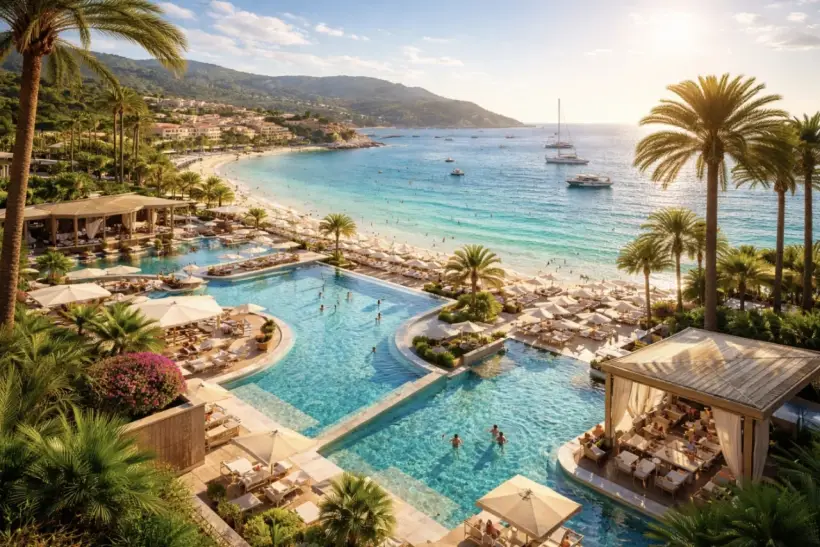
Europe’s hotel market is entering 2026 with capital clearly tilting toward resorts and destination-led assets, while urban and corporate segments face a more uneven demand backdrop and greater exposure to geopolitical volatility. That was one of the clearest signals from IHIF EMEA 2026 in Berlin, where leisure was identified as the primary demand driver and Southern Europe as the core geographic focus for new allocations. The event itself gathered more than 2,500 delegates, over 700 global investors and participants representing $581 billion in assets under management.
That shift is playing out against a stronger investment backdrop across the continent. HVS said European hotel transaction volume rose 30% in 2025 to €22.6 billion, the third-highest level ever recorded. The market logged 461 deals covering 725 hotels and more than 107,000 rooms, while single-asset transactions accounted for nearly 70% of the total, reaching a record €15.6 billion.
Why leisure hotels are drawing more capital in Europe
The central IHIF EMEA thesis was that leisure remains the most resilient demand story in the sector because affluent travelers are still traveling frequently and are less sensitive to macroeconomic pressure than other customer groups. Hospitality Net’s summary of the forum said resorts and destination properties are now at the center of capital allocation strategies, with luxury average daily rates continuing to outperform.
That view is broadly consistent with CBRE’s 2026 outlook. The firm expects leisure travel to remain the main engine of European hotel demand, forecasting domestic leisure growth of about 7% and inbound leisure growth of 5% in 2026. Overall performance growth is expected to be more measured than in the immediate post-pandemic rebound years, but demand fundamentals remain healthy.
Southern Europe is consolidating its lead
IHIF EMEA positioned Southern Europe as the geographic center of the current hotel investment cycle. The appeal is both structural and practical: strong leisure performance, globally recognizable destinations and a deep pool of assets suitable for repositioning and value creation. Hospitality Net highlighted Portugal as a market combining growth potential with relative accessibility, while France remains highly desirable but difficult to penetrate and Eastern Europe continues to be viewed as a strong secondary play.
Transaction data support the idea that capital remains concentrated in the most liquid hotel geographies. According to HVS, the UK retained first place in 2025 with 25% of total European hotel investment volume, France moved into second position and Spain ranked third. Among single-asset markets, Spain was one of the three most liquid in Europe, with €2.1 billion in transaction volume, behind only the UK and France.
Scale is becoming the new currency of hotel capital
If leisure is the demand story, scale is increasingly the capital story. Hospitality Net said investors are moving away from isolated asset purchases and toward platform strategies including portfolios, branded collections and operating platforms that offer better efficiency, stronger control and clearer exit routes. In a more complex environment, simply owning one good hotel is no longer enough for many institutional buyers.
The structure of deal flow also points in that direction. While European portfolio transaction volume rose only 3% in 2025 to €7.0 billion, the number of hotel portfolios traded increased 22%, and the number of hotels per portfolio deal fell 11%. That suggests growing demand for more selective and strategically assembled platforms rather than only very large portfolio packages.
Rising construction costs are reshaping development strategy
Another major IHIF EMEA theme was scarcity on the supply side. Rising construction costs and increasingly complex repositioning requirements are forcing investors to reassess underwriting assumptions, with renovation and asset transformation often preferred over ground-up development.
That is reinforced by the broader European supply picture. CBRE said hotel development remains broadly disciplined across the region, with most major markets showing relatively low medium-term supply growth by historical standards. Across Europe, projected five-year growth in room-night demand and travel spending is expected to outpace supply growth, which helps explain why scarcity has become such an important part of the investment narrative.
Urban hotels and corporate demand no longer look uniformly strong
The forum also made clear that hospitality is not moving in one direction everywhere. Hospitality Net described the sector as an industry of two parts: a resilient and fast-growing leisure segment on one side, and a more uncertain urban and corporate demand picture on the other. Some urban markets are showing signs of softening, especially those more reliant on Middle Eastern demand, while even strong performers such as Italy retain some fragility because of their exposure to US travelers.
CBRE still expects international business travel in Europe to grow by around 10% in 2026, but many Western European gateway markets are likely to see only modest performance gains. The firm forecasts Europe-wide RevPAR growth of roughly 1% to 3%, with a number of Western markets facing stable rather than accelerating performance because ADR levels are already high and traveler price sensitivity is rising.
Execution and asset management are becoming decisive
IHIF EMEA also pointed to a shortage of high-quality independent asset management. Participants highlighted a gap between ownership objectives and operating execution, especially in luxury assets where performance dispersion can be significant. That makes asset management increasingly central to value creation, particularly for investors pursuing repositioning-led strategies.
The makeup of capital on the deal market reflects that shift. HVS said private equity activity in European hotels fell 39% in 2025, while owner-operators and real estate investment companies became the dominant forces. That points to a market where operating expertise, direct control and a longer ownership horizon are gaining importance relative to purely financial arbitrage.
As International Investment experts report, IHIF EMEA 2026 captured more than a passing preference for resorts. It highlighted a deeper reordering of European hotel capital toward assets and markets that combine resilient leisure demand, limited new supply, scalable platform potential and measurable value creation through repositioning and operational execution. In 2026, the strongest performance is likely to come not just from the best destinations, but from the assets where scarcity and execution discipline meet.
International hotel brands are strengthening Georgia’s position
Georgia deserves separate attention as it is increasingly securing a place on the map of international hospitality capital as a growth market at the intersection of Europe, the Black Sea region and the Middle East. According to the Georgian National Tourism Administration, branded hotels in Georgia posted a 50.4% occupancy rate in the first and second quarters of 2025, up 7.4% from a year earlier; Batumi led the market with 66.3% occupancy, while branded hotel occupancy nationwide reached 67.4% in June 2025. Against that backdrop, Georgia continues to expand its tourism base. Geostat said the number of international visitors reached about 2.2 million in the third quarter of 2025, up 7.6% year over year.
The growing presence of international hotel brands is one of the clearest consequences of that momentum. In February 2026, Hospitality Investment Forum Tbilisi announced participation from representatives of Ritz-Carlton, Anantara, Waldorf Astoria and Fairmont, alongside executives linked to Marriott International, Hyatt, Hilton, IHG, Radisson Hotel Group, Wyndham Hotels & Resorts, Kempinski and other global operators, underlining the rising interest in Georgia from international hospitality players. One of the most visible projects in that pipeline is Wyndham Grand Batumi Gonio on Georgia’s Black Sea coast. Industry reports say Wyndham Grand Batumi Gonio and Wyndham Grand Residences Batumi Gonio are both expected to open in 2026, positioning the development as a major upscale resort-led scheme in Gonio aimed at premium leisure demand and longer stays.
For Georgia, this trend matters not only as a story about new hotels, but as a sign of a more mature phase in the country’s tourism economy. The launch of new international brands, including La Quinta by Wyndham in Batumi in 2025, reinforces the view that global operators increasingly see Georgia’s Black Sea coast as a scalable hospitality market rather than a niche destination. Combined with rising visitor volumes, stronger occupancy in branded hotels and sustained institutional attention, that strengthens Georgia’s position as one of the most dynamic hospitality growth markets in the wider region.
Is real estate under a global brand necessarily an investment product? Not always. The presence of a well-known international brand does not automatically make a property an investment asset. Even the world’s leading hotel operators include not only classic hotels in their brand portfolios, but also hotel residences. This type of property is designed primarily for leisure and living rather than for generating income. In essence, it is residential real estate with hotel-style services. Even in the luxury segment, such a product is generally not intended to deliver profit: its price is formed without factoring in potential investment returns. That is why promises of guaranteed income from developers in such cases are usually no more than a marketing tool rather than a reflection of the actual economic model.
The Wyndham Grand Batumi Gonio project belongs to a different category. It is a full-scale hotel property in the true sense of the word, with income generation as its core function. Wyndham Grand is exclusively a hotel brand, and the concept of the project fully reflects that hospitality model. The complex includes a 20-story hotel, hotel villas, townhouses, and family residences. In this case, the family residences combine two functions at once: comfortable living and profit generation. However, this is possible only within the framework of this specific project. At Wyndham Grand Batumi Gonio, the family residences are integrated into the infrastructure of the hotel complex, meaning they are effectively part of the hotel itself and generate returns under a hotel operating model.
This is the key difference from many other offers on the market. Developers often sell family residences under a well-known hotel brand, but without full hotel infrastructure such residences cannot be considered a genuine investment product. In such cases, the brand name alone does not turn the property into an income-generating asset.
Who guarantees the income once the hotel is completed? After construction is completed, the hotel is handed over to a professional management company. In the case of Wyndham Grand Batumi Gonio, the operator is Aimbridge Hospitality, one of the global leaders in hotel management.
The management company is responsible for attracting guests, maintaining high service standards, strengthening the hotel’s reputation, and increasing room rates over time. As the average room rate rises, the hotel’s overall revenue grows as well, which in turn increases the income generated for unit owners.
Hotel income also depends heavily on the strength of the brand. International hotel brands operate powerful loyalty programs, and the largest global players have tens or even hundreds of millions of loyal customers. For a professional investor, this is one of the key indicators, because the scale and recognition of the brand directly influence the stability of demand.
A major international management company is not just an operating partner, but a system built on decades of experience, proven marketing expertise, and global customer acquisition channels. That is exactly what Aimbridge Hospitality represents. By contrast, a local management company usually performs mainly technical and administrative functions and does not have comparable capabilities to promote a property on the international market.
A strong brand influences not only occupancy, but also room rates. As a rule, the larger and more established the international brand, the higher the hotel’s occupancy and the higher the average room price. This directly affects the income of both the hotel itself and the individual room owners.
Can the property be sold while the guaranteed income period is still in effect? At Wyndham Grand Batumi Gonio, resale is possible even during the construction stage. A buyer can choose between two options.
The first option is to sell the room back to the developer at the increased price. Moreover, if the client chooses this option, the developer is obligated to repurchase the unit.
The second option is to resell the room through the developer at market value. If the developer is unable to resell the room within six months, the owner has the right to sell the unit independently.
Under either option, the guaranteed income feature remains attached to the room: it is transferred together with the property and reissued to the new buyer.
FAQ: European hotel investment in 2026
Why are leisure hotels attracting the most attention from investors
Because leisure demand remains more resilient, affluent travelers are still spending, and resort assets have generally held pricing power better than many urban and corporate formats.
Why is Southern Europe the main focus for hotel capital
Because the region combines strong leisure fundamentals, globally recognized destinations and a broad pipeline of repositioning opportunities that can support value creation.
What is happening to the European hotel investment market overall
It is growing. European hotel transaction volume rose 30% in 2025 to €22.6 billion, making it one of the strongest years on record.
Why are investors focusing more on platforms than on single hotels
Because platform strategies offer scale, better operating efficiency and clearer exit options, which matter more in a market with higher execution complexity.
Why is new hotel development less attractive now
Because construction costs are higher and project underwriting is more complex, making renovation and repositioning of existing assets comparatively more manageable.
Will urban hotels remain important in Europe
Yes, but their outlook is more mixed. Business travel is improving, yet many gateway markets are facing high ADR bases and rising price sensitivity, which may limit faster growth.