







 Vietnam Mortgage Surge Pushes Homes Out of Reach
 Lithuanian Apartment Prices Accelerate Across Major Cities
 London Flats Lose Value Ahead of Leasehold Reform
 Construction of the Batumi–Sarpi Highway Begins in Georgia
 Baltic Property Investment Accelerates in 2026
 Hong Kong and Singapore Renew Their Expat Rivalry
Dubai Arrest Follows WhatsApp Photo
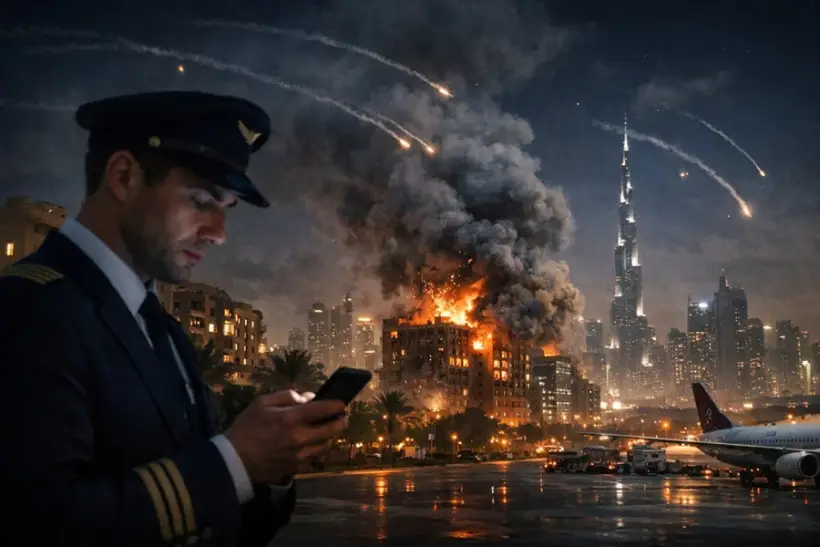
In Dubai, an Emirates cabin crew member was arrested after sending a photo to a closed WhatsApp chat. The image showed a smoking building after an Iranian drone strike. He sent it to colleagues simply to ask whether it was safe to go to work that day.
What is known about the Dubai Emirates arrest
The core account comes from Detained in Dubai, which said the crew member was detained after sharing the image in a private WhatsApp group during discussion of safety conditions following a drone incident. That version was later repeated by several English-language outlets covering detentions of airline workers and foreign nationals in the UAE during the recent period of Iranian drone and missile attacks. As of publication, no public charge sheet, court filing or detailed official case summary has been released that independently sets out the facts of this specific prosecution.
According to those reports, the man was first called in for questioning and then detained. The reported trigger was not a public social-media post but the transmission of an image inside a private chat. That detail turned the case into a broader test of digital privacy, information control and legal risk for expatriates working in the UAE.
UAE rules on sharing drone strike images and incident footage
The official line from UAE authorities was already strict before the reported arrest. On March 6, 2026, the state news agency said Attorney-General Hamad Saif Al Shamsi had warned against photographing, publishing or circulating images and videos of incident locations or damage caused by falling projectiles and shrapnel. He said such material could trigger public panic and misrepresent the actual situation in the country.
The Public Prosecution later issued a separate warning against publishing or circulating rumours, false information or unverified material from unknown sources through social platforms or other technological means. Its statement added that legal accountability could apply not only to original creators but also to people who share or repost such content. That language is significant because it expands legal exposure beyond public posting and into the wider act of digital distribution.
Which UAE cybercrime provisions may apply
The main legal framework is Federal Decree-Law No. 34 of 2021 on Combatting Rumors and Cybercrimes, which took effect on January 2, 2022. The UAE government’s official platforms describe it as a comprehensive framework for misuse of digital networks, online platforms and information technology, including conduct that may affect public order, state security and confidence in public institutions.
The law’s published text states in Article 22 that anyone who uses a network or information technology to provide information, data, reports or documents not authorized for publication or circulation, where that harms the interests of the UAE, its agencies, or its reputation, can face temporary imprisonment. Article 23 addresses dissemination of information, news or images that would endanger UAE security or harm public order, with temporary imprisonment and a fine of up to AED 1 million. Article 25 sets penalties of up to five years in prison and fines of up to AED 500,000 for publishing material intended to damage the reputation, prestige or dignity of the state or its institutions.
Did authorities track private WhatsApp messages
The most explosive element in the case is the claim that police identified the message through electronic surveillance even though it was sent inside a private chat. That allegation comes from the rights group’s account and has been echoed in later media reports, but there is no public technical explanation, formal official acknowledgment of access to this specific WhatsApp exchange, or open court record proving how the message was detected. The most accurate formulation, based on currently available evidence, is that this is a serious allegation rather than an independently verified finding.
What is already clear from the official record is the broader legal principle. UAE prosecutors have publicly warned against circulating sensitive incident imagery and unverified information, and the cybercrime law is drafted broadly enough to cover a wide range of digital transmission behavior. In practical terms, that means the private nature of a conversation does not itself guarantee immunity if authorities later obtain the material and decide it falls within national-security or public-order restrictions.
Why the case matters for expats, tourists and airline staff
The story matters beyond one arrest because it affects a much larger population of expatriates, tourists and aviation workers living in or passing through the UAE. During a period of regional conflict, the country tightened control over wartime and security-related information, raising legal exposure even for routine messages sent to colleagues, relatives or friends rather than for political commentary or media publication.
For airline personnel, the risk is especially acute. Cabin crew and airport workers operate near aviation infrastructure and transport nodes where any image of debris, smoke or damage may be treated as sensitive. Combined with the UAE’s expansive cybercrime provisions, that creates legal vulnerability not only for public-facing communication but also for informal internal exchanges outside official reporting channels.
As International Investment experts report, the reported arrest of an Emirates crew member shows how sharply the UAE’s digital-information rules can collide with everyday behavior: even a closed-message exchange about personal safety may attract criminal scrutiny if authorities conclude that the content touches state security, public order or the reputation of the country.
FAQ
Can someone in the UAE face charges for sharing incident photos privately?
Yes, potentially. Official warnings and the cybercrime law focus on publication, circulation and reposting of sensitive or unverified material, and the legal risk is not limited to open social-media posting.
Did UAE authorities officially confirm access to a private WhatsApp chat?
No public official confirmation has been located. That claim comes from a rights-group account and media repetition of that account, not from an open technical or judicial record.
What penalties can apply under the UAE cybercrime law?
Depending on the provision used, penalties can include temporary imprisonment, prison terms of up to five years and fines that can reach AED 1 million.
Why did UAE authorities issue public warnings in March 2026?
Officials said sharing images of incident locations, damage, rumours or unverified information could create panic, distort the real situation and harm security and stability.
Why is this case especially relevant to expats and airline workers?
Because they are often physically close to airports, transport hubs and affected areas, making them more likely to record or forward sensitive material during fast-moving security incidents.