











EU Moves to Ease Jet Fuel Crunch
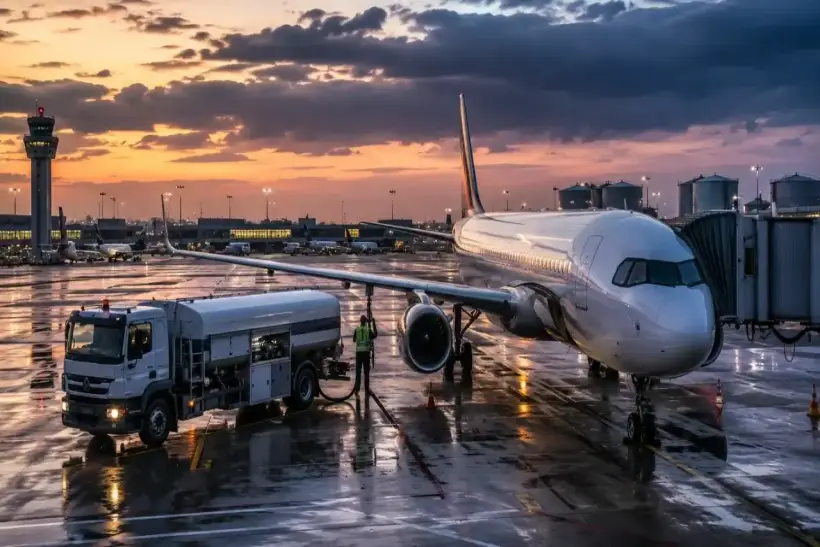
The European Union has introduced new measures for aviation as the risk of a jet-fuel crunch rises before the summer travel season. Bloomberg reported that Brussels is allowing airlines to use Jet-A, the fuel standard normally used in the US, instead of Europe’s Jet-A1 standard as long as safety requirements are met. The move gives carriers another supply option as Europe’s fuel market faces pressure from disrupted energy flows linked to the Middle East conflict.
Jet-A and Jet-A1 are both turbine fuels for commercial aviation, but they differ in technical specifications, especially freezing point. Jet-A1 is normally used in Europe and is designed for lower-temperature performance, while Jet-A is widely used in the US. The European Union Aviation Safety Agency said operators must understand the differences between the fuels, particularly when operating in cold conditions and at high altitude.
Fuel risk threatens the summer schedule
The European Commission held a meeting of the Oil Coordination Group on May 7 with experts from EU countries and the Energy Community secretariat. The meeting focused on oil security of supply and EU-level coordination as the Middle East conflict continues to affect energy markets.
The issue is especially sensitive for aviation because the summer season puts maximum strain on airports, aircraft and fuel infrastructure. Even a limited supply disruption can increase costs, force route changes, delay flights and squeeze airlines already facing elevated fuel bills.
Europe depends on imported jet fuel
Bloomberg earlier reported that about 40% of the EU’s jet fuel is imported and that half of those volumes pass through the Strait of Hormuz. That makes European aviation vulnerable to shipping disruptions as well as higher insurance, logistics and crude-product costs.
The Strait of Hormuz is one of the world’s most important routes for oil and petroleum products. When traffic through it is disrupted, European airlines face not only higher prices but also the physical rerouting of supply. In that context, permission to use the US fuel standard is a practical attempt to widen the available market.
A fuel observatory will map bottlenecks
Under its AccelerateEU plan, the European Commission said a new Fuel Observatory will map supply, prioritize alternative jet-fuel sourcing and optimize distribution. The Commission also plans to assess European refining capacity and measures to ensure that domestic refineries are used as fully as possible.
In this context, a fuel observatory means a mechanism for tracking stocks, supply routes and risks across countries and airports. That matters because shortages rarely hit evenly. One airport may operate normally while another faces local constraints because of logistics, contracts or infrastructure.
Airports back the EU response
ACI Europe, the European airports association, said no airport in Europe is currently facing jet-fuel shortages and flight operations are proceeding normally. Still, the group supported the Commission’s plan as an appropriate response to possible shortage risks while uncertainty remains over safe and stable passage through the Strait of Hormuz.
That position shows the industry is trying to avoid panic while preparing for a worse scenario. Airports need early visibility on possible fuel bottlenecks because fuel supply is tied to scheduling, ground handling, slots and flight redistribution.
Passenger rights remain in force
The Financial Times reported that EU transport commissioner Apostolos Tzitzikostas warned airlines that cancellations caused by higher fuel prices would not exempt them from compensating passengers. He said expensive kerosene is part of the normal commercial risk of operating an airline and does not qualify as an extraordinary circumstance under EU rules.
That leaves airlines with limited room to maneuver. If a flight is cancelled for economic reasons, the carrier risks losing revenue while also facing compensation claims, passenger rebooking costs and possible pressure on valuable airport slots. Airlines are therefore more likely to raise fares, adjust frequencies and reshape routes before resorting to broad cancellations.
IAG downplays the risk of summer disruption
The National reported that International Airlines Group, the owner of British Airways, Iberia, Aer Lingus, Vueling and LEVEL, does not see the fuel situation as a reason to expect disruption in its main markets this summer. The group said it had already purchased about 70% of its annual fuel needs and had local arrangements at key hubs.
Even where physical supply looks manageable, the financial pressure is significant. The Guardian reported that IAG now expects its annual fuel bill to reach about €9 billion, compared with a previous estimate of around €7.1 billion, and plans to offset part of the increase through fares and cost control.
Ticket prices become the main transmission channel
If the fuel squeeze does not lead to widespread cancellations, passengers are likely to feel it mainly through fares. Jet fuel directly affects the cost of operating a flight, especially on long-haul routes where fuel is a major expense. Airlines can raise ticket prices, add fuel surcharges, reduce low-margin services and shift capacity to routes with stronger demand.
For consumers, that means less favorable booking conditions in summer 2026. Flights may still operate, but cheap seats are likely to become scarcer, especially on popular international routes and in markets with limited competition.
Sustainable aviation fuel cannot solve the immediate crunch
ReFuelEU Aviation, the EU regulation for sustainable aviation fuel, requires fuel suppliers to gradually increase the share of sustainable fuel blended with conventional aviation fuel. Sustainable aviation fuel is made from renewable or lower-carbon feedstocks and is designed to reduce aviation emissions over the long term.
That system cannot quickly replace conventional jet fuel in a supply crisis. Production remains limited, costs are higher and infrastructure scales gradually. That is why the EU’s immediate response focuses on distribution, monitoring, alternative sourcing and fuel-standard flexibility rather than rapid decarbonization.
Aviation enters summer under tighter oversight
The EU’s Jet-A decision shows that Brussels is willing to widen technical options temporarily to protect air connectivity. At the same time, the bloc is not relaxing passenger-rights obligations or giving airlines automatic immunity from compensation rules. The crisis is therefore two-sided: carriers must secure fuel, preserve schedules and comply with consumer law.
As experts at International Investment report, the EU measures reduce the risk of a sudden fuel disruption but do not remove European aviation’s underlying vulnerability: dependence on imported jet fuel, costly logistics and geopolitical routes. The critical conclusion is that passengers may not see mass cancellations, but they are likely to face higher fares and a less flexible route network. For Europe, aviation energy security is becoming a matter of economic security, not just transport policy.
FAQ in English
What did the EU decide on jet fuel?
The EU is allowing airlines to use Jet-A, a fuel standard common in the US, as an additional option alongside Europe’s Jet-A1 standard, provided safety requirements are met.
Why is Europe facing a jet-fuel risk?
The risk stems from the Middle East conflict, disrupted energy flows, EU dependence on imported jet fuel and uncertainty around shipments through the Strait of Hormuz.
How does Jet-A differ from Jet-A1?
Both are turbine fuels used in aviation, but Jet-A1 has a lower freezing point and is normally used in Europe, while Jet-A is widely used in the US.
Will airlines cancel flights in summer 2026?
Mass cancellations are not the base case, but airlines may adjust schedules, cut less profitable routes and raise fares if fuel pressure persists.
Must airlines compensate passengers for fuel-related cancellations?
Yes. The European Commission’s position is that higher fuel prices alone are not an extraordinary circumstance that exempts airlines from passenger compensation rules.