












Austria Extends Schengen Border Checks
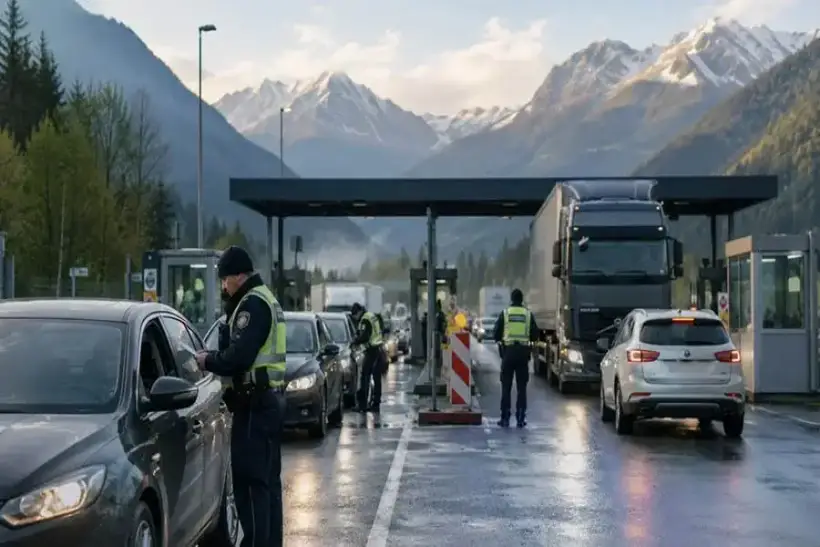
Austria will keep temporary checks at its internal Schengen borders with Slovakia, Czechia, Hungary and Slovenia until at least 15 June 2026, adding to a widening patchwork of controls across Europe’s passport-free travel area. The measure does not close borders, but it raises the likelihood of document checks, roadside stops and closer scrutiny of short-stay limits for non-EU travellers.
Austria keeps controls on four border corridors
Vienna has prolonged checks at land borders with Czechia, Hungary and Slovenia, as well as land and river borders with Slovakia. According to a 13 May report by VisaHQ, the measure will remain in force until 15 June 2026 and will mainly affect road, coach, selected rail and logistics routes across Central Europe.
The European Commission register says Austria cited continuing threats linked to irregular migration through the Balkan routes, pressure on the asylum reception system and basic services, Russia’s war against Ukraine, and the security situation in the Middle East aggravated by terrorist groups. In legal terms, the measure is a temporary reintroduction of internal border control inside the Schengen Area, where borders are normally crossed without passport checks.
Schengen rules allow checks only as an exception
The Schengen Borders Code permits member states to temporarily restore internal border controls in the event of a serious threat to public policy or internal security. The measure must remain exceptional, be used as a last resort, be limited in time and scope, and respect the principles of necessity and proportionality.
For foreseeable threats, including major events or persistent security risks, controls may be introduced for up to six months and renewed for further six-month periods. Once controls have been in place for six months, the state concerned must provide a more detailed risk assessment in each new notification, and longer use triggers reporting obligations to EU institutions.
Europe’s internal border map is getting denser
Austria is part of a broader European trend. The current list of temporary internal controls also includes Germany, France, Italy, Poland, Denmark, Norway, Sweden, the Netherlands, Slovenia and Switzerland, with stated reasons ranging from irregular migration and migrant smuggling to sabotage threats, terrorism, organised crime and major international events.
Germany is keeping checks on borders with France, Luxembourg, Belgium, the Netherlands, Denmark, Austria, Switzerland, Czechia and Poland until 15 September 2026. France has extended controls until 31 October 2026 across all internal borders, including land, air and sea routes. Norway and Sweden have measures in place until 11 November 2026, while Poland’s controls run until 1 October 2026.
The Balkan route remains a political trigger
Frontex, the EU border agency, reported that detections of irregular border crossings at the EU’s external borders fell by 26% in 2025 to almost 178,000, the lowest level since 2021. It also noted a marked fall on the Western Balkan route, while warning that the situation at Europe’s borders remains uncertain.
That tension is at the heart of Austria’s decision. The headline migration numbers are falling, but Central European governments continue to cite smuggling networks, secondary movements of asylum seekers and internal-security risks as grounds for keeping checks in place.
Travellers face more document discipline
For EU and Schengen citizens, the practical impact is the need to carry a passport or national identity card when crossing into Austria. For non-EU nationals, including tourists, investors, corporate travellers and residence-permit holders, the safer approach is to carry a passport, visa where required, residence card, invitation, accommodation proof or evidence of the trip’s purpose.
The checks do not change the 90-days-in-any-180-day rule for short stays by non-EU and non-Schengen nationals. They also do not replace visa rules. They do, however, increase the chance that the length and legality of a stay may be checked not only at the external Schengen border, but also inside Europe.
Digital borders add another layer
The EU Entry/Exit System, a digital database recording external border crossings by non-EU short-stay travellers, began phased operations on 12 October 2025 and became fully operational on 10 April 2026. It replaces manual passport stamps with digital records of entries, exits and refusals of entry, while also recording facial images, fingerprints and travel-document data.
Austria’s internal checks are not part of that system because they take place inside the Schengen zone, not at its external frontier. For travellers, however, the combined effect is clearer: entry data are recorded electronically at the external border, while documents, route and lawful stay can still be checked inside the zone.
Business routes in Central Europe face added friction
The most visible impact may come not at airports, but on land corridors linking Vienna, Bratislava, Brno, Prague, Budapest, Ljubljana and nearby industrial zones. For passengers, the risk is selective delays. For employers, it means tighter pre-trip document checks. For logistics firms, it adds uncertainty to route planning.
The controls are especially relevant for companies relying on frequent deliveries, cross-border work and short business trips. Even selective checks can create cumulative costs when they coincide with the tourist season, roadworks, public holidays or large events in neighbouring countries.
As International Investment experts report, Austria’s extension shows that the Schengen Area is entering a phase of managed but increasingly visible internal fragmentation: free movement remains legally intact, but travellers and businesses must allow for more documentation, more time and more regulatory uncertainty. The critical risk is that temporary checks become a routine migration and security-policy tool, even though the Schengen model was built on treating such restrictions as exceptional.
FAQ
Why has Austria extended Schengen border checks?
Austria cites irregular migration, the Balkan route, pressure on the asylum system, Russia’s war against Ukraine and security risks linked to the Middle East.
How long will Austria’s checks remain in place?
The current Austrian controls at borders with Slovakia, Czechia, Hungary and Slovenia are scheduled to run until 15 June 2026.
Does this mean Austria has closed its borders?
No. The borders remain open, but travellers may face temporary and selective document checks.
Who can be checked at the border?
Both EU citizens and non-EU nationals can be checked. EU citizens should carry a passport or national identity card, while non-EU nationals should carry a passport, visa or residence permit where required.
Does this affect the 90/180-day Schengen rule?
The rule itself does not change, but the chance of a lawful-stay check inside the Schengen Area is higher.
What is the EU Entry/Exit System?
It is a digital system that records entries and exits of non-EU short-stay travellers at external Schengen borders, replacing manual passport stamps with electronic records and biometric data.