












Philippine Developers Turn Defensive
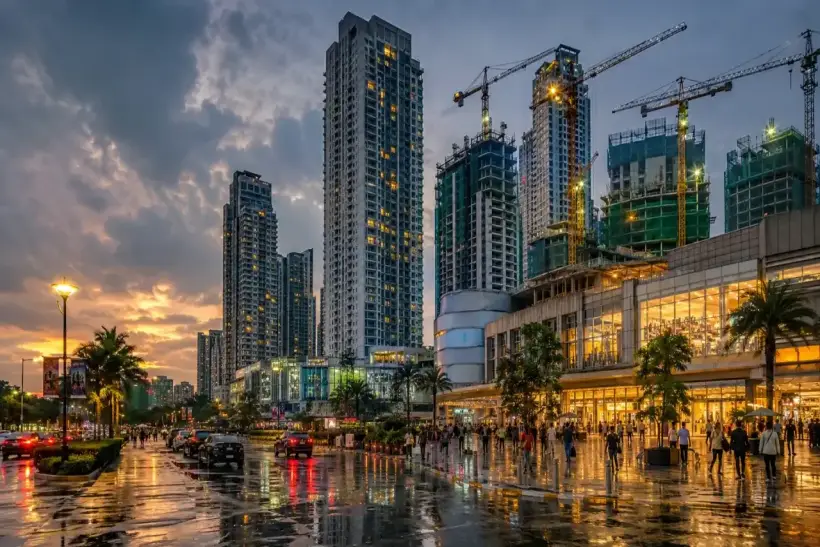
Manila’s property market is entering a more cautious phase as the Middle East crisis adds pressure to household income, construction costs and interest rates at a time when the capital’s condominium market is already dealing with excess supply and weak demand.
Manila housing faces a new external shock
Major Philippine developers are adjusting strategy as the macroeconomic backdrop deteriorates. The Business Times reported on May 11, 2026, that Manila’s residential and retail segments remain vulnerable after the pandemic, with condominium sales in the first quarter of 2026 on course for record-low take-up rates, according to Colliers Philippines, while developers face higher construction costs, elevated borrowing costs and weaker purchasing power linked to the Middle East crisis.
For the industry, the shift points to a move away from aggressive launches and toward cash-flow protection. In practice, that usually means fewer new projects, longer payment terms, discounts, greater focus on completed inventory and more selective capital allocation. The pressure is most visible in the National Capital Region, where apartment demand has long depended on middle-income buyers, investors, renters and remittances from Filipinos working overseas.
Remittances have become a property-market risk
The link between the Middle East crisis and Philippine real estate runs through labor markets and remittances. The Bangko Sentral ng Pilipinas, the country’s central bank, records overseas workers’ cash remittances as a key source of household income: total inflows reached $35.63 billion in 2025, while January–February 2026 remittances rose to $5.81 billion from $5.63 billion a year earlier.
The Middle East remains a major destination for Filipino workers. Inquirer reported that remittances from the region totaled about $6.5 billion in 2025, roughly 18% of all inflows, with more than 2.4 million Filipinos working there. The report also cited a government scenario in which remittances could fall sharply under a full deployment ban and large-scale repatriation.
For developers, this is a direct demand risk. Remittances are often used for down payments, mortgage servicing and apartment purchases by migrant families. Any disruption to overseas employment, evacuation of workers or rise in household expenses can quickly affect mid-market housing sales.
Condo oversupply weighs on prices and sales
Manila’s condominium market was already overloaded before the latest geopolitical shock. BusinessWorld, citing Colliers, reported that residential vacancy in Metro Manila could rise to 25% in 2026 as unsold units in the mid-income and lower mid-income segments continue to weigh on the market. Vacancy ended 2025 at 24.7%, up from 23.9% in 2024.
The weakest point is the lower mid-income segment. In the first quarter of 2026, BusinessWorld reported, citing a Colliers market report, that cancellations in the 3.6 million to 7 million Philippine peso price bracket reached 2,024 units, exceeding take-up of 1,720 units. The affordable segment was stronger, with 1,629 units taken up against 728 cancellations.
That pattern suggests a purchasing-power problem, not merely excess supply. Buyers who entered payment plans when rates were lower and recovery expectations were stronger now face higher living costs, more expensive financing and uncertainty over income. For developers, this means slower capital turnover and a harder task selling completed inventory without openly cutting headline prices.
Inflation and rates reshape buyer calculations
The macroeconomic backdrop weakened almost simultaneously with housing demand. The Philippine Statistics Authority said headline inflation accelerated to 7.2% in April 2026 from 4.1% in March, bringing the January–April average to 3.9%. A year earlier, April inflation stood at just 1.4%.
The Bangko Sentral ng Pilipinas listed the target reverse repurchase rate at 4.50% as of May 12, 2026, with the overnight lending rate at 5.00% and the overnight deposit rate at 4.00%. For homebuyers, that means higher debt-servicing costs; for developers, it means more expensive capital and greater caution before launching new phases.
The broader economy also slowed. The Philippine Statistics Authority estimated first-quarter 2026 gross domestic product growth at 2.8% year on year, while gross capital formation declined 3.3%. That leaves less room for a quick recovery in sectors tied to consumer confidence and long-term credit.
Retail property is steadier but not immune
Retail property looks more resilient than housing, but it is also exposed to the shock. Colliers’ 2026 Philippine property outlook said mall refurbishment, tenant-mix changes and experience-led retail formats remain central to competitiveness, while some future supply is shifting outside Metro Manila.
Manila malls depend not only on rents but also on foot traffic, consumer spending and the ability of international brands to expand despite higher logistics costs. If the Middle East crisis keeps fuel and transport costs elevated, tenants may become more cautious about store openings, while mall owners may need to offer more flexible lease terms.
Developers move to protect balance sheets
The defensive turn among Philippine developers does not mean the market has stopped. It signals a transition from volume-led growth to risk management. Companies with strong balance sheets, land banks and diversified portfolios should be better placed to endure a period of weak sales than smaller players tied to a single segment or location.
Buyers are gaining more room to negotiate. Discounts, longer payment terms, completed units and rent-to-own structures are becoming competitive tools. Yet the fundamental risk remains: if inflation and borrowing costs stay high, demand recovery will depend less on promotions and more on real income growth.
as International Investment experts report, the main risk for Philippine real estate is that an external shock has arrived while the domestic market is still digesting excess supply. Manila’s property market does not look structurally broken, but its recovery is becoming slower and more expensive: developers may have to sacrifice either sales speed or margins, while buyers need to focus less on promised yields and more on liquidity, payment schedules and income resilience.