







 How Ukraine’s New-Build Housing Market Has Changed Over Four Years
 European Prime Rents Rise as Property Yields Turn Higher
 The Most Expensive Airlines in Europe in 2026
 Housing Prices in Italy Reach a Two-Year High
 Travellers Increasingly Choose Cooler Scandinavia
 Serbia Property Sales Decline as Transaction Value Rises
Slovakia Loses Investor Confidence
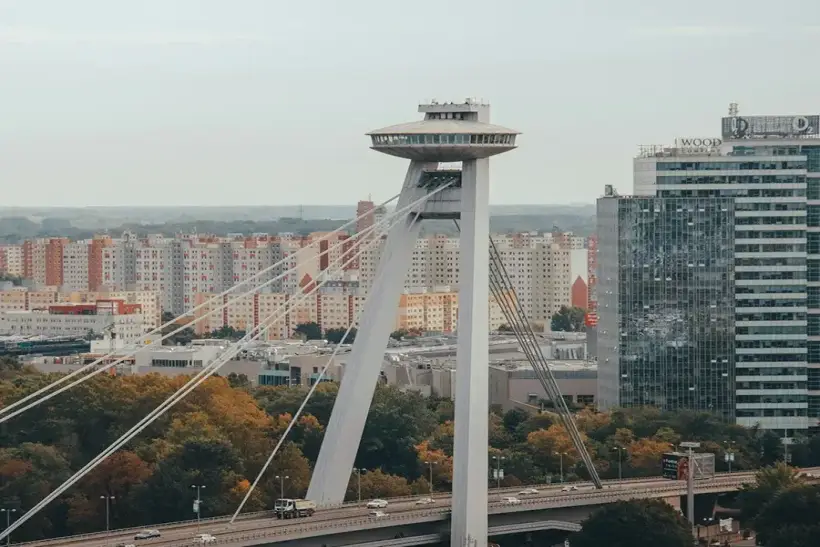
Slovakia is facing its weakest foreign-investor sentiment since the start of the pandemic, with 40% of surveyed European companies saying they would no longer choose the country for investment today. The problem is not a single indicator but a combination of weak growth, higher taxes, unpredictable policy, rising labour costs and heavy dependence on the automotive industry
Foreign companies are becoming more cautious
For decades, Slovakia’s investment model rested on a clear formula: European Union and eurozone membership, proximity to Germany and Austria, a strong industrial base, skilled labour and a deep automotive cluster. That model still works, but its advantage is visibly weakening.
The Slovak Spectator, citing the business-climate survey, reported that 40% of foreign firms would no longer invest in Slovakia. The primary release of the Slovakia 2026 Business Survey shows that European investor sentiment is at its weakest in recent years, with expectations for the overall economy close to the level seen in March 2020 at the outbreak of the pandemic. The survey covered 112 companies operating in Slovakia, 91% of which were owned by entities from other European countries.
Only 4% of firms call the economy good
Business assessments have turned sharply negative. Only 4% of companies rated Slovakia’s current economic situation as good, 35% called it satisfactory and 61% described it as bad. Expectations are even weaker: only 3% expect the economy to improve, while 77% expect it to deteriorate.
At the company level, the picture is less severe but still cautious. Some 22% of respondents expect their own business situation to improve, 45% expect stagnation and 33% expect deterioration. That distinction matters: foreign investors do not necessarily see their Slovak assets as failing, but they are increasingly negative about the environment in which those assets operate.
Investment plans remain subdued
The survey shows that new investment momentum has not returned. Sales growth is expected by 31% of companies, while 34% expect a decline. Some 24% plan to increase employment, while 25% plan cuts. Investment is set to rise at 28% of firms, but 32% plan to reduce it.
These numbers do not imply a mass capital exit. They point to a more dangerous process: foreign companies may increasingly treat Slovakia as a place to maintain existing operations rather than an obvious destination for expansion. For a country whose industrial modernization has depended heavily on foreign capital, that is a strategic warning.
Economic policy is the main complaint
Companies identified economic-policy conditions as the biggest risk, cited by 60% of respondents. Almost as important were wage costs at 59%, demand developments at 56% and shortages of skilled labour at 47%. Another 63% of companies reported rising costs because of tariffs, logistics or regulatory requirements.
This is not just a list of grievances. For investors, predictability often matters more than a headline tax rate. If a company cannot see where taxes, labour costs, subsidies, energy rules and administrative requirements will be in a year, it delays expansion or chooses another country.
Fiscal consolidation has added pressure
Fiscal policy has become one source of weaker sentiment. In 2024, Slovakia’s parliament approved a consolidation package that the government projected would save about €2.7 billion. KPMG noted that the package included a higher base for social-security contributions, tax changes and a new financial-transactions tax, all of which could increase employer costs and administrative burdens.
Businesses also had to prepare for the financial-transactions tax that took effect in April 2025. DLA Piper said the tax rates include 0.40% on outgoing payments with a €40 cap per transaction, 0.80% on cash withdrawals with no cap, €2 annually on card payments and 0.40% on recharged expenses with no cap.
Growth is too weak for a new cycle
The macroeconomic backdrop does not help long-term investment decisions. The European Commission forecasts Slovakia’s real gross domestic product growth at 1.0% in 2026 after 0.8% in 2025, before a rise to 1.4% in 2027. The Commission said private consumption is slowing because of fiscal consolidation, while trade activity is being hit by tariffs and subdued external demand.
For investors, that is a difficult combination: costs are rising, regulation is more complex and domestic or external demand is not strong enough to offset the pressure. In that environment, new factories, research centers or logistics projects require a higher level of certainty.
Automotive dependence has become a vulnerability
Slovakia remains one of Europe’s most automotive-driven economies. SARIO says the automotive industry accounts for 46.5% of industrial-production revenues and 10.4% of gross domestic product, with about 170,000 people employed directly by carmakers and Tier 1 suppliers and 255,000 directly and indirectly.
That specialization was once Slovakia’s main advantage, but it is now also a risk. The transition to electric vehicles, tariff disputes, weak European demand and dependence on German industry expose the country to decisions made outside its borders. If new electric-mobility investment arrives more slowly than expected, Slovakia’s industrial model loses momentum.
Labour is becoming more expensive and scarce
Slovakia no longer competes mainly on low labour costs. In the foreign-company survey, expected labour-cost growth for 2026 averaged 7.2%, while almost half of respondents reported shortages of qualified labour.
Radio Slovakia International, citing economists, reported that the country will increasingly need foreign workers: low birth rates and the outflow of skilled people are shrinking the workforce, and OECD data show that by 2054 there could be about 63 people of retirement age for every 100 working-age residents.
Investors still see strengths, but want stability
Slovakia has not lost all competitive advantages. Advantage Austria, publishing the same business-climate findings, noted that around two-thirds of surveyed firms would still invest in the country again. That means the investor base has not collapsed.
Companies still value EU membership, infrastructure, the quality of local suppliers, energy infrastructure and payment discipline. But these strengths no longer fully offset concerns about unpredictable economic policy, weak public administration, public-procurement transparency, the tax burden and anti-corruption performance.
Regulation has become a competitiveness issue
The European Commission’s country report says Slovakia faces structural challenges that undermine productivity growth and economic potential. It names the unpredictable regulatory environment, administrative burdens and fragmented governance as factors that hurt the country’s ability to implement investment projects and diversify the economy.
For investors, that becomes a practical problem. A project can look attractive financially but still be too slow or risky to execute. Permitting delays, rule changes, difficulty accessing national or EU funding, administrative procedures and poor coordination between authorities can erase part of the country’s advantages in geography and labour.
Not all indicators point to failure
The picture is not one of complete investment collapse. The European Investment Bank’s EIBIS 2025 survey found that 88% of Slovak firms invested in the last financial year, matching the EU average, while only 3.3% were finance-constrained, one of the lowest shares recorded. It also found that 82% of Slovak firms were engaged in international trade and 35% used generative artificial intelligence.
That makes the situation more complex. Slovak firms continue to invest and adopt technology, but confidence is weakening. This is not a crisis of current operations; it is a risk to the next capital cycle. If confidence in rules is not restored, the next wave of investment may go to Czechia, Poland, Hungary, Romania or Southern Europe.
Direct investment has become volatile
Financial data confirm the caution. CEIC, using National Bank of Slovakia data, shows that foreign direct investment equaled just 0.1% of nominal GDP in December 2025, down from 1.4% in the previous quarter. The historical range since 2008 has been wide, from minus 5.1% of GDP in September 2020 to 10.5% in March 2009.
Trading Economics, also citing the National Bank of Slovakia, shows that foreign direct investment in Slovakia decreased by €480.8 million in February 2026 after an increase of €205.5 million a month earlier.
Slovakia risks becoming a maintenance location
The core risk is a change in status. Foreign companies may not close factories and offices because they have already invested capital, built supply chains and trained workers. But new projects, expansions, research centers and high-tech production lines may go elsewhere if rules look more stable, labour access is easier and tax changes are less abrupt.
That matters because long-term competitiveness depends not only on having factories, but on which functions stay in the country. If Slovakia keeps assembly while losing research, software, battery technology, electronic components and management roles, its position in the value chain will weaken.
The investment brand needs a reset
Slovakia still has important assets: the euro, geography, an industrial base, suppliers, energy infrastructure and experience with major foreign investors. But those are no longer enough in the new competition for capital. Regional rivals are offering subsidies, industrial parks, faster permits, tax stability, access to workers and more aggressive investment promotion.
As International Investment experts report, the critical risk for Slovakia is not that 40% of firms are dissatisfied with today’s conditions, but that dissatisfaction may move from surveys into investment budgets. If the government does not restore predictability in the tax and regulatory environment, the country may keep old factories but lose the new projects that will define Central Europe’s industrial map for the next decade.
FAQ on foreign investment in Slovakia
Why are foreign companies less positive about Slovakia
The main reasons are unpredictable economic policy, higher tax and administrative burdens, rising labour costs, shortages of skilled workers and weak external demand. Companies also point to public-administration efficiency, procurement transparency and anti-corruption concerns.
How many firms would no longer invest in Slovakia
According to the Slovakia 2026 Business Survey, 40% of surveyed companies said they would no longer choose Slovakia for investment today. At the same time, 59% said they would still choose the country again.
Does this mean investors are leaving Slovakia
No. It signals weaker confidence and slower new investment rather than a mass exit. Many companies remain in Slovakia but may limit expansion, delay projects or choose other markets for new investment.
What strengths does Slovakia still have
Slovakia retains EU and eurozone membership, a strategic Central European location, a strong industrial base, an automotive cluster, quality suppliers and relatively good energy infrastructure.
Why is the automotive industry important
The automotive sector is Slovakia’s largest industrial pillar and a major source of foreign investment. But heavy dependence on it makes the economy vulnerable to tariffs, weak demand, the electric-vehicle transition and decisions by large international manufacturers.
What does Slovakia need to restore investor confidence
The key conditions are predictable tax policy, lower administrative burden, effective use of EU funds, transparent public procurement, stronger anti-corruption measures, faster permitting and a long-term strategy for labour and innovation.