










Nuuk Opens the Arctic
Nuuk’s new international airport has turned Greenland’s capital from a hard-to-reach Arctic city into a direct entry point for tourists, diplomats and investors. The surge of interest in the island coincides with renewed US attention to the Arctic, expanding air links and domestic debates over whether a small economy can absorb more foreign capital and political pressure.
New airport redraws Greenland’s map
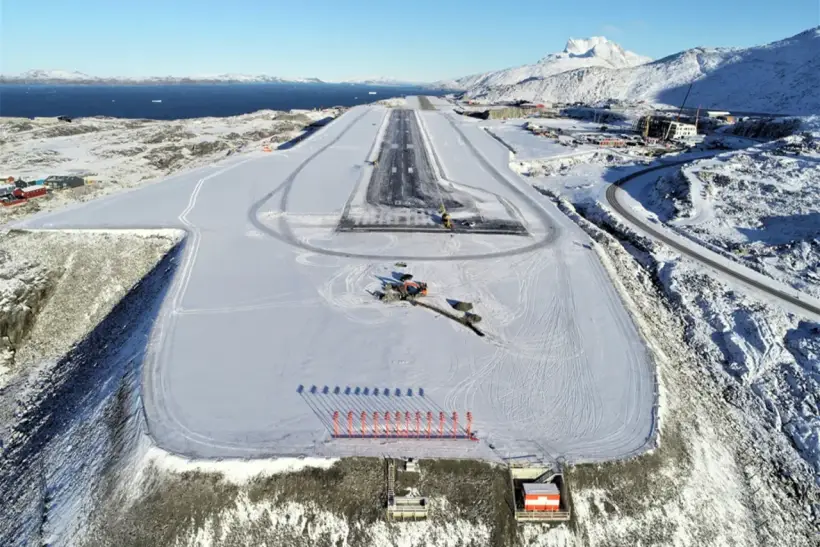
Nuuk International Airport has become Greenland’s most important infrastructure project in years. After opening on November 28, 2024, the capital gained a 2,200-meter runway capable of handling larger aircraft on North Atlantic routes. Before that, most international passengers flew into Kangerlussuaq, a former US military base, and then transferred to smaller aircraft to reach Nuuk and other towns.
Bloomberg reported that the new airport is already attracting not only tourists but also diplomats, political activists and supporters of Donald Trump, for whom Greenland has become a symbol of US ambitions in the Arctic. For an island of about 57,000 people, this means a sharp acceleration of outside attention that until recently was mostly limited to military, scientific and resource issues.
The airport has changed more than logistics. It has altered the island’s political geography. Distance used to act as a natural filter for tourists, businesses and officials. Now Greenland’s capital is more accessible to direct flights from North America and Europe, creating economic opportunities while also increasing exposure to external interests.
Direct US flights bring Nuuk closer
United Airlines launched direct service between Newark and Nuuk, becoming the first US carrier to operate a scheduled nonstop route to Greenland. The seasonal route gives American travelers access to the island without connecting through Iceland or Denmark. The airline has already confirmed that the service will return in summer 2026.
For tourism, this is a structural shift. A trip to Greenland once required difficult connections and was often viewed as an expedition. The island is now moving onto the route map of premium mass tourism: short Arctic trips, cruises, hiking, whale watching, glaciers and northern lights are becoming more accessible to affluent US travelers.
But a direct flight does not mean the whole infrastructure is ready. Nuuk has limited hotel capacity, weather can disrupt schedules and Greenland has no full road network between towns. Domestic travel still depends on aviation, sea transport and weather windows.
Airport becomes a geopolitical tool
Greenland is an autonomous territory within the Kingdom of Denmark, but its importance extends far beyond Danish-Greenlandic relations. The island sits between North America and Europe, controls important Arctic approaches and has mineral resources, including rare earth elements. Rare earth elements are metals critical for electronics, defense, batteries, wind turbines and high-tech manufacturing.
After Donald Trump’s return to the White House, Washington’s interest in Greenland again became one of the most sensitive issues in northern politics. The US is expanding its diplomatic presence, discussing economic projects and emphasizing the island’s strategic importance for North Atlantic and Arctic security.
Arctic Today reported that the opening of an expanded US diplomatic hub in Nuuk was met by protests against Trump’s ambition to increase American influence on the island. For local authorities, the situation creates a difficult balance: Greenland needs investment, connectivity and new markets, but society does not want to become the object of an external bargain between Washington, Copenhagen and large investors.
Tourism grows faster than infrastructure
Visit Greenland says Nuuk’s new airport is the first part of a broader transport transformation. Additional international airports in Ilulissat and Qaqortoq are expected to improve access to the west and south coasts. This could reduce the cost and complexity of travel and distribute visitor flows beyond the capital.
But growing tourism demand is already raising questions among residents and businesses. The Guardian reported that Greenland is debating how to protect nature, local communities and ownership from excessive dependence on foreign operators. The government has introduced new tourism rules to ensure that sensitive areas and key activities do not pass fully under outside control.
The issue is scale. Greenland wants to develop tourism as a source of income and jobs, but its natural environment is fragile and its settlements are small. Even a moderate increase in flights can sharply increase pressure on hotels, ports, tour companies, emergency services and utilities.
American tourists come for more than glaciers
Interest in Greenland has intensified not only because of nature. For some American travelers, the island has become a political symbol after Donald Trump’s statements about expanding US control over the territory. Such trips combine tourism, ideological interest and curiosity about a region now at the center of international debate.
For the local market, this flow is ambiguous. Visitors bring money to hotels, restaurants, guides and transport providers. But politicized tourism can increase tensions, especially if visitors treat Greenland not as a self-governing society but as an object of US strategy.
Greenlanders have long dealt with outside attention to mineral extraction, military infrastructure and Arctic routes. Now tourism has added another channel, making political presence more everyday through delegations, private visits, media attention and symbolic trips.
Diplomats use Nuuk’s new accessibility
The airport expansion matters not only for holidaymakers. For diplomats, military analysts, investors and international organizations, direct access to Nuuk reduces the cost and complexity of travel. It accelerates contacts with local authorities, businesses and civic groups.
European countries are also paying closer attention to Greenland. Amid competition among the US, China and Russia in the Arctic, the European Union is seeking to strengthen political and economic ties with the island. For Brussels, Greenland matters for northern security, raw materials, climate policy and maritime navigation.
This interest creates a new diplomatic burden for local institutions. Greenland’s government must manage relations with Denmark, the US, the European Union, investors and its own public, which closely watches questions of sovereignty and the distribution of economic benefits.
Economy gets an opportunity and a dependency risk
Tourism can help Greenland diversify its economy. Diversification means reducing dependence on one or several sources of income by developing new sectors. For an island where fisheries, Danish subsidies and a small domestic market play major roles, new air links open the way for a broader services economy.
Nordic Investment Bank has said the new airport should strengthen global connectivity, trade and tourism, while local companies are preparing for the arrival of larger passenger groups. For small businesses, that means new orders, seasonal employment and a chance to sell services directly to foreign visitors.
But dependence on tourism may become a new vulnerability. Arctic tourism is sensitive to weather, airfares, insurance costs, geopolitical risk and income cycles in the US and Europe. If visitor numbers grow faster than local capacity, housing, service and land prices could increase social pressure.
The Arctic is closer, but not easier
The new airport does not remove Greenland’s harsh conditions. Weather remains the main constraint: fog, wind, snow and rapidly changing visibility can disrupt schedules even with modern infrastructure. For travelers, that means flexible itineraries; for businesses, it means high service costs.
Infrastructure outside the capital remains fragmented. Most settlements are not connected by roads, so tourism depends on domestic flights, helicopters, boats and seasonal routes. New airports in Ilulissat and Qaqortoq should partly ease the problem, but they will not eliminate the island’s geographic complexity.
The Washington Post reported that American tourists are already testing Greenland’s tourism system, encountering limited accommodation and dependence on weather. For the local market, this is an early warning: demand has arrived faster than a fully developed service base.
What changes for investors and tourism businesses
In the coming years, the central question will not be whether tourists can fly to Nuuk, but whether Greenland can manage the new demand. Air links create a market, but hotels, guides, transport, emergency services, visitor centers, environmental rules and local participation will determine whether growth becomes sustainable.
For investors, the most promising areas include hotels, Arctic logistics, local tour operators, marine excursions, airport services and training programs for workers. But every project will face political sensitivity, strong environmental expectations and questions over local control.
For tourists, Greenland remains an expensive and complex destination despite the new flights. Direct access lowers the entry barrier, but it does not turn the island into a mass resort. Its appeal is tied to rarity, nature and culture, all of which can be damaged by excessive commercialization.
as reported by International Investment experts, Nuuk’s airport is not just a transport project but a new node of Arctic politics. It gives Greenland access to capital, tourists and diplomats, but it also reduces the protective role of remoteness. The main risk is that economic gains from tourism and foreign interest may be distributed unevenly, while political pressure grows faster than local institutions can build rules. For Greenland, the next few years will test whether it can use new accessibility without losing control over its own development.
FAQ on Nuuk airport and Greenland tourism
Why is Nuuk’s new airport important for Greenland?
The new airport can handle larger aircraft and direct international flights, making Greenland’s capital much easier to reach. It reduces reliance on transfers through the former military base at Kangerlussuaq and turns Nuuk into the island’s main gateway.
When did Nuuk International Airport open?
Nuuk International Airport opened on November 28, 2024. Its new 2,200-meter runway can support transatlantic routes.
Which direct flights connect the US and Greenland?
United Airlines operates a seasonal direct route between Newark and Nuuk. It is the first scheduled nonstop service by a US airline to Greenland.
Why is Greenland important to the United States?
Greenland has a strategic location between North America and Europe and is important for Arctic security, maritime routes and access to mineral resources. That is why the US is increasing diplomatic and economic attention to the island.
Is Greenland ready for more tourism?
Greenland is more accessible, but its infrastructure remains limited. The island has few hotels, challenging weather, no road network between towns and local authorities are trying to protect nature and resident interests from excessive outside commercialization.