







 Egypt Prepares New Law for Property Developers
 Young Japanese Buyers Turn to 50-Year Mortgages
 Argentina Narrows Tourism Gap as Arrivals Rise
 Seattle Luxury Housing Loses Its Former Momentum
 The World’s Strongest Passports for Travel, Living and Investment
 Russian Developers’ Debt Nearly Doubled in a Year
EU aviation industry calls for suspension of EES: queues and disruptions at airports across Europe
The Guardian
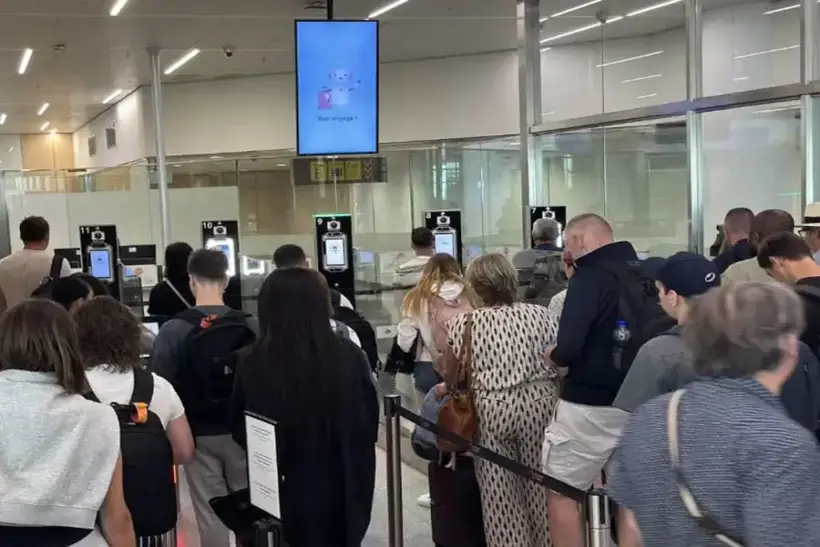
Leading aviation organizations have urged the European Commission to temporarily suspend the rollout of the EU Entry/Exit System (EES) during the peak summer travel season. The initiative is linked to overcrowding at airports and a sharp deterioration in passenger service, with travelers reportedly forced to wait in queues of up to five hours, according to The Guardian.
Crisis at European airports
A joint letter has been sent to European Commission President Ursula von der Leyen by three major aviation bodies — Airports Council International Europe (ACI Europe), Airlines for Europe (A4E), and the International Air Transport Association (IATA). They are calling for the suspension of the EU Entry/Exit System (EES) during periods of peak passenger traffic.
The organizations say the rollout of the system is already causing queues of up to five hours at border control in several European airports. Some flights are departing with empty seats as passengers fail to clear control in time for boarding, while flight delays are also being recorded. European airports are expected to handle around 40 million more passengers in July and August compared to previous months, increasing the risk of further disruption.
“We have reached a critical point,” the industry groups said. “Passengers are already being forced to queue for long periods outside terminal buildings and on open aprons because border control facilities cannot process arriving flights.”
The letter proposes allowing the temporary suspension of biometric checks when passenger flows exceed the capacity of border services. It stresses that border authorities, airports, and airlines are under constant pressure, and that urgent measures are needed before the situation worsens during the peak travel season.
Implementation of the EES in Europe
The EU Entry/Exit System (EES) began rolling out across the Schengen area in October 2025 and became mandatory on 10 April 2026. The system covers 25 of 27 EU member states, as well as Iceland, Norway, Liechtenstein, and Switzerland. It requires non-EU nationals to be registered at external borders, including the collection of biometric data such as fingerprints and photographs.
After the full rollout, data processing has proven slower than initially expected, leading to delays and increased pressure on airport terminals during peak periods. Significant disruptions have been reported in airports including Geneva, Lisbon, Malta, Brussels, and Amsterdam Schiphol. In Milan, around 100 passengers missed a flight to Manchester because they failed to complete border checks in time.
Experts report malfunctions in self-service kiosks, fingerprint recognition errors, and repeated registration requirements at different stages of the process. Airport operators attribute the difficulties to staffing shortages and technical challenges in deploying the system. Industry specialists also point to insufficient passenger awareness and the transitional nature of the rollout phase. Ryanair management has previously described the situation as a systemic failure in the implementation of new rules.
Suspension of biometric checks
Some European countries have already temporarily suspended or relaxed biometric checks under the EES framework. Greece has introduced a temporary suspension until September to ease pressure on border control during the peak tourist season.
In May, French police temporarily suspended additional checks at the port of Dover. The head of Rome airports noted in late June that suspending the system for non-EU citizens during the summer may be necessary to prevent serious disruption.
“Some international travelers are reconsidering their plans to visit Europe due to the prospect of excessive border delays,” the industry groups said. “This is undermining Europe’s reputation, particularly European tourism and transport infrastructure.”
Conclusion
Analysts at International Investment note that the challenges surrounding the implementation of the EES go beyond a technical upgrade of border control and reflect broader questions about the resilience of Europe’s passenger management system. The industry is struggling to cope even outside peak seasons, despite initial expectations that automation would streamline processes.
Although the program was developed over several years, critics suggest that more time should have been allocated for testing and adaptation. At present, the rapid and full-scale rollout across all European countries increasingly appears to have been a flawed approach.
The aviation industry’s demand for a mechanism allowing temporary suspension of checks effectively challenges the rigidity of existing EU regulations and their applicability during seasonal fluctuations in traffic. Going forward, the key issues will be further technical refinement of the system and a political decision on how flexible its application should be.