













Wildfires in Spain: the largest evacuation in the 21st century
El Mundo
More than 73,000 people have been forced to leave their homes due to large-scale wildfires affecting four provinces. Another nearly 98,000 residents remain under movement restrictions. This is the largest evacuation in Spain in the 21st century, according to El Mundo.
Scale of the disaster in Spain
Largest fires
The largest fires broke out in Burgohondo (Ávila), in the western part of the Madrid region, where three separate fires merged, as well as in the municipality of Vall d’Uixó in Castellón province. A national emergency level was declared on the evening of July 23. Previously, this level of response had only been used for several hours during the large-scale power outage in April 2025.
How many people have been evacuated
As of the evening of July 27, 73,152 people had been forced to leave their homes. This is comparable to the population of the cities of Palencia or Ciudad Real and is almost twice the population of Teruel.
The largest number of residents left their homes in the Madrid region — 31,865. It was followed by Ávila with 25,087, Castellón with around 10,000, and Toledo with 6,200. Later, authorities allowed residents of nine municipalities in Toledo to return home, although the number of people who returned was not specified.
Movement restrictions
Another 97,797 people remain in areas subject to movement restrictions due to the risk of the fire spreading. Such measures affect 19,062 residents in the Madrid region, 8,735 in Ávila, and 70,000 in Castellón. Overall, the consequences of the three major wildfires have affected 170,949 residents across four provinces.
Wildfires in Spain have burned more than 85,000 hectares
The active fires have destroyed around 85,500 hectares of land. Ávila accounts for approximately 50,000 hectares, with the fire near Burgohondo already described as the largest in the region’s history. In the Madrid region, flames have affected around 25,000 hectares, while Toledo accounts for 2,000 hectares and Castellón for 8,500 hectares.
The most difficult situation remains in the areas of Mijares, Casillas, and north of the San Juan reservoir. While conditions improved in the first two areas, the situation in the latter area continues to cause serious concern.
Spain’s Interior Minister Fernando Grande-Marlaska warned that a new heatwave would be one of the key factors influencing the development of the situation. He called on residents to exercise maximum caution.
What is happening in Spain now
Where evacuees are staying
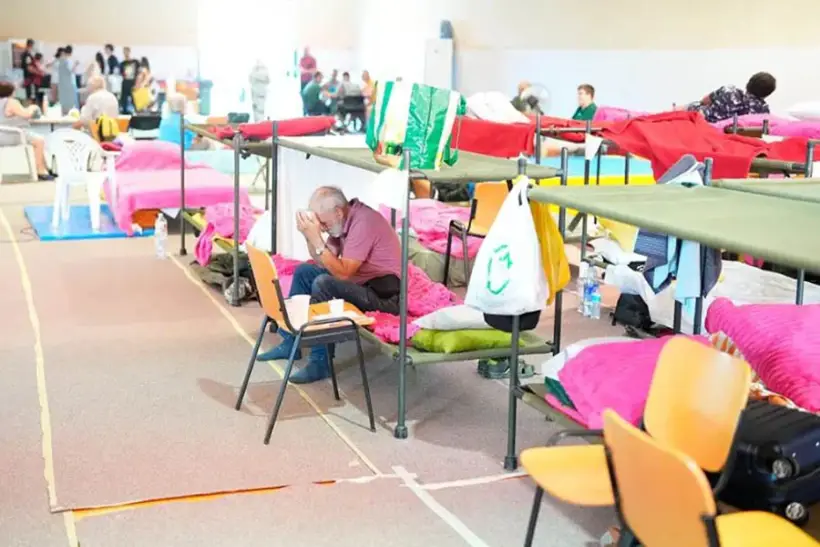
Many evacuees have been living in temporary shelters for several days and do not know whether their homes survived. Residents of the Tiétar Valley in Ávila province, who left their towns over the weekend, tried to return to join volunteers fighting the fires. However, Civil Guard officers blocked entrances to the affected towns and did not allow anyone to enter.
One resident of La Adrada said that she had participated in volunteer efforts until Sunday evening. According to her, around 150 people remained in the village and worked alongside emergency services to create firebreaks around residential areas. She noted that people were exhausted and needed replacements, as some fire outbreaks were still active.
Shortage of emergency personnel
Civil Guard commanders acknowledged that one of the main problems was the inability to assist all residents who refused to leave their homes despite evacuation orders. With limited resources, priority was given to evacuating people, carrying out rescue operations, and protecting those who followed official instructions.
Representatives of the agency also said the crisis had once again highlighted a long-standing shortage of personnel in rural areas. In their assessment, current staffing levels are insufficient to handle all tasks simultaneously during an emergency of this scale.
Looting concerns in abandoned homes
Civil Guard spokesperson Mercedes Martín said law enforcement officers had received several reports of possible thefts from abandoned homes. Activated security alarms were among the signs reported by residents. The first complaints came from residents of Pelayos de la Presa in the Madrid region.
According to Martín, it will only be possible to determine whether thefts actually occurred after residents return home. Owners will then be able to check their property and file police reports if necessary. The Civil Guard has increased patrols in affected areas.
Impact on tourism and Spain’s economy
The emergency has become the largest of its kind in recent decades. For comparison, throughout the previous year, 42,913 residents had to leave dangerous areas due to wildfires, while in 2024 the figure was 6,827.
After the earthquake in Lorca, around 30,000 people spent the night away from their homes, although mandatory evacuation orders affected only 10,000 residents. The volcanic eruption on La Palma affected 7,800 people. The floods in the Valencia region in 2024 destroyed hundreds of buildings but did not require the relocation of such a large number of people.
Analysts at International Investment note that the large-scale wildfires have become a serious challenge not only for residents of affected areas but also for Spain’s tourism industry. Entry restrictions, road closures, and the evacuation of towns could affect the summer season, especially in Ávila, Madrid, and Castellón, where tourist flows traditionally increase during this period.
The greatest risks are linked to rural tourism, the hotel sector, and local businesses in municipalities located near the fire zones. Temporary closures of accommodation facilities, canceled trips, and reduced visitor activity could lead to financial losses for entrepreneurs.
At the same time, Spain’s major tourist destinations continue to operate normally. Authorities expect restrictions to be gradually lifted once the situation stabilizes and that tourist flows will recover.