







 Lithuanian Apartment Prices Accelerate Across Major Cities
 Norway's Sovereign Fund Commits €1.5bn to European Warehouses
 Market Rout of October 2026: Can Branded Hotels Protect Capital?
 Residential Property Prices in Tbilisi Rise by 5.9% Year-on-Year
 Ras Al Khaimah Hotels Reposition Ahead of Wynn Opening
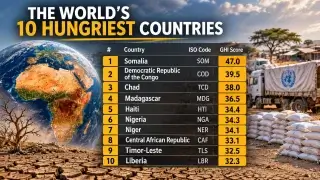 The 10 Hungriest Countries in the World
Georgia's Tourism Revenue Hits Record High

Georgia's international travel revenue reached $4.69 billion in 2025, while the tourism industry's value added totaled GEL 6.78 billion. In January–September 2026, revenue increased by 4.4%, reaching a record high for the nine-month period. Transactions made with foreign bank cards rose by 30.7% in the first four months of the year. However, growth varied significantly across different segments of the tourism industry.
International Travel Revenue
According to the National Bank of Georgia, international travel revenue reached approximately $4.69 billion in 2025, compared with $4.43 billion in 2024. The annual increase was around 6%.
Revenue also significantly exceeded pre-pandemic levels. In 2019, international travel generated $3.27 billion, but in 2020 the figure plunged by 83.4% to $542 million. The industry subsequently recovered, with revenue in 2025 exceeding the 2019 level by 43.5%.
In January–September 2026, Georgia earned $3.80 billion from international travel, the highest amount recorded for the first nine months of any year. Revenue stood at $3.64 billion during the same period in 2025, representing annual growth of 4.4%.
Quarterly performance, however, was uneven. In Q1, revenue increased by just 0.5% year-on-year, while Q2 recorded a decline of 3.8%. The situation improved considerably in July–September, when revenue reached $1.86 billion, up 11.9% compared with Q3 2025.
The quarterly distribution also highlights the pronounced seasonality of Georgia's tourism market. In 2025, the third quarter accounted for approximately 35.5% of annual revenue. The summer season remains the industry's most profitable period.
Tourism's Contribution to Georgia's Economy
According to the National Statistics Office of Georgia (Geostat), the tourism industry's value added reached GEL 6.78 billion in 2025, compared with GEL 5.97 billion in 2024. This represented nominal growth of 13.7%.
However, tourism's contribution to gross domestic product remained virtually unchanged at 7.39% in 2025, compared with 7.37% a year earlier. This partly reflects growth in Georgia's overall GDP, which prevented the industry's expansion from significantly increasing its share of the economy.
In 2019, tourism's value added stood at GEL 3.63 billion before declining to GEL 2.56 billion in 2020. The indicator gradually recovered after the pandemic and reached its highest level for the period under review in 2025.
Preliminary statistics for the first half of 2026 indicate further expansion. Tourism's total value added reached GEL 3.46 billion over the six-month period. Its share of GDP stood at 6.97% in Q1 and 7.83% in Q2, averaging 7.43% for the first half of the year.
These figures remain preliminary, making it too early to assess the industry's full-year performance in 2026.
Which Tourism Segments Are Growing Fastest?
A comparison of 2024 and 2025 figures reveals substantial differences between tourism-related activities. The strongest growth in value added was recorded in air transport and accommodation services.
Air transport led the increase, with nominal growth reaching 66.8%. Hotels and other accommodation providers recorded a 17.1% rise, reflecting expanding economic activity in tourism infrastructure.
Value added in food and beverage services increased by 12.2%, while travel agencies and booking services recorded growth of almost 10%. Land and water transport showed much weaker performance, with value added increasing by only 1.6%.
Growth across Georgia's tourism industry is therefore uneven. Air transport, accommodation, and food services recorded the strongest increases in 2025.
It is important to note that these figures represent nominal value added. An increase does not necessarily indicate equivalent growth in the physical volume of services, as price changes also affect the results.
Foreign Bank Card Transactions Rise by 30.7%
Another indicator of economic activity associated with international travel is the volume of transactions conducted using foreign-issued bank cards.
According to the National Bank of Georgia, these transactions totaled approximately GEL 5.19 billion in 2025, compared with GEL 4.37 billion in 2024. Annual growth was around 19%.
In January–April 2026, transaction volumes reached GEL 1.76 billion, up from approximately GEL 1.34 billion during the same period a year earlier. This represented an increase of 30.7%.
Transaction volumes exceeded the previous year's figures in all four months of 2026. However, year-on-year growth slowed in April compared with earlier months.
Foreign bank card transactions provide an additional measure of economic activity associated with travel to Georgia. Nevertheless, they should not be equated directly with international tourism revenue, as the indicators differ in currency, statistical coverage, and calculation methodology.
Key Trends in Georgia's Tourism Market
Comparing international travel revenue, tourism value added, and foreign bank card transactions reveals several important trends.
First, international travel revenue reached an all-time high in 2025. Growth continued during the first nine months of 2026, although quarterly results varied considerably. The most significant acceleration occurred in Q3.
Tourism value added grew faster than international travel revenue in 2025. However, the industry's share of GDP remained almost unchanged, reflecting expansion in other sectors of the Georgian economy.
Among individual activities, air transport recorded the strongest growth. Double-digit increases were also observed in accommodation and food services.
Foreign bank card transaction volumes rose particularly rapidly in early 2026. However, the slowdown recorded in April requires further monitoring. Without data for subsequent months, it is not yet possible to determine whether this marks the beginning of a sustained trend.
Taken together, these indicators confirm tourism's significant role in Georgia's economy. Each measures a different aspect of the industry, and examining them collectively provides a more comprehensive assessment than relying on any single statistical indicator.