







 Vietnam Mortgage Surge Pushes Homes Out of Reach
 Lithuanian Apartment Prices Accelerate Across Major Cities
 London Flats Lose Value Ahead of Leasehold Reform
 Construction of the Batumi–Sarpi Highway Begins in Georgia
 Baltic Property Investment Accelerates in 2026
 Hong Kong and Singapore Renew Their Expat Rivalry
Middle East Air Disruption Spread Wider
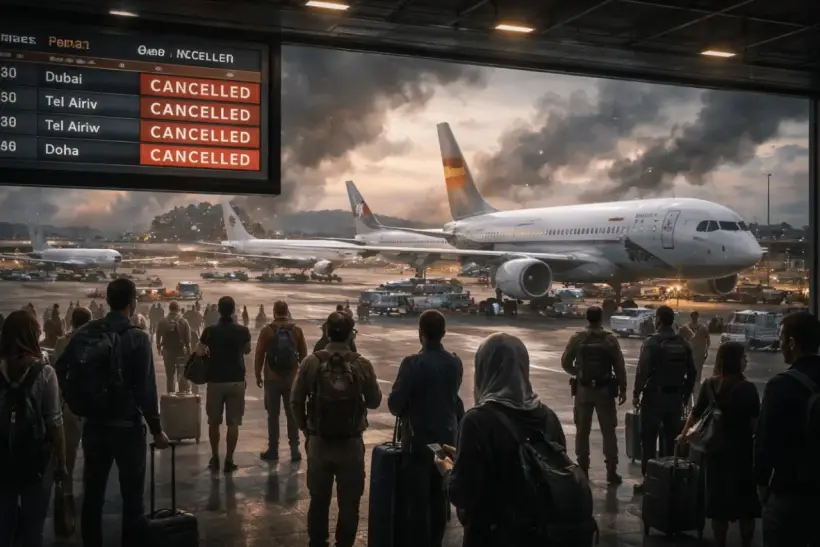
Lufthansa, KLM and Air Canada all changed regional operations
The clearest carrier restrictions are set out by Lufthansa Group. The airline says that because of the current situation in the Middle East and the associated severe air-traffic restrictions, it is suspending flights to and from Dubai, Abu Dhabi, Amman and Erbil until March 28, while Riyadh remains suspended until April 5 for operational reasons. That matters because in Germany’s case the immediate disruption is not an across-the-board state ban on routes, but a concrete decision by the country’s largest airline to halt services in response to safety and operational risk.
KLM describes a similar pattern from the Netherlands. The carrier says it is currently not flying through the airspace of Iran, Iraq and Israel, nor over several countries in the Gulf region. It adds that flights to, from or via destinations in the region are canceled or adjusted, while a separate company statement said services to Tel Aviv, Dubai, Riyadh and Dammam had been suspended through part of March. That shows the Dutch case is best understood as a combination of airline network adjustment and airspace avoidance rather than a single government decision to “shut down Middle East air routes.”
Air Canada said earlier in March that all flights to and from Dubai and Tel Aviv were suspended because of the military situation in the Middle East, with a planned restart from March 23. Even if some schedules were subsequently revised, that step demonstrates that Canadian operators were also forced to pull back from major Middle East gateway routes for a period of time.
Governments are issuing warnings, not one coordinated closure order
The UK Civil Aviation Authority, or CAA, said on March 1 that many flights to and from the Middle East had been canceled as a result of the ongoing situation. It advised passengers to check the latest Foreign, Commonwealth and Development Office, or FCDO, guidance and to verify their trip directly with the airline before leaving for the airport. That wording is important because it confirms the scale of disruption without implying that London itself issued a blanket order “shutting Middle East air routes.”
The British government did in fact update its Foreign Office travel advice hub, creating a specific section for British nationals affected by the Middle East crisis and linking to country guidance for Bahrain, Qatar, the UAE, Kuwait, Israel and other destinations. This is another example of how states are responding primarily through consular and travel warnings, while the direct air-transport fallout is then carried by airlines through cancellations and reroutings.
The United States is following a similar model. The U.S. State Department updated its travel advisory for the United Arab Emirates and said that on March 2 it ordered the departure of non-emergency U.S. government employees and eligible family members because of the threat of armed conflict. The advisory also tells U.S. citizens to reconsider travel to the UAE due to the threat of armed conflict and terrorism. That is a serious escalation in official guidance, but it is still not the same thing as a U.S. government aviation measure closing all Middle East routes.
The Netherlands has framed the issue in comparable terms. Government.nl said the situation remains unpredictable and unsafe, while Netherlands Worldwide warned that airspace over much of the region was largely closed and that many flights to the Netherlands with a stopover in the Middle East had been canceled. This shows that even countries that did not impose a unified aviation ban on regional flying are still facing a direct impact through broken transit chains and disrupted passenger flows.
French diplomatic channels likewise confirm persistent transport disruption. France Diplomatie said commercial flights had almost resumed normal operations, but that several airlines had extended the suspension of their flights to and from the region. Other French diplomatic pages noted that links via Doha, Dubai and Abu Dhabi had been interrupted and that some passengers were forced to rebuild itineraries after cancellations. For France too, the picture is one of advisories, consular support and air-transport disruption rather than a single state decree “closing routes.”
Why passengers outside the region are also being hit
The most important operational point is that Middle East airports are not merely destination markets. They function as major global transfer hubs. That means any restriction affecting airspace over Iran, Iraq, Israel or parts of the Gulf quickly spills over into journeys such as London to Bangkok, Amsterdam to Singapore, Frankfurt to Delhi or Toronto to Dubai. KLM explicitly says it is changing not only endpoint flights to the region but also routes passing through it, while Netherlands Worldwide highlights problems on flights to the Netherlands that rely on Middle East stopovers.
That is why the headline idea of “Middle East route shutdowns” actually points to a broader issue in global aviation connectivity. EASA warns that risks now extend beyond the core conflict airspaces into neighbouring zones exposed to military operations and interceptions. Airlines are therefore forced to choose between cancellations, longer block times and materially higher costs for crews, fuel and network recovery.
Why the Travel And Tour World framing needs caution
The central weakness in the Travel And Tour World headline is that it groups Germany, the United States, the United Kingdom, France, the Netherlands, Canada and Hungary as if all of them had taken one coordinated state decision. The official record does not support that. What can be documented is a layered picture of airline suspensions, foreign-ministry warnings and closures or restrictions within the affected regional airspace itself. In Hungary’s case, publicly verifiable official international evidence is thinner than it is for Germany, the Netherlands, Canada, the United States, the United Kingdom and France, so a stricter factual treatment should mention Hungary only as part of the broader headline framing, not as an equally documented airline-disruption case.
The most accurate way to present the story is this: European and North American airlines, along with government authorities, have intensified route restrictions, advisories and schedule changes because of rising Middle East airspace risks, and the resulting disruption now extends far beyond the region itself. That framing aligns more closely with the evidence and reduces the risk of overstating the scope of formal state action.
As International Investment experts report, the current aviation crisis around the Middle East matters not only as a regional security episode but as a stress test for the global transfer-hub model. While governments issue warnings and airlines reroute around risk zones, the immediate burden falls on passengers, connections and business mobility between Europe, Asia and the Gulf.
FAQ
Question: Is it true that Germany, the U.S., the U.K., France, the Netherlands, Canada and Hungary all shut Middle East routes at the same time?
Answer: No. The verified record points instead to a mix of travel advisories, airspace restrictions inside the region and airline decisions to cancel or reroute flights. The idea of one coordinated shutdown is too broad.
Question: Which airlines officially confirmed restrictions?
Answer: Lufthansa Group suspended several routes to Dubai, Abu Dhabi, Amman, Erbil and Riyadh, KLM said flights to, from or via the region were canceled or adjusted, and Air Canada said it had suspended flights to Dubai and Tel Aviv.
Question: What are official authorities telling passengers to do?
Answer: The UK CAA advises checking directly with airlines and following FCDO guidance, while the U.S. State Department told travelers to reconsider travel to the UAE because of armed-conflict and terrorism risks.
Question: Why are passengers not traveling to the conflict zone also affected?
Answer: Because hubs such as Dubai, Abu Dhabi and Doha connect Europe, Asia and Africa, and avoiding dangerous airspace reshapes the routing of a much wider set of long-haul flights.
Question: How serious do aviation safety bodies think the risks are?
Answer: EASA says there are additional high risks not only in Iranian airspace but also in neighbouring areas affected by hostilities and interceptions.