







 Vietnam Mortgage Surge Pushes Homes Out of Reach
 Lithuanian Apartment Prices Accelerate Across Major Cities
 London Flats Lose Value Ahead of Leasehold Reform
 Construction of the Batumi–Sarpi Highway Begins in Georgia
 Baltic Property Investment Accelerates in 2026
 Hong Kong and Singapore Renew Their Expat Rivalry
UAE Developers Move to Calm Investors
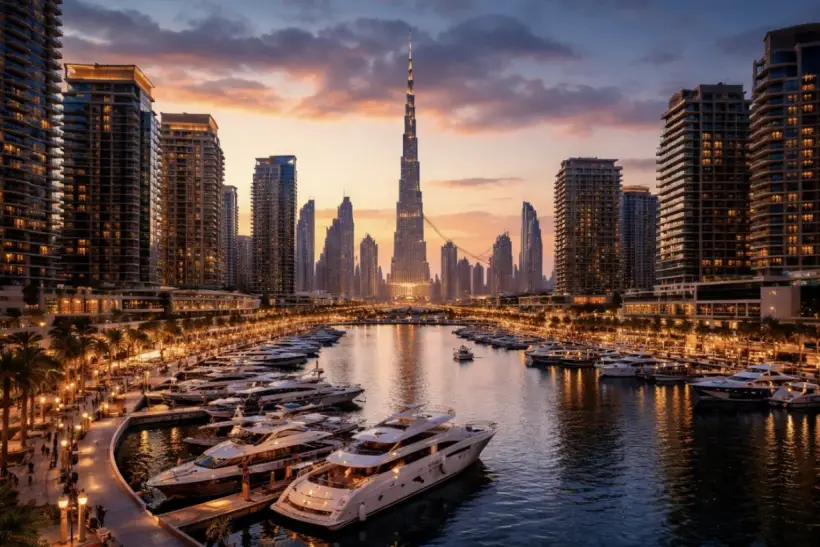
UAE property faces a wartime confidence test
Developers in the UAE moved in late March to reassure investors that the war around Iran would not derail the property markets of Dubai and Abu Dhabi, even as regional security became a direct pricing factor for Gulf real estate. Bloomberg reported on March 26 that developers were trying to calm buyers and bondholders who had grown more cautious after attacks and rising military uncertainty in the Gulf. The report came two weeks after another Bloomberg story said UAE developers’ bonds had sold off sharply and that the sector risked an abrupt end to its rapid borrowing and construction cycle.
Why the Iran war is hitting UAE real estate sentiment
The market’s vulnerability is not mainly about the disappearance of demand. It is about the sudden repricing of one of the UAE’s core investment advantages: the perception of Dubai and Abu Dhabi as safe havens for capital, expatriates, family offices and international homebuyers. Bloomberg previously reported that nearly 2,000 missiles and drones had been launched at the UAE, and Ambassador Yousef Al Otaiba said more than 93% were intercepted and that ports and airports reopened quickly. Even with that interception rate, the fact of repeated attacks weakened the stability premium that had underpinned property valuations and cross-border investor confidence.
Reuters described the current moment in early March as the first real stress test of the UAE’s multiyear property boom. It said strikes on airports, ports and residential areas had punctured the region’s aura of exceptional stability, while exposing how dependent parts of the market remain on offshore money. In that environment, geopolitical risk has started to matter alongside prices, financing costs and project delivery.
How demand and transactions in Dubai started to weaken
The first signs of cooling are already visible. Reuters, citing Goldman Sachs analysts, said UAE real-estate transaction volumes in the first 12 days of March fell 37% from a year earlier and 49% from the previous month. It also reported that some properties were being offered at discounts, with price cuts of 12% to 15% on selected listings. That does not yet amount to a broad market crash. It looks more like a fast repricing of expectations and of the risk premium attached to Gulf assets.
The bond market has reacted more sharply. Bloomberg reported on March 13 that UAE property developers became one of the weakest pockets of emerging-market credit and that new issuance had effectively stalled. That matters because developers had increasingly relied on bonds to fund new residential projects in Dubai and Abu Dhabi during the boom.
Why developers still argue fundamentals remain strong
Even so, the sector entered this shock from a position of unusual strength. According to Dubai Land Department data, total real-estate transactions in Dubai exceeded AED 917 billion in 2025, a record high. Property sales alone reached more than AED 682 billion, with more than 214,000 sales transactions recorded during the year. In other words, the market was not weakening structurally before the war shock hit. It was coming off one of the strongest years in its history.
The listed developers were also carrying record backlogs. Emaar said in February that property sales reached an all-time high of AED 80.4 billion in 2025 and that its revenue backlog stood at AED 155 billion at year-end. Aldar, Abu Dhabi’s largest listed developer, reported a record development revenue backlog of AED 71.7 billion. Those numbers matter because they represent already sold projects that are expected to translate into revenue over the coming years, giving developers a cushion against short-term volatility.
What the UAE authorities are doing to support confidence
Support is also coming from the state. On March 18, the UAE central bank rolled out a resilience package to support banks, liquidity and lending as the war’s fallout dented investor sentiment. Bloomberg said the package was intended to reinforce the banking system and sustain credit capacity, while Reuters reported that banks would be able to access up to 30% of reserve balances and benefit from temporary relief on some loan-classification rules for borrowers affected by extraordinary circumstances.
At the same time, officials and major business figures are trying to preserve the UAE’s image as a long-term investment platform rather than a crisis zone. Bloomberg reported on March 19 that the UAE was standing by its previously announced $1.4 trillion economic and investment framework with the US. Bloomberg also noted on March 23 that major dealmaking in the region was continuing even as the Iran war entered its fourth week. The message from both government and business has been consistent: short-term fear exists, but large-scale capital flight has not yet become the defining story.
Why luxury property is the most exposed segment
The most exposed segment is the high end. Luxury real estate became one of the defining symbols of Dubai’s boom, and Bloomberg reported in July 2025 that homes priced above $10 million were still setting records, with the city’s ultra-prime market remaining exceptionally strong even as some analysts warned of a broader correction. But the luxury segment is also the one most dependent on perceptions of safety, frictionless mobility and confidence among globally mobile wealthy buyers.
That is why the current reassurance campaign from developers matters so much. They are not just defending construction timelines or balance sheets. They are defending the narrative that Dubai and Abu Dhabi remain places where wealth can be stored, deployed and protected during a regional crisis. So far, markets are not pricing a repeat of 2009. But investors are clearly asking harder questions about liquidity, refinancing, launch timing and the sector’s reliance on foreign demand.
How the UAE compares with Georgia
Georgia offers a very different risk story. It does not have Dubai’s financial scale or market depth, but it is also not directly embedded in the Gulf war theatre that is now affecting perceptions of the UAE. According to Geostat, Georgia’s real GDP grew 7.5% in 2025, while international visitor visits reached 6.9 million, up 6.2% from 2024. That means tourism and the broader economy both continued to expand, supporting demand for housing, aparthotels and resort-oriented development.
The safety profile is also different. In the 2025 Global Terrorism Index, Georgia registered a zero score for the impact of terrorism. In the 2025 Global Peace Index, the country ranked 109th out of 163 states. That is not a top-tier peace ranking, but it still reflects a fundamentally different investor risk profile from a market located near an active regional conflict.
The user’s comparison with Georgia’s luxury segment also has substance. Market research on Georgia has repeatedly pointed to limited supply in parts of the premium and luxury hospitality segment relative to demand, which has helped support pricing and occupancy. More recent Galt & Taggart analysis for Batumi shows that new premium projects are now coming to market, suggesting developers are trying to fill that gap as tourism expands and foreign demand stays relevant. In practical terms, UAE developers are now defending a mature luxury ecosystem against a war-related risk premium, while Georgia is still building out premium stock from a lower base amid strong tourism and GDP growth.
As International Investment experts report, the UAE story matters not because the country’s property fundamentals suddenly disappeared, but because for the first time in years a Middle East geopolitical shock has begun to directly reprice one of the region’s most globalized real-estate markets. Against that backdrop, Georgia does not look like a substitute for Dubai, but it does look like an alternative destination for capital seeking tourism growth, solid GDP momentum and a lower direct link to the current war, while some luxury niches there still remain supply-constrained.
FAQ
Why are UAE developers trying to reassure investors now?
Because the Iran war has become a direct factor in how investors price UAE real estate, developer bonds and regional safety. Bloomberg and Reuters have both reported weaker market sentiment and early signs of slower transaction activity in March.
Has the UAE property market already collapsed?
Not on the available evidence. It is more accurate to say the market has suffered a sharp confidence shock and localized cooling. Dubai still came into 2026 after a record 2025, and the March figures look more like a war-driven repricing than a fully established market collapse.
What does backlog mean for a developer?
Backlog refers to the stock of already sold projects whose revenue has not yet been fully recognized. It matters because it gives developers visibility on future cash flow. Emaar reported AED 155 billion of backlog and Aldar reported AED 71.7 billion at the end of 2025.
How is Georgia different from the UAE for property investors?
Georgia is smaller and less liquid, but it posted 7.5% real GDP growth in 2025 and a 6.2% rise in international visitor visits, while not being directly exposed to the Gulf war theatre in the same way as the UAE. The UAE remains deeper and wealthier, but it is now being forced to price in a new geopolitical risk premium.
Is there really a luxury supply gap in Georgia?
In premium hospitality and some high-end resort niches, market research has pointed to limited supply relative to demand, although new premium projects are now being launched, especially in Batumi. That suggests the gap is not permanent, but it has not been fully closed.