







 Vietnam Mortgage Surge Pushes Homes Out of Reach
 Lithuanian Apartment Prices Accelerate Across Major Cities
 London Flats Lose Value Ahead of Leasehold Reform
 Construction of the Batumi–Sarpi Highway Begins in Georgia
 Baltic Property Investment Accelerates in 2026
 Hong Kong and Singapore Renew Their Expat Rivalry
US Housing Spring Loses Momentum Again
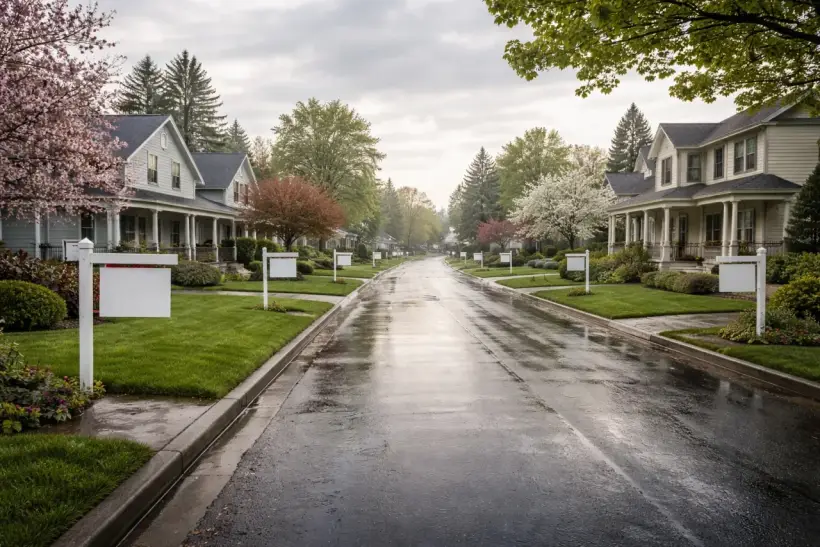
The US housing market entered the crucial spring selling season with hopes of a rebound after several stagnant years, but by mid-April that outlook had weakened again. A Bloomberg Opinion column published on April 17 argues that better affordability and healthier inventory at the start of 2026 were not enough to secure a turnaround, as renewed anxiety, higher borrowing costs and softer buyer activity pushed the market back toward another disappointing spring.
Why the 2026 spring selling season is underperforming
Spring is typically the decisive window for US home sales, as families try to buy before the school year ends and move during summer. This year, however, March data showed that demand failed to hold even after conditions briefly improved earlier in the year. The National Association of Realtors reported that existing-home sales fell 3.6% from February to a seasonally adjusted annual rate of 3.98 million in March, the weakest pace in nine months. Sales were down 1% from a year earlier, while the median price of an existing home sold rose 1.4% to $408,800. Unsold inventory rose to 1.36 million units, equal to 4.1 months of supply, up from 3.8 months in February.
That mix matters because it shows a market where supply is improving but transactions are still not following through. More homes are available, yet affordability remains too strained and buyer conviction too weak for that added inventory to translate into a broad sales recovery. That gap between better selection and hesitant demand is now defining the market.
Mortgage rates are still restraining buyers
A central reason for the renewed slowdown is the cost of mortgage borrowing. Freddie Mac said the average rate on a 30-year fixed mortgage was 6.30% in the week ending April 16. That is below the level seen a year earlier, but still high enough to keep many households on the sidelines. The market briefly saw rates move down toward and below 6% earlier in 2026, yet that relief did not last. As inflation concerns and geopolitical tensions resurfaced, mortgage rates moved higher again just as the busiest buying period began.
For many US households, the difference between a mortgage near 6% and one meaningfully above that level is not marginal. It changes the monthly payment in a way that can determine whether a purchase is feasible. The 2026 spring season is underscoring a familiar lesson: housing demand does not recover simply because rates are below peak levels; it recovers when borrowing costs fall steadily enough for buyers to trust that affordability is improving rather than fluctuating.
Inventory is rising, but demand remains cautious
March figures from Realtor.com show a market that is less restrictive than a year ago. The median listing price was $415,450, down 2.2% year over year. Active listings rose 8.1%, new listings edged up 0.7%, and the median home spent 57 days on the market, four days longer than a year earlier. Inventory has now increased on an annual basis for 29 consecutive months, although the pace of that recovery is starting to level off.
The improvement is not evenly spread across the country. The South and West have moved closer to, or even above, pre-pandemic inventory benchmarks, while the Northeast and Midwest remain much tighter. That leaves the national market looking more buyer-friendly overall, but still fragmented enough that seller leverage remains intact in several local markets.
Real-time indicators show buyers pulling back
More current weekly data from Redfin suggest that the slowdown continued into April. Pending US home sales fell 4.1% from a year earlier during the four weeks ending April 12, the largest decline in more than a year. The company also reported weaker home-touring activity, indicating that demand is cooling not only in closed transactions but also at the earlier stages of buyer engagement.
Those forward-looking measures are important because they show whether the market is likely to strengthen in the coming weeks. For now, they point in the opposite direction: buyers are delaying decisions even as the number of available homes improves. For sellers, that means longer marketing periods, more price negotiation and less confidence that a property will move quickly before the summer slowdown begins.
Builders are losing confidence as well
The weakness is not limited to existing homes. The National Association of Home Builders said its April builder sentiment index fell to 34 from 38 in March. A reading below 50 means negative assessments outnumber positive ones. The index for current single-family sales fell to 37, the six-month sales outlook dropped to 42, and prospective buyer traffic slid to 22. That is a clear signal that developers are seeing both high financing costs and weaker customer flow during the peak season.
Construction has not stopped altogether. Data from the US Census Bureau and the Department of Housing and Urban Development showed housing starts running at a 1.487 million annualized pace in January, up 7.2% from the revised December level. But single-family starts were down 2.8% from the previous month, showing that the most rate-sensitive part of the market remains vulnerable even when total building activity holds up.
What this weak spring means for prices and sales
The market is now showing three trends at once. Buyers have more choice, many of them are still unwilling to move, and sellers are gradually becoming more realistic on pricing. That is visible in lower listing prices, longer time on market and a softer pricing environment at the listing stage. Yet the resale market is still recording a year-over-year increase in the median transaction price, showing that the balance between weaker demand and still-limited quality supply remains fragile.
For 2026, the implication is that the US housing market has not yet exited its long normalization phase. It no longer looks as frozen as it did in the weakest periods of 2023 through 2025, but it has not reached a durable recovery either. The spring season that was supposed to confirm a turning point is instead showing how dependent home sales remain on mortgage costs, household confidence and the broader macroeconomic backdrop.
As International Investment experts report, the weak start to the US spring selling season does not point to an immediate nationwide price correction, but it does increase the likelihood of slower home-price growth, longer selling times and sharper local competition among sellers in the second half of 2026, especially in markets where inventory has already recovered more visibly.
FAQ: US housing market in spring 2026
What is happening in the US housing market in spring 2026?
The spring season has started weaker than expected. Existing-home sales fell in March, pending sales also declined in April, and buyers have turned more cautious because mortgage borrowing remains expensive and the economic backdrop is uncertain.
Why has the spring selling season underperformed?
The main reason is still mortgage affordability. Even after a brief drop earlier in the year, the average 30-year fixed mortgage remained around 6.3%, which has not been low enough to bring buyers back in large numbers.
Are US home prices falling?
At the listing level, the median asking price in March was down 2.2% from a year earlier. But at the transaction level, the median price for existing homes sold was still up 1.4% year over year. That shows a market that is cooling, but unevenly.
Is inventory improving?
Yes. Active listings rose 8.1% year over year in March, and the supply of unsold existing homes increased to 4.1 months. That gives buyers more choice than a year ago, although shortages still persist in some regions.
What is happening in the new-home market?
Builder confidence weakened in April, with the headline sentiment index falling to 34 and prospective buyer traffic dropping further. Overall construction is still running, but the single-family segment remains sensitive to high borrowing costs and fragile demand.
Could the market recover later in 2026?
That is possible if mortgage rates stabilize or move lower and household confidence improves. For now, the most current indicators point more to a pause than to a firm rebound.