













The World’s Youngest and Oldest Economies
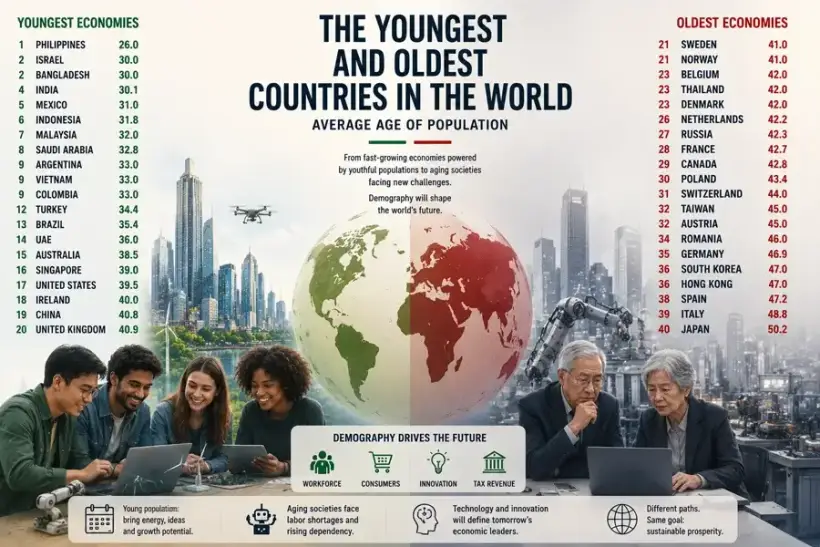
Imagine a country where the average resident is 26 years old, and another where everyone is 50. This is the stark demographic contrast between the Philippines and Japan.
If the world’s largest economies were lined up along an age spectrum, the Philippines would sit at the very front—a nation where half the population is under 26. At the far end would be Japan, where the median age has crossed the half-century mark.
According to a new study by Visual Capitalist, this widening gap represents one of the most underestimated fault lines in the global economy. Utilizing data from the CIA World Factbook, the study ranks the planet's 40 largest economies by median age. In essence, it provides a roadmap of who will be working, consuming, innovating, and paying taxes ten, twenty, and thirty years from now.
The Youth Club
Right behind the Philippines, the list of the youngest economies features a group of nations that, at first glance, share little in common: Israel, Bangladesh, India, Mexico, and Indonesia. Israel and Bangladesh share the second spot with a median age of 30, followed closely by India (30.1), Mexico (31.0), and Indonesia (31.8). What binds them is what demographers call the "emerging market youth boom"—a history of high birth rates that is now translating into an abundance of labor.
Among them, India stands out. As the world’s sixth-largest economy by nominal GDP, it maintains the demographic profile of a developing nation. Its median age is just 30.1, compared to 39.5 in the United States and nearly 41 in the United Kingdom. This allows India to play in the big leagues of the global economy while retaining a demographic edge typically associated with much smaller economic players.
The authors of the study view this combination not merely as a statistical quirk, but as a distinct competitive advantage. A younger generation that grew up with smartphones in hand is adopting new technologies—including artificial intelligence tools—significantly faster than generations locked into legacy work practices.
The Aging Giants
At the opposite end of the spectrum are the economies sociologists have long labeled "aging giants." Japan (50.2 years), Italy (48.8), and Spain (47.2) top the list of the oldest nations. They are closely followed by Germany, South Korea, and Hong Kong—regions defined by some of the world’s highest life expectancies and lowest birth rates.
For these economies, demographic maturity is not an abstract future threat; it is a daily operational reality. Fewer young workers mean a heavier burden on pension systems, stagnant labor force growth, and an urgent need for mitigating strategies—ranging from raising the retirement age to widespread automation and robotics.
Why It’s More Than Just Numbers
The temptation to conclude that the young will simply outpace the old is a trap many commentators fall into. The "demographic dividend"—the window of time when the working-age population peaks—creates an opportunity for growth, but does not guarantee it. History offers plenty of examples of young nations that failed to convert demographic potential into economic output due to job shortages, poor education systems, or political instability. Population youth is merely raw material, not a finished product.
The reverse is equally true. An aging population is not an immediate economic death sentence. Despite its demographic headwinds, Japan remains the world’s third-largest economy and continues to lead technologically across several industries. Demographics set the parameters within which policy decisions are made, but they do not dictate the outcomes.
Where AI Meets Demographics
The study’s most compelling conclusion lies at the intersection of age and technology. A young, tech-literate population is theoretically quicker to adapt to AI-driven workflows. Tasks that used to take hours five years ago—such as automated report processing, extracting contract terms, or condensing an 80-page document into a five-line summary—are now executed in seconds.
If this hypothesis holds, global economics is approaching a fascinating fork in the road. Countries with young populations and sufficient economic scale—primarily India, but also Indonesia, Mexico, and to a large extent Israel with its advanced tech ecosystem—enjoy a rare convergence of factors: a robust demographic resource combined with a high readiness for technological disruption.
For aging economies, the path is driven by necessity rather than speed of adoption. For them, technology is no longer an optional upgrade, but a vital tool to offset a shrinking labor force.
Global Median Age Breakdown (Top 40 Economies)
Between the two extremes of the Philippines and Japan lie the remaining 38 major economies:
30.0 – 35.0: Israel (30.0), Bangladesh (30.0), India (30.1), Mexico (31.0), Indonesia (31.8), Malaysia (32.0), Saudi Arabia (32.8), Argentina (33.0), Vietnam (33.0), Colombia (33.0), Turkey (34.4)
35.1 – 40.0: Brazil (35.4), UAE (36.0), Australia (38.5), Singapore (39.0), USA (39.5), Ireland (40.0)
40.1 – 45.0: China (40.8), UK (40.9), Sweden (41.0), Norway (41.0), Belgium (42.0), Thailand (42.0), Denmark (42.0), Netherlands (42.2), Russia (42.3), France (42.7), Canada (42.8), Poland (43.4), Switzerland (44.0), Taiwan (45.0), Austria (45.0)
45.1 – 50.2: Romania (46.0), Germany (46.9), South Korea (47.0), Hong Kong (47.0), Spain (47.2), Italy (48.8), Japan (50.2)
Demographics remain one of the few economic metrics that can be forecast decades into the future with near-perfect accuracy; the people who will make up the workforce twenty years from now have already been born. Because of this, a table that looks like dry statistical data is actually one of the most precise previews of what the next generation's global economy will look like, experts at International Investment conclude.