







 Covivio Hotels Revenue Grows 4.7% as European Markets Split
 Lithuanian Apartment Prices Accelerate Across Major Cities
 Georgia's Tourism Revenue Hits Record High
 Norway's Sovereign Fund Commits €1.5bn to European Warehouses
 Market Rout of October 2026: Can Branded Hotels Protect Capital?
 Residential Property Prices in Tbilisi Rise by 5.9% Year-on-Year
Top 10 Cities in the World with the Best Public Transport
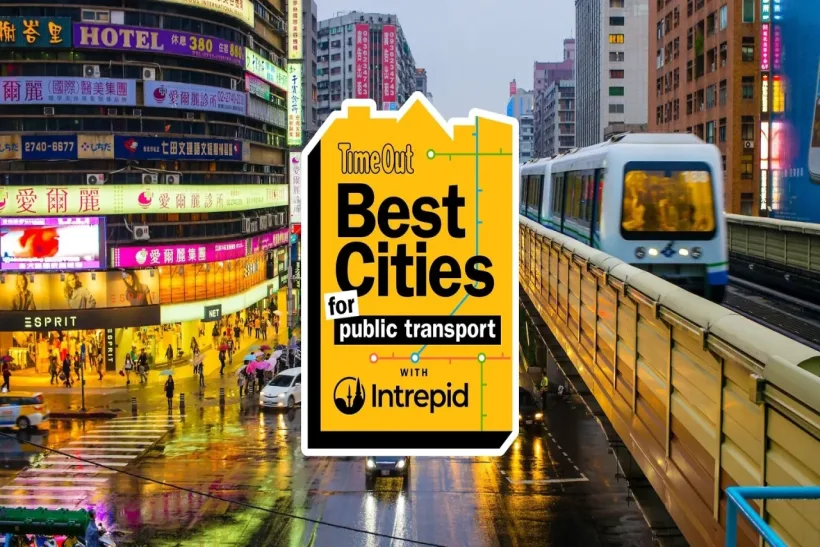
Time Out magazine has published a new ranking of cities with the most convenient public transport. It is based on the results of an annual survey in which more than 24,000 local residents rated their city’s transport on a five-point scale from “terrible” to “amazing.”
The top 10 is compiled from cities whose residents described their transport as “good” or “amazing.” To keep the ranking as diverse as possible, only one city per country, the one with the highest score, was eligible.
1. Taipei
First place went to the capital of Taiwan, Taipei, with a score of 95%. Locals value the clean metro stations, the queue markings on platforms and the strict adherence to timetables. In 2025, the metro carried more than 767 million passengers, or about 2.1 million people a day.
The EasyCard travel card works on the metro and buses, can be used for YouBike bike rentals, and can even pay for purchases at 7-Eleven stores. The network continues to grow: New Taipei’s light rail and the Circular Line recorded a record 30 million trips last year.
2. Singapore
Singapore’s transport system was ranked second in the world with a score of 93.5%. Around 3.5 million daily trips are served by 146 metro stations, and the share of trains arriving on schedule in 2025 was 99.4%.
In the summer of 2026, the city saw an event more than 30 years in the making: three new stations – Keppel, Cantonment and Prince Edward Road – finally closed the Circle Line loop. Acting Minister for Transport Jeffrey Siow joked at the opening ceremony that people can now stop asking the transport authority why the Circle Line isn’t a circle.
3. Hong Kong
Hong Kong (92.8%) rounded out the top three. Almost 100% of MTR heavy rail journeys in 2025 were completed on time, and over the year the system handled nearly 2 billion trips.
The city’s main distinguishing feature is the variety of transport modes. A high-speed train, the century-old double-decker “ding ding” tram and the Star Ferry can all be paid for with a single Octopus card.
4. Edinburgh
The most unexpected result of the ranking was Edinburgh: with a score of 92.4%, it took fourth place and became the best city in the UK, leaving London behind, as well as Europe’s former transport leaders Zurich and Vienna.
The backbone of the city’s transport system is the bus company Lothian Buses, which is owned by the city council and carried 119 million passengers in 2025.
Edinburgh’s trams recorded a record 12.5 million trips after the line was extended to Newhaven via Leith three years ago. Today, fares can be paid with a contactless card with a daily or weekly cap on charges.
5. Seoul
Fifth place went to Seoul (91.1%). The Seoul metro is known for its clean carriages and mobile coverage underground, and a ride costs €0.90.
The year before last, the city introduced the Climate Card, a monthly pass for €37 covering the metro, buses and Ttareungi city bikes.
Since September 2026, it has been replaced for residents by the new Climate Pass, while tourists can still buy passes valid for one to seven days.
6. Zurich
The Swiss metropolis (90.7%) in sixth place stands out because all of its transport modes work as a single mechanism.
A tram or bus stop is located roughly every 300 metres, and one ZVV ticket is valid on trams, buses, the S-Bahn, funiculars and even boats on Lake Zurich and the Limmat River.
7. Vienna
Vienna (90.3%) in seventh place remains a symbol of affordable transport: for the last 13 years, an annual pass cost €365, or one euro a day.
In January 2026, the price rose to €467, but this did not affect residents’ ratings. In 2025, Vienna’s transport carried 903 million passengers, and a record was set for the number of annual passes issued.
8. Tallinn
Tallinn (85.3%) stayed on the list thanks to a bold experiment. In 2013, it became the first European capital to make public transport free for registered residents, and the city has still not abandoned this policy. Tourists have to pay for travel, but tickets are inexpensive, and the Tallinn Card combines unlimited transport with discounts on major attractions.
9. Helsinki
In the Finnish capital (83.6%), a single HSL ticket is valid on trams, buses, the metro, commuter trains and light rail, as well as on the year-round ferry to the Suomenlinna fortress, a UNESCO World Heritage Site. The newest part of the network is the Jokeri light rail line 15, which opened in October 2023, about ten months ahead of schedule.
10. Medellín
Colombia’s Medellín (83%) closes out the top ten. The local metro, opened in 1995, is a source of civic pride, and passengers follow an unwritten code of courtesy known as “Cultura Metro.”
The city’s hallmark is the Metrocable cable car system, which connects hilly neighbourhoods with the valley. The first line, in Santo Domingo, began operating in 2004 and was one of the first urban cable car lines in the world. Today there are six such lines, and one of them climbs up to the forests of Arví Park.
In 2025, Medellín’s transport network, which includes trains, cable cars, trams and buses, handled more than 310 million trips.
Places 11 through 20 went to Shanghai (82.7%), Warsaw (81.9%), Osaka (81.6%), Stockholm (80.3%), Jakarta (79.2%), Riyadh (78.2%), Hamburg (77%), Amsterdam (76.9%), Vancouver (76.7%) and Oslo (75.9%).
The results show that residents’ high ratings depend not only on the size of the network. A unified payment system, punctuality and cities’ willingness to develop their infrastructure step by step are just as important, International Investment notes.