







 Israel Expels Russians and Ukrainians
 Bosnia and Herzegovina Restricts Work Visas for Nationals of Four Countries
 76% of Europeans Plan Trips, 40% Use AI
 Short-Term Rental Rates in Greece Rise by 8%
 Uzbekistan Changes Real Estate Investment Terms: 20 Years of Tax Incentives
 Georgia Construction Costs Spike in September: What Drove the Price Increase?
Russia’s GDP Growth Slows to 1%: Risks of Stagnation
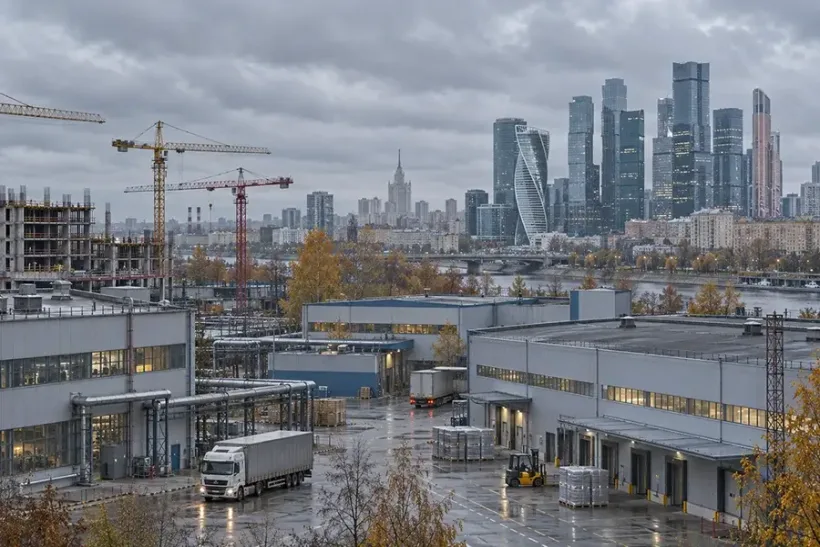
Russia’s economy continues to lose momentum. In the third quarter of 2026, GDP grew by 1% compared with the same period of 2025. The figure exceeded forecasts, but not all sectors remained in positive territory. Experts see little evidence of a sustained recovery and warn of the risk of prolonged stagnation.
What Is Supporting Russia’s Economy
Domestic demand provided the main support in July–September. Food service turnover rose by 5.2% compared with the third quarter of 2025, while retail trade increased by 4.2%. Manufacturing output grew by 2.5%, construction by 2% and freight turnover by 2.7%. These are separate sector indicators, not their percentage-point contributions to GDP.
Russia’s Ministry of Economic Development highlights mechanical engineering and metallurgy within the industrial sector. Gains in trade and services are linked to household spending, which supports output and business activity. But consumption is growing faster than many producers can expand capacity, so demand is not generating the same level of growth across all sectors.
Consumer spending lost momentum towards the end of the third quarter. Combined turnover in retail trade, paid services and food services increased by 3.7% year on year, compared with 6% in the second quarter. One of the main drivers of economic growth is therefore beginning to weaken.
Which Sectors in Russia Are Cutting Output
Several major industries recorded declines. In the third quarter of 2026, agricultural production fell by 3.9% compared with the same period of 2025, mineral extraction by 2.7%, and energy supply by 2.8%. Wholesale trade turnover decreased by 0.7%, while passenger turnover was down by 3%.
The causes of the downturn differ. Agricultural figures were affected by the strong harvest in 2025, while the extractive sector faced production restrictions and conditions in foreign trade. Experts also partly attribute weaker electricity demand to warm weather in September. Some factors are temporary; others may constrain output for longer.
Russia’s industrial sector is also developing unevenly. Manufacturing output rose by 5.6% in September compared with the same month of 2025. However, a study by the Russian Academy of Sciences’ Institute of Economic Forecasting, published by Kommersant, identified declines in 15 of the sector’s 24 branches.
|
Indicator |
Q3 2026, % |
|
Food service turnover |
+5.2 |
|
Retail trade |
+4.2 |
|
Manufacturing |
+2.5 |
|
Construction |
+2.0 |
|
Wholesale trade |
−0.7 |
|
Mining and quarrying |
−2.7 |
|
Energy supply |
−2.8 |
|
Agriculture |
−3.9 |
Change from Q3 2025. The figures do not represent the sectors’ contributions to GDP.
Investment and Demand Are Weakening
Falling investment in Russia has become one of the clearest warning signs. According to Rosstat’s preliminary estimate, fixed-capital investment declined by 8.5% in January–September compared with the same period of 2025. The fall reached 6.2% in the third quarter, 6.6% in the second and 14.3% in the first. The decline has continued for 18 consecutive months.
Prolonged cuts in capital spending reduce orders for equipment and construction work and could make it harder to modernise production facilities. High financing costs compound the problem: even businesses with stable demand are becoming more cautious about expansion.
Early signals for the fourth quarter are mixed. In October, cash inflows in consumer-facing industries fell by 2.2% relative to the seasonally adjusted average for July–September, according to Bank of Russia monitoring. In investment-related industries, the decline was 2.9%. These figures measure cash flows rather than GDP directly, but they point to weaker activity.
Leading indicators also suggest that economic activity is slowing. In October, the composite PMI for manufacturing and services fell from 50.8 to 50 points, the threshold between expansion and contraction. New orders declined, while selling prices rose at their fastest pace since January. The index does not cover the entire economy, but offers an additional view of business conditions.
Russia’s GDP: Results and Forecasts
In January–March 2026, Russia’s GDP contracted by 0.2% compared with the same period of 2025. Growth reached 1.3% in the second quarter and slowed to 1% in the third. The economy returned to positive territory but failed to maintain its pace.
Rosstat’s preliminary estimate for July–September exceeded expectations. The Ministry of Economic Development had forecast growth of 0.6%, while analysts surveyed by Interfax expected 0.7%. The Bank of Russia had projected 1%, matching the published figure.
The Ministry of Economic Development revised its estimate of Russia’s GDP growth in January–September from 0.6% to 0.8%. It expects growth of 0.6% for 2026 as a whole and 1.4% in 2027. The Bank of Russia puts the respective ranges at 0.5–1% and 1–2%. Analysts surveyed by Interfax expect 0.6% and 1.2%.
The central bank expects consumer prices to increase by 7.1–7.6% in 2026, with inflation returning to 4% in 2027. Its projected average key interest rate next year is 12.5–13.5%, while gross fixed capital formation is expected to rise by 1–3%. These conditions limit companies’ ability to finance new projects and expand production.
|
Source |
2026 |
2027 |
|
Ministry of Economic Development |
0.6% |
1.4% |
|
Bank of Russia |
0.5–1% |
1–2% |
|
Analysts surveyed by Interfax |
0.6% |
1.2% |
Forecasts as of November 2026.
Stagnation Risks in Russia
Tatiana Tirskikh, managing director at Expert RA, describes Russia’s economy as experiencing a marked slowdown, approaching stagnation. In her view, there is no sustained upturn across a broad range of sectors. Positive GDP figures have not been accompanied by an even expansion of output, leaving the economy more vulnerable to a further weakening of demand.
Sergey Konygin, senior economist at Sinara investment bank, warns of stagflation risks — a combination of weak economic growth and high inflation. In these conditions, higher consumer spending may push up prices without a comparable expansion of supply. Expensive loans also make it harder for companies to increase capacity and launch new projects.
International Investment analysts note that the outlook for 2027 will depend not only on GDP growth, but also on its drivers. Government spending and consumption support certain segments but do not offset falling capital investment. Without a recovery in investment and productive capacity, Russia’s economy risks remaining in a prolonged period of weak growth.
Frequently Asked Questions (FAQ)
What is economic stagnation in simple terms?
Stagnation is an extended period in which the output of goods and services barely increases. Companies become slower to expand their workforce, launch fewer new activities and postpone major investments.
How is stagnation different from a recession?
During stagnation, economic activity remains broadly flat; during a recession, it contracts. Slow but positive GDP growth does not, by itself, mean the economy is in recession.
How does stagnation affect household incomes and businesses?
Companies can find it harder to increase revenue and finance expansion, potentially limiting hiring and wage growth. When incomes rise more slowly than prices, households lose purchasing power.