







 Georgia Construction Costs Spike in September: What Drove the Price Increase?
 "Bike&Wine": Italian Journalists Tour Georgia by Bicycle
 Tanker Hits Cruise Ship in the US
 Thousands of US Flights Canceled After Major Technical Outage
 Best Cities in Europe for Real Estate Investment
 This Year Has Been a Record-Breaker for Tbilisi Hotels — Shalva Alaverdashvili
Uzbekistan Changes Real Estate Investment Terms: 20 Years of Tax Incentives
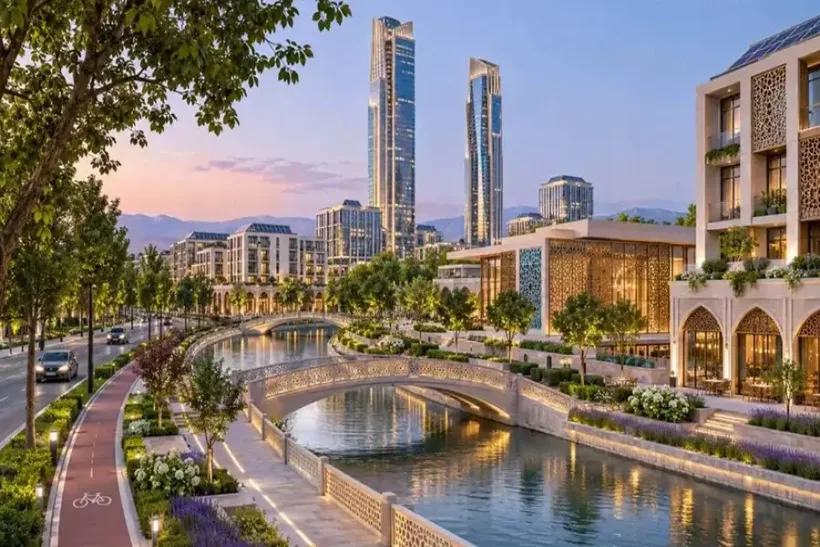
Gov.uz
Uzbekistan is introducing 20-year tax incentives for real estate investment. The measures apply to projects worth at least $50 million in New Tashkent and Samarkand, according to the Ministry of Investment, Industry and Trade. Developers are also being offered special terms for land allocation and major development projects.
Tax Incentives in Uzbekistan
Presidential Decree No. UP-243, dated November 10, 2026, which took effect on November 11, underpins the program. It establishes a special legal regime for New Tashkent and the Shirin area of Samarkand. The support targets companies carrying out approved urban development projects, rather than all buyers of apartments or commercial property.
The main benefit is a 20-year exemption from land and property taxes. It applies to properties developed under projects worth at least $50 million. The incentives do not automatically cover every property an investor owns in Uzbekistan: location, intended use and the terms of the individual agreement all matter.
Profits from renting out or selling completed properties qualify for a 1% tax rate. For direct investments of at least $50 million, the rate applies for five years; from $100 million, ten years; and from $500 million, fifteen years. This is a separate incentive: the 20-year exemption from the two property-related taxes does not mean that profit tax is waived for the same period.
|
Investment amount |
Profit tax rate |
Duration |
|
From $50 million |
1% |
5 years |
|
From $100 million |
1% |
10 years |
|
From $500 million |
1% |
15 years |
Note: The exemption from land and property taxes lasts 20 years.
Until January 1, 2040, dividends from these projects will not be taxed if they are reinvested in Uzbekistan. General contractors and design firms will receive VAT exemptions when purchasing certain services from foreign providers. Customs concessions will also apply to the import of equipment and materials during construction, within the prescribed limits.
Which Projects Qualify for Investment
Uzbekistan's investment program is not limited to housing. Eligible projects include hotels, business centers, shopping complexes, non-residential and mixed-use skyscrapers at least 200 meters tall, resorts and theme parks. Educational, healthcare, cultural, sports and utility infrastructure facilities may also qualify for support.
Land must be allocated by the special-zone directorate as a single lot, and each project must meet economic and architectural criteria. Retail, tourism and service developments require a preliminary agreement to bring in a leading international brand. Direct government funding of the project is generally excluded, except for engineering infrastructure.
An exception applies to hotels operated by well-known international chains: incentives may be available for investments below $50 million if the brand meets the specified ranking criteria. The benefits and each party's obligations will be set out in an individual investment agreement. Participation therefore requires approval rather than automatically granting tax relief.
Land and Guarantees for Investors
The authorities plan to offer investors land plots with technical conditions prepared in advance. Alongside auctions, a Swiss Challenge mechanism will be introduced: a company proposes a project, after which other bidders may offer better terms. If no competing offer is submitted, the original proponent receives the right to the plot.
Under the special regime, the starting land price may in some cases be reduced to $1 and the down payment to 10%, with the balance paid interest-free over four to seven years. Once a property is commissioned, investors may acquire ownership of the land at no additional cost or lease it for up to 49 years. The terms will be determined separately for each project.
The measures also include a 20% discount on infrastructure charges or the option of interest-free installments. Foreign investors have been promised ten years of protection against adverse legislative changes. The Ministry of Investment will maintain a register of agreements and assign a dedicated official to each project to support it through completion.
What Is Being Built in New Tashkent
New Tashkent is a separate city whose construction began in 2023. About 20,000 hectares have been allocated to the project, with the first phase covering 6,000 hectares. Under the authorities' plans, the city will have residential neighborhoods, a business district, universities, clinics, hotels and public spaces.
At an October meeting with entrepreneurs, the authorities acknowledged that private capital was being attracted slowly. Work financed mainly by the state was under way on more than 1,000 hectares, while 94 hectares had been allocated to investors. Two-thirds of these plots were intended for housing, and active construction had yet to begin on another 28 lots. Delays in permitting and cumbersome administrative procedures were among the reasons cited.
On October 12, seven facilities worth a combined $1 billion were commissioned, including the first phase of the Shark Bahori residential complex, a school, a park, and energy and road infrastructure. The same day, work began on ten new projects worth $2.5 billion involving companies from China, Turkey, the UAE and other countries. One is the Metropolis business district, with offices, a hotel, housing and retail space.
Projects planned for the first stage of the city's development are valued at $50 billion. These are plans, however, not funds already invested: as of October 2026, more than $2 billion had been invested in New Tashkent, according to official figures. The gap between the announced scale and the current level of private-sector participation helps explain why the authorities are offering such long tax incentives.
|
Indicator |
Value |
|
Total planned city area |
20,000 ha |
|
First-phase area |
6,000 ha |
|
Planned first-stage investment |
$50 billion |
|
Investment attracted by October 2026 |
Over $2 billion |
|
Facilities commissioned on October 12 |
$1 billion |
|
New projects launched on October 12 |
$2.5 billion |
Outlook for Investors in Uzbekistan
International Investment analysts note that Uzbekistan's new tax regime could lower costs for major developers, especially in the hotel, office and retail sectors, where it takes years to recover capital. For these businesses, land costs, utility connections and approval timelines are just as important as taxes.
The practical results will become clear only after tenders are held and investment agreements are signed. Project returns will depend on how quickly the new city attracts residents, its transport links with Tashkent and the creation of jobs. Hotels and office buildings need steady demand, while shopping centers need customers. Tax incentives alone guarantee neither occupancy nor high returns.
Some countries already have experience with largely empty developments and unfinished projects on a similar scale. In Malaysia's Forest City residential development, apartments and commercial premises remain vacant. By June 2026, the median transaction price had fallen by 12%, and the authorities were trying to revive the area through a special financial zone.
Even state-funded megaprojects are being reconsidered in the Middle East. In Saudi Arabia, construction of The Line, a planned 170-kilometer city, has been postponed until after 2030, while work on the Mukaab skyscraper, the centerpiece of Riyadh's New Murabba district, has been suspended. In the UAE, Masdar City continues to develop, but the original ambition of a fully zero-carbon city has been abandoned.
There is also an example of outright cancellation: in 2025, Senegal halted the $6 billion Akon City project and replaced it with a more modest development plan. These experiences show that long-term tax breaks are no substitute for phased development and testing demand before large-scale construction begins.
Real Estate Investment in Uzbekistan: Frequently Asked Questions
What tax incentives are available to real estate investors in Uzbekistan?
Approved projects in New Tashkent and Samarkand's Shirin area are exempt from land and property taxes for 20 years.
How much must investors put into real estate in Uzbekistan to qualify for tax incentives?
Generally, at least $50 million. Exceptions are available for some hotel projects involving international chains.
What is the profit tax rate for New Tashkent developers?
A 1% rate on income from selling and renting property applies for five, ten or fifteen years for investments of at least $50 million, $100 million and $500 million, respectively.
Which types of real estate in Uzbekistan qualify for incentives?
Approved projects involving hotels, business centers, shopping and mixed-use complexes, and other eligible properties in the designated areas.
Can individual apartment buyers in Uzbekistan claim the new tax incentives?
No. The program targets investment projects undertaken by developers, not ordinary apartment buyers.