












Foreign Direct Investment in Georgia Rises to $1.69 Billion
Foreign direct investment (FDI) inflows into Georgia increased by 7.6% in 2025 compared to 2024, reaching $1,688.7 million, according to the National Statistics Office. The capital structure was dominated by equity participation and reinvested earnings, while the role of debt financing declined. Leading sectors for investment included finance, transportation, information technology, and construction. These figures reflect growing international investor interest in the Georgian economy and its long-term potential.
FDI Dynamics in Georgia
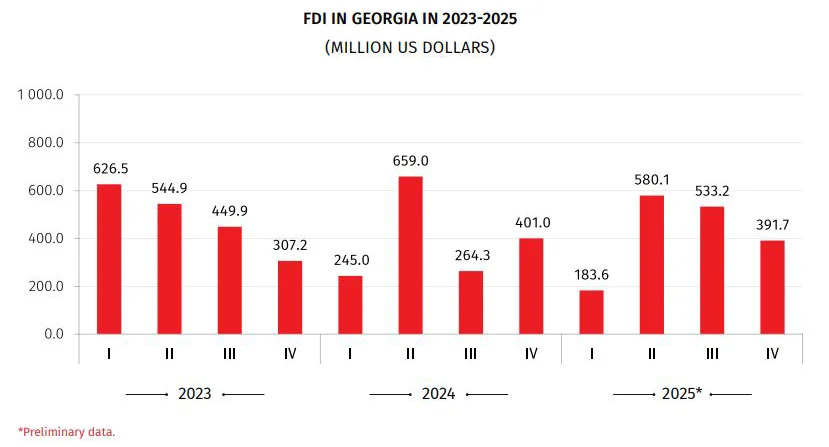
Quarterly data over the past three years illustrate shifts in investment activity. In 2023, investment inflows were high during the first half of the year: Q1 – $626.5 million, Q2 – $544.9 million, with a decline in Q4 to $307.2 million.
In 2024, the trend was more volatile. A weak start in Q1 ($245 million) was followed by a sharp increase in Q2 ($659 million), a drop in Q3 ($264.3 million), and a surge in Q4 to $401 million.
In 2025, the year began with $183.6 million, followed by a jump to $580.1 million in Q2. Q3 recorded one of the highest levels in recent years ($533.2 million), while Q4 remained substantial at $391.7 million.
Investment Structure in Georgia: Strengthening Quality
Geostat experts note a clear shift toward long-term equity investments and reinvested earnings, with debt instruments playing a limited role.
Equity Capital Growth
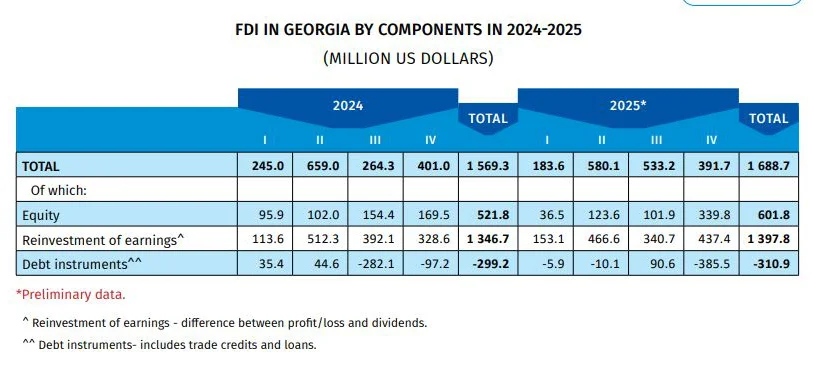
In 2025, equity investments reached $601.8 million (+15.3%). In Q4, inflows totaled $339.8 million – more than double the maximum figure for the same quarter in 2024 ($169.5 million). This growth indicates long-term investor intentions, including acquiring stakes in Georgian companies and establishing new businesses.
Reinvested Earnings
Reinvested earnings remained high. In Q4, they amounted to $437.4 million, and the annual total nearly reached $1.4 billion, up 3.8% from $1.34 billion in 2024. This demonstrates that foreign companies operating in Georgia are successfully conducting business and prefer reinvesting profits rather than distributing them as dividends.
Debt Instruments
Q4 2025 saw a net outflow of $385.5 million in debt instruments, reflecting repayment of intra-company loans exceeding new lending. Over 12 months, the net outflow totaled $310.9 million, slightly deeper than the 2024 level (-$299.2 million). However, this trend is offset by robust growth in equity capital and reinvested earnings, making the investment structure healthier and more sustainable.
Geography of Foreign Direct Investment in Georgia in 2025
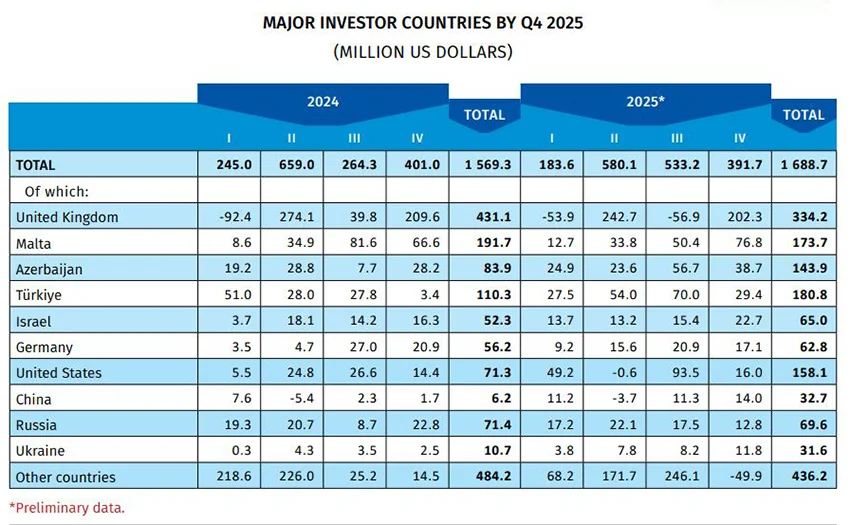
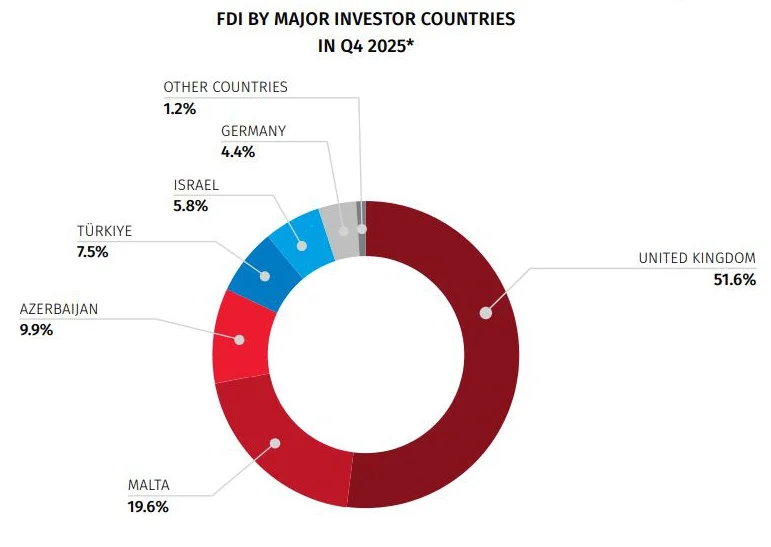
FDI in Georgia grew significantly due to both traditional partners and other countries. In Q4, the largest investors – the United Kingdom, Malta, and Azerbaijan – accounted for over 80% of total inflows, highlighting capital concentration among key players.
The United Kingdom led with a 51.6% share in Q4 ($202.3 million), while the total annual inflow reached $334.2 million, slightly below the 2024 level ($431.1 million). Quarterly peaks occurred in Q2 (~$243 million).
Malta increased Q4 investment from $66.6 million in 2024 to $76.8 million in 2025, with a total annual volume of $173.7 million, slightly below 2024 ($191.7 million). Azerbaijan nearly doubled its FDI to Georgia – from $83.9 million to $143.9 million, with Q3 ($56.7 million) being the largest, reflecting major energy and transport projects.
Turkey raised annual investments from $110.3 million to $180.8 million, concentrating activity in Q1 and Q3, while Q4 ($29.4 million) was moderate. The United States more than doubled annual inflows from $71.3 million to $158.1 million, with a Q3 peak ($93.5 million), showing strong corporate interest in infrastructure and technology projects.
Israel increased investments from $52.3 million to $65 million. China demonstrated almost sixfold growth – from $6.2 million to $32.7 million – signaling interest in long-term technology and infrastructure projects.
Russia maintained a high level of investment ($69.6 million), remaining a stable partner, albeit slightly lower than the previous year. Ukraine tripled its capital inflows – from $10.7 million to $31.6 million.
This pattern provides a foundation for the long-term stability of Georgia's economy and its integration into international investment flows.
Priority Investment Sectors in Georgia
Sectoral distribution in 2025 shows a shift toward high value-added and infrastructure projects.
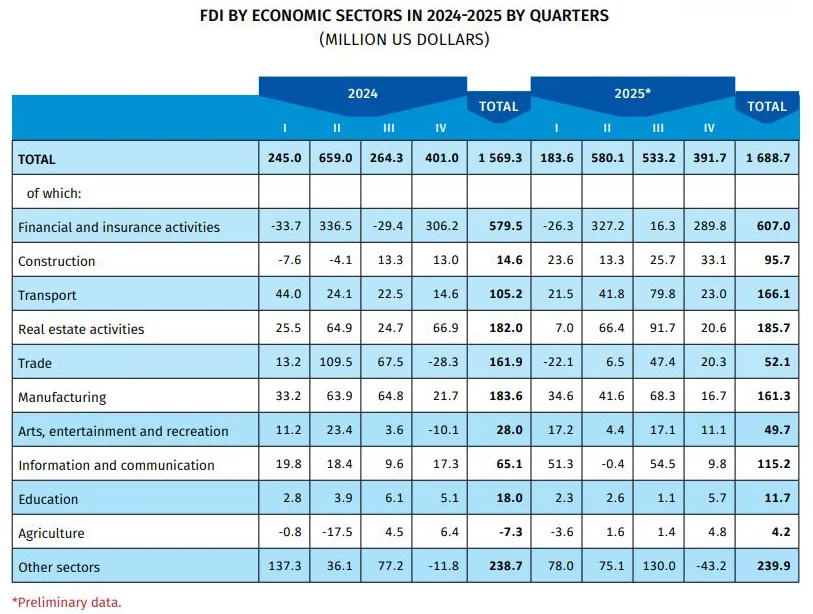
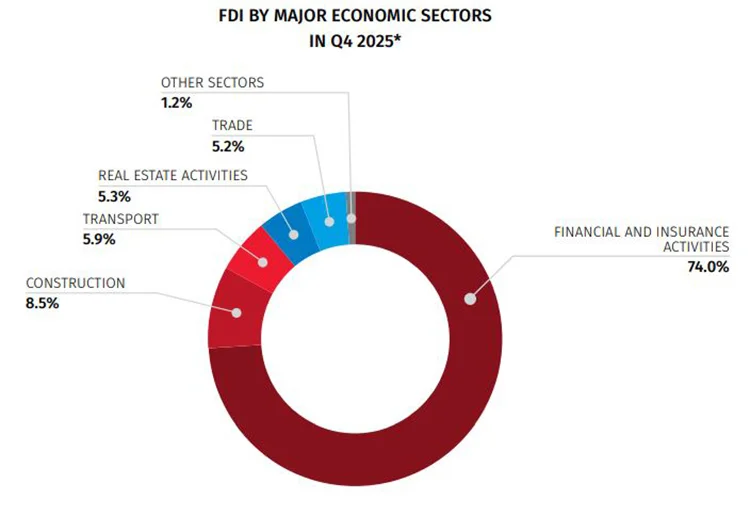
Finance and insurance remained dominant, attracting $607 million (35.9% of total FDI). In Q4, this sector accounted for 74% of all investments ($289.8 million), reflecting investor confidence in the Georgian banking system.
The transport sector grew to $166.1 million, up $60.9 million from 2024, highlighting Georgia's growing role as a transit hub and key international logistics link.
Information and communication expanded rapidly, reaching $115.2 million, a 1.5-fold increase, reflecting investor interest in digital infrastructure and high-tech projects.
Construction showed the largest absolute increase – rising by $81.1 million to $95.7 million from $14.6 million in 2024, indicating steady investment in infrastructure and residential projects.
Real estate remained strong at $185.7 million, among the highest in sectoral distribution.
Manufacturing attracted $161.3 million, retaining its importance for foreign capital. Despite a slight decline from the record 2024, the sector remains significant.
Agriculture returned to positive territory ($4.2 million) after -$7.3 million in 2024, showing renewed investor interest.
Arts, entertainment, and recreation grew to $49.7 million from $28.0 million, reflecting development of tourism and resort infrastructure.
Overall, finance, real estate, and transport accounted for 56.7% of all FDI in 2025, with Q4 showing even higher concentration (finance, construction, and transport captured 88.3% of investment inflows).
Structural Shift and Resilience of Georgia’s Investment Model
Analysts from International Investment note that FDI growth in Georgia was driven primarily by long-term equity and reinvested earnings rather than debt financing. The shift toward equity and reinvestment strengthens the stability of investment flows despite quarterly volatility caused by one-off debt operations. Geographic diversification is expanding: alongside traditional partners – the United Kingdom, Azerbaijan, and Turkey – the United States, European, and Asian countries are increasingly active.
Finance, transport, IT, and construction remain the main magnets for foreign capital, forming a foundation for long-term and sustainable economic development in Georgia. The combination of structural improvements and broadening of the geographic and sectoral base indicates that the Georgian economy is strengthening its position internationally and continuing its integration into global investment flows.