







 How Ukraine’s New-Build Housing Market Has Changed Over Four Years
 European Prime Rents Rise as Property Yields Turn Higher
 The Most Expensive Airlines in Europe in 2026
 Housing Prices in Italy Reach a Two-Year High
 Travellers Increasingly Choose Cooler Scandinavia
 Serbia Property Sales Decline as Transaction Value Rises
Budapest Prices Surge Before Champions League Final
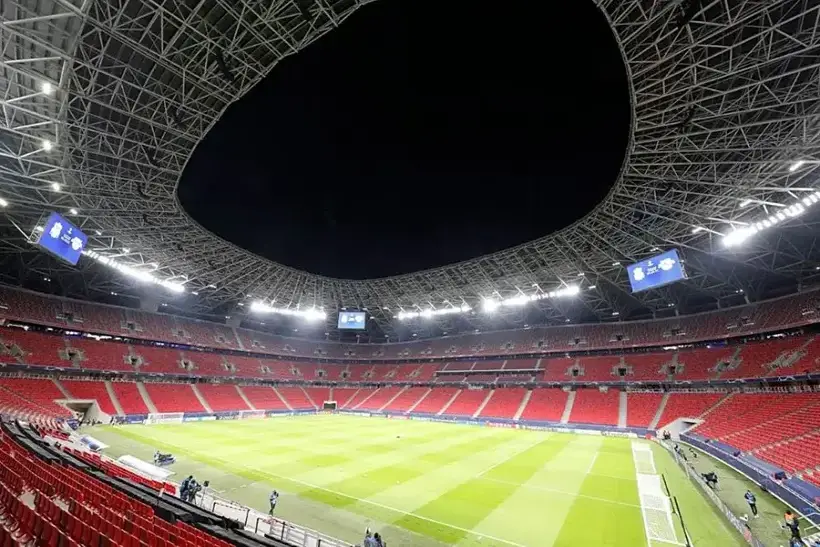
AP Photo/Laszlo Balogh
Budapest is entering late May with a sharp surge in tourism demand as the Champions League final between Arsenal and Paris Saint-Germain turns the Hungarian capital into one of Europe’s hottest short-term hotel markets. Airfares, hotels and short-term rentals are rising faster than normal seasonal patterns, giving the city a stress test as a host of global sports events.
The Champions League final lifts Budapest demand
The 2025/2026 UEFA Champions League final will be played on May 30, 2026, at Puskás Aréna in Budapest. Hungary’s official tourism portal says the country will host the final of Europe’s top club football competition for the first time, with the event expected to energise not only the stadium but the entire city, from fan zones to hotels, restaurants and transport.
Hungary Today, citing Kiwi.com data, reported that searches for flights to Hungary have nearly doubled before the match, with demand rising not only from Europe’s largest football markets but also from outside the continent. Daniela Chovancová, PR manager at Kiwi.com, said the final has turned Budapest into an international destination within days, pushing air and accommodation demand toward peak levels.
Hotels are moving toward full occupancy
The clearest effect is already visible in accommodation. Budapest is approaching the final with near-full occupancy, while hotel and apartment prices have increased sharply. This is not a normal late-May spike: a football final creates concentrated demand from supporters, corporate guests, sponsors, media, UEFA staff, tour operators and premium hospitality buyers.
Daily News Hungary reported that the Arsenal-PSG final has triggered a surge in flight and hotel prices as thousands of fans prepare to travel to the Hungarian capital. The outlet said hotels and aviation are under simultaneous pressure, with direct flights becoming more expensive and available rooms in convenient districts disappearing quickly.
Flights have become the main bottleneck
The Budapest final creates a specific challenge for Arsenal and PSG fans: the Hungarian capital has solid European connectivity, but its aviation market is smaller than London, Paris, Frankfurt or Munich. When demand appears almost simultaneously, direct flights rise quickly in price and passengers start looking at alternative routes through Vienna, Bratislava, Prague or long rail and coach connections.
The Financial Times reported that Arsenal fans faced a dramatic rise in travel costs, with some budget-airline tickets from London to Budapest increasing more than tenfold and average hotel prices reaching about €690 compared with €146 a year earlier. The newspaper also noted that Arsenal received 16,824 tickets for the final, while Puskás Aréna’s capacity limits the number of spectators.
PSG fans face the same logistics squeeze
French demand adds further pressure. Le Monde reported that PSG received 17,200 tickets, far below the club’s roughly 36,000 season-ticket holders. Interest in travel to Budapest rose 556% after PSG qualified, with some fans looking at alternative arrival cities because of expensive direct flights and scarce accommodation.
That makes the final a logistics event as much as a sporting one. Even fans without match tickets may travel for the atmosphere, fan zones, bars and city-centre screenings. As a result, pressure on hotels, short-term rentals, public transport and taxis may exceed the official stadium attendance.
Puskás Aréna tests the city’s infrastructure
Puskás Aréna has already hosted major international matches, including European Championship games and the 2023 Europa League final, but the Champions League final is a larger global event. UEFA has published an official Budapest event guide with information on city movement, the stadium, fan areas and matchday rules.
For Budapest, this is a chance to strengthen its status as a city capable of competing for Europe’s biggest sports events. It also adds pressure on Ferenc Liszt International Airport, railway stations, metro lines, hotels, police, security services, restaurants and districts near the stadium. The higher the demand, the greater the risk of queues, transport disruption, inflated prices and tensions over short-term rentals.
Tourism gets a short but expensive peak
Budapest’s tourism base was already strong before the final. Hungary’s Central Statistical Office said that in March 2026, nearly 1.2 million guests spent 2.7 million nights at tourist accommodation establishments across the country; arrivals rose 0.6% year on year and tourism nights increased 0.9%. The data show that the final is landing on top of an active tourism season rather than a weak market.
For hotels, this is close to an ideal setup: a strong seasonal base is amplified by a global event. For tourists and residents, the picture is more mixed. Accommodation prices rise faster than incomes, some ordinary travellers may delay visits, and residents in central districts face more noise, queues and short-term rental pressure.
Short-term rentals return to the political debate
The Champions League final arrives as Budapest is already debating the limits of tourist accommodation. The city has been tightening rules on short-term rentals, and District VI, Terézváros, banned the operation of private apartments as tourist accommodation from January 1, 2026. The Sun previously described the district, known for theatres, the Hungarian State Opera and Andrássy Avenue, as a symbol of the conflict between tourism and permanent housing.
The debate becomes more visible during major events. Owners can earn unusually high income over a few nights, but the city must decide how many apartments should serve visitors and how many should remain part of the long-term housing stock. The Champions League final strengthens both arguments: business sees revenue, while residents see pressure on neighbourhoods and prices.
The economic effect will be uneven
Hotels, airlines, restaurants, bars, taxis, transfer companies, short-term rentals and premium services are likely to benefit most. Museums, tour operators, retailers, souvenir sellers and delivery services may also gain. But the impact will be concentrated over a few days and in central districts rather than evenly distributed across the broader economy.
For property investors, the event demonstrates the power of event tourism in Budapest. Apartments, aparthotels and hotels near transport links, the centre and Puskás Aréna receive a short-term yield premium. But that income should not be treated as permanent: it depends on the event calendar, short-term rental rules, aviation capacity and the city’s willingness to handle mass tourism without tighter regulation.
Budapest gains visibility but risks overheating
The Champions League final gives Budapest a global showcase. Millions of viewers will see the city through broadcasts, tens of thousands of visitors will spend locally, and the Hungarian capital will strengthen its position in sports and event tourism. For a country competing with Prague, Vienna, Krakow and the Balkans for visitors, that marketing value is significant.
The risk is reputational overheating. If fans face excessive hotel prices, difficult logistics, inflated transport fares and ticket shortages, part of the experience will be negative. For the city, the challenge is to ensure that short-term revenue does not become a long-term argument against major events.
As reported by experts at International Investment, the Champions League final in Budapest is a major test for the tourism market, not just a football celebration. The critical issue is not whether the city can fill hotels: that is already happening. The real question is whether Budapest can convert several days of extreme demand into a durable reputation as a reliable event hub without deepening the conflict between the tourism economy, housing affordability and residents’ quality of life.