







 Vietnam Mortgage Surge Pushes Homes Out of Reach
 Lithuanian Apartment Prices Accelerate Across Major Cities
 London Flats Lose Value Ahead of Leasehold Reform
 Construction of the Batumi–Sarpi Highway Begins in Georgia
 Baltic Property Investment Accelerates in 2026
 Hong Kong and Singapore Renew Their Expat Rivalry
Bulgaria’s building sector faces a cooler 2026
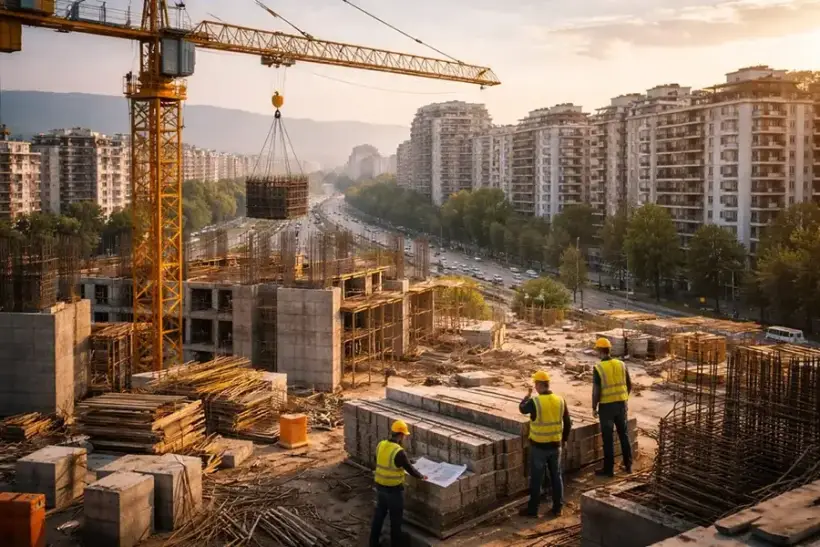
After a strong 2025, the market is moving into a slower phase
Bulgaria’s construction industry is expected to slow sharply in 2026 after a stronger performance in 2025. According to an industry report circulated via Yahoo Finance and other distribution platforms, real construction output is projected to decelerate from 4.7% growth in 2025 to 1.5% in 2026 because of lower budget funding for infrastructure. Even so, the medium-term outlook remains positive, with average annual growth of 3.7% forecast for 2026-2029.
That forecast comes as current official data still show a fairly resilient market. Bulgaria’s National Statistical Institute said the construction production index rose 3.1% in February 2026 from the previous month on a seasonally adjusted basis and increased 8.0% year on year. Building construction was the strongest segment, with annual growth of 16.8%, while civil engineering, which includes infrastructure works, rose 7.7%.
Bulgaria construction outlook for 2026
The central message of the new forecast is that Bulgaria’s construction market is not expected to contract, but to move from rapid expansion to a more restrained growth rate. The report says the slowdown in 2026 will be driven mainly by weaker infrastructure spending from the budget. That matters because infrastructure has been one of the sector’s key supports in recent years, alongside investment in energy and industrial projects.
The broader outlook is more supportive than the near-term one. GlobalData, as cited on the MarketResearch platform, expects Bulgaria’s construction industry to grow 3.9% in real terms in 2025 and then record an annual average growth rate of 3.7% between 2026 and 2029. That medium-term performance is expected to be supported by private and public investment in transport, renewable energy and industrial construction.
Why Bulgaria’s construction sector is slowing
The main reason is a shift in the structure of support. If 2025 benefited from stronger infrastructure-related spending, 2026 is expected to receive less momentum from that source. As a result, the sector is becoming more dependent on private investment, foreign capital, lending growth and the rollout of individual large projects rather than on budget-backed infrastructure alone.
Official data for the start of the year add nuance to that picture. In January 2026, Bulgaria’s overall construction production index fell 1.2% from the previous month, before rebounding by 3.1% in February. That kind of monthly volatility suggests the industry is entering 2026 with a less even expansion pattern, even though annual growth rates remain positive.
Residential construction in Bulgaria remains firm
Housing-related activity still looks stronger than the headline outlook. Bulgaria’s National Statistical Institute said municipalities issued permits in the fourth quarter of 2025 for 2,425 residential buildings containing 15,642 dwellings with 1.8 million square meters of gross building area. Compared with the same quarter of 2024, the number of permits for new residential buildings rose 26.6%, the number of dwellings increased 58.6%, and gross building area jumped 62.9%.
Project starts were also active. In the fourth quarter of 2025, construction began on 1,783 residential buildings with 9,177 dwellings and 1.16 million square meters of gross building area. From a year earlier, the number of started residential buildings rose 15.9% and their gross area increased 21.6%. That suggests developers entered 2026 with a relatively solid residential pipeline even as the broader sector is expected to slow.
Which projects may support the market after 2026
Despite the expected cooling, infrastructure is not disappearing from Bulgaria’s growth story. GlobalData links the longer-term expansion outlook to investment in transport, renewable energy and industrial projects. One of the supporting factors cited is the Transport Connectivity Programme 2021-2027, with investment of BGN 3.9 billion, or roughly $2.2 billion, aimed at improving the country’s transport infrastructure. The programme itself is listed on Bulgaria’s official EU funds portal.
That suggests the market is changing pace more than direction. In the near term, construction may find it harder to rely on budget-led infrastructure spending alone, but the medium-term base in transport, energy and industrial investment remains intact. That is why the 2026 forecast is weaker than the broader 2026-2029 outlook.
What the forecast means for Bulgaria’s economy
For Bulgaria’s economy, construction remains a useful indicator of investment momentum. When the sector slows because of lower infrastructure funding, the effect is usually felt not only by contractors but also by building-material producers, equipment suppliers, logistics firms and labor demand. At the same time, strong housing-permit and building-construction figures suggest that private activity is still offsetting part of the cooling.
As International Investment experts report, Bulgaria’s construction industry is likely to move in 2026 from a rapid recovery phase into a more mature one, where the key issue will no longer be whether the sector expands, but which segments are strong enough to replace a weaker budget-driven infrastructure impulse.
FAQ
What is the forecast for Bulgaria’s construction industry in 2026?
The industry report expects real growth to slow to 1.5% in 2026 after 4.7% in 2025.
Why is Bulgaria’s construction sector expected to slow?
The main reason cited is reduced budget funding for infrastructure projects.
What is the medium-term outlook for Bulgaria construction?
Average annual growth of 3.7% is forecast for 2026-2029.
What do the latest official statistics show?
In February 2026, construction production in Bulgaria rose 8.0% year on year, while building construction increased 16.8%.
What is happening in Bulgaria’s housing segment?
In the fourth quarter of 2025, permits for new residential buildings rose 26.6% from a year earlier, while dwellings in those buildings increased 58.6%.
Which segments may support the market after 2026?
Analysts point to transport, renewable energy and industrial construction.