











Israel Builds Faster Than Buyers Can Absorb

Israel entered the second half of 2026 with almost 84,100 new homes remaining for sale, equivalent to 28.9 months of supply. Unadjusted transaction volume is still below the previous year, but May produced a substantial recovery from an exceptionally weak April. Prices have begun to decline, mortgage lending remains high, and the construction pipeline continues to expand faster than projects are being completed.
Sales Declined, but May Changed the Picture
The original Semerenko Group analysis was based mainly on February–April data and emphasised the sharp April contraction, when only about 5,120 homes were sold. More recent March–May figures are now available, meaning that April should no longer be treated as the current monthly sales rate. Some of the article’s conclusions still rely on calculations derived from that single weak month.
Approximately 21,390 homes were sold between March and May 2026. That was 10.6% below the preceding three months and 5.7% below the corresponding period of 2025. After seasonal adjustment, however, sales increased by 2.4% from the previous period and by 0.5% annually. May generated about 8,350 transactions, including 3,700 new homes and 4,650 resale properties. Government-supported programmes represented approximately 32.5% of May new-home sales. The statistical trend shifted to average monthly growth of about 0.9% from February, pointing to a weak market with a partial recovery rather than an uninterrupted collapse.
The Resale Segment Remains More Exposed
New homes accounted for approximately 8,910 March–May transactions, while secondhand properties accounted for 12,480. New-home sales increased by 0.4% from the previous three months and by 8.2% annually.
Resale activity fell by 17.2% from the preceding three-month period and by 13.7% from a year earlier. Even after seasonal adjustment, the decreases were 8% and 9.1%, respectively.
Developers can support transactions through deferred payments, financing assistance and additional benefits. Private owners usually have fewer options and may have to compete through a lower final price or more flexible completion terms.
About 84,130 New Homes Remain for Sale
At the end of May, approximately 84,130 new homes remained available for sale, equivalent to 28.9 months of supply at the recent sales pace.
The measure improved slightly from April’s 29.5 months but remained high. The inventory trend has stabilised since December 2025 after increasing by an average of 1.4% a month between April 2022 and November 2025.
The Tel Aviv District contained 30.2% of the stock, or about 25,390 units, while the Central District held another 21,000. Jerusalem led individual cities with approximately 10,370 homes remaining for sale, followed by Tel Aviv–Jaffa with 9,810.
The figure does not represent 84,000 completed and vacant apartments. It includes developer-owned homes in projects at different stages of construction.
The 39- and 59-Month Estimates Are Stress Scenarios
The source article divides the total inventory by April sales, producing an estimated 39 months when all new-home transactions are included and 59 months when government-supported purchases are removed.
The arithmetic is correct, but the economic interpretation is limited. April was exceptionally weak, while the official supply measure uses a more stable recent sales rate. After activity recovered in May, the estimate declined to 28.9 months.
Subsidised transactions are also a genuine part of the market. Removing them from the denominator while retaining the full inventory does not provide a forecast of how long the entire stock will take to sell.
Prices Have Begun Responding to Weak Demand
The national dwelling price index declined by 1% when April–May transactions were compared with March–April. Because the two periods overlap, the result is not a conventional 1% decline occurring solely during one calendar month.
Prices were 2% below their April–May 2025 level, while the new-home index fell by 3.9% annually. Over five years, however, the general index remained 31.2% higher and the new-home index 29.9% higher.
The Central District recorded the largest annual decrease at 3.2%, followed by Haifa at 2.6% and Tel Aviv at 2.5%. Prices increased in the Northern and Jerusalem districts.
NIS 10,859 Is a Modelled Payment
The Alrov Institute’s Housing Affordability Index examines a typical four-room apartment in 12 major cities. For a 25-year mortgage financing 70% of the purchase price, the modelled average monthly payment was NIS 10,859 in the first quarter of 2026. The amount declined by 0.3% from the previous quarter and by 5.5% annually.
It is not the actual average payment made by every borrower and does not represent every four-room apartment.
The institute’s public page also does not provide sufficient data to verify the claim that exactly 70% of all first-home buyers would be unable to purchase the modelled property. That figure should not be presented as an official nationwide statistic.
Thirty Percent of Income Is Not a Regulatory Cutoff
The source article uses a rule under which mortgage payments should remain below 30% of net income. Dividing NIS 10,859 by 30% produces a required income of approximately NIS 36,200 a month, but this is an analytical benchmark rather than a binding banking rule.
The Bank of Israel classifies loans with a payment-to-income ratio above 40% as higher risk. Many mortgages are granted with ratios between 30% and 40%.
Maximum loan-to-value limits also differ by borrower. A single-home buyer may finance up to 75%, a replacement-home buyer up to 70%, and an investor up to 50%. The 70% used by the affordability index is therefore a model assumption rather than a universal requirement.
Mortgage Lending Remains Substantial
Seasonally adjusted new mortgage borrowing averaged approximately NIS 9 billion a month during April and May, compared with about NIS 10 billion during the first quarter.
Outstanding household housing debt reached approximately NIS 663 billion at the end of March, increasing by 1.5% during the quarter and by about 7.3% annually. Some 2026 mortgage disbursements finance purchases signed much earlier because new-development loans are often drawn in stages.
Mortgage volumes and current transaction numbers therefore measure different stages of the purchasing process and should not be expected to move together every month.
The Policy Rate Fell to 3.5%
The Bank of Israel reduced its policy rate by 0.25 percentage points to 3.5% on July 6. It was the third reduction of 2026 after cuts in January and May, bringing the cumulative decrease to 0.75 percentage points.
Lower rates may support demand and reduce payments on some variable-rate loans, but they do not eliminate the down-payment barrier or guarantee an identical reduction in all mortgage offers.
The Construction Pipeline Is Still Expanding
Construction began on approximately 76,470 homes between April 2025 and March 2026, an increase of 1.7% from the previous 12 months. About 62,140 homes were completed, a rise of 15.7%.
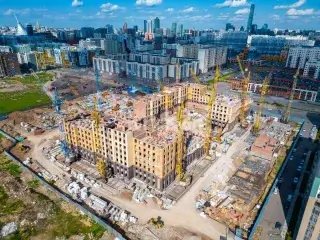
Starts exceeded completions by approximately 14,330 units. These homes will not enter the market immediately, but the difference indicates that the development pipeline continues to expand.
Faster completions increase effective supply, but they also intensify competition in cities where developers are already carrying large inventories.
Planning Announcements Are Not Current Inventory
A neighbourhood containing approximately 4,500 homes has been approved in Kiryat Shmona, together with public, commercial and transport infrastructure. The development must still proceed through land preparation, permits, financing and construction.
An umbrella infrastructure agreement worth about NIS 2 billion was signed for approximately 6,000 homes in the Israeli settlement of Karnei Shomron in the West Bank. The agreement does not mean that all units have building permits or will be marketed simultaneously.
Publicly available information does not define the Mevaseret Zion component with the same precision. Adding these initiatives together as 16,500 homes of immediate supply is therefore misleading.
Shortage and Oversupply Coexist
High national inventory does not mean that Israel has eliminated every housing shortage. Some homes are in the wrong location for a particular buyer, are priced above household budgets or will not be completed for several years.
At the same time, almost 29 months of supply contradicts the idea of a universal physical shortage. In some districts, the market is facing a shortage of financeable buyers rather than a shortage of apartments.
As International Investment experts report, Israel’s housing market has moved from a general shortage narrative toward segmentation by price, location and construction stage. Almost 84,100 new homes for sale are increasing pressure on developers but have not solved affordability, as modelled mortgage payments and required equity remain high. Rate cuts may temporarily support demand, but a large development pipeline and weak resale activity limit the scope for rapid price appreciation. The principal investor risk is purchasing a property whose price already assumes infrastructure and demand that may arrive years after the apartment itself.
FAQ: Israel’s Housing Market
How many homes were sold in spring 2026?
Approximately 21,390 homes were sold between March and May.
Are sales continuing to decline every month?
No. April was exceptionally weak, but May sales recovered to about 8,350 homes.
How many new homes remain for sale?
Approximately 84,130, equal to 28.9 months of supply.
Are all unsold homes completed?
No. The total includes projects at different stages of construction.
Does Israel have a housing glut?
Aggregate new-home inventory is high, but affordable housing in desirable, financeable locations may remain scarce.
How much have prices fallen?
The national index declined by 2% annually, while the new-home index fell by 3.9%.
What is the modelled mortgage payment?
NIS 10,859 a month for a typical four-room apartment financed at 70% over 25 years.
Must mortgage payments remain below 30% of income?
No. Thirty percent is a conservative guideline, not a binding regulatory ceiling. Loans above 40% of income are considered higher risk.
Why does mortgage borrowing remain high?
Many mortgages are drawn in stages and relate to purchases signed in earlier periods.
Does planning approval mean apartments will soon be available?
No. Planning, infrastructure, permits and construction can take several years.