







 Israel Cuts Rate to 3.25% for Third Meeting
 Russian and Belarusian Owners List More Latvian Property
 Georgian Law Enforcement Busts Scammers Posing as Real Estate Brokers
 World’s Largest Economies in 2026: GDP and Purchasing Power Rankings
 Turkish Airlines Cancel Flights to Moscow
 Escalation in the Middle East: New US and Iranian Strikes
Top 10 Countries With the Largest Private Wealth
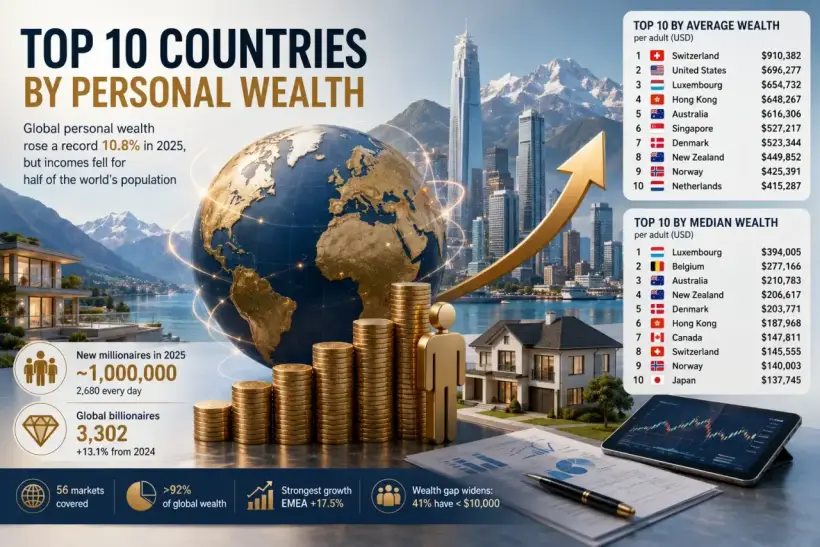
Global private wealth rose by a record 10.8% in 2025, but incomes fell for half the world's population
Swiss bank UBS has published its annual Global Wealth Report 2026, which shows that the world's total private wealth, measured in dollars, grew by 10.8% in 2025 – the fastest pace of growth in at least three years.
That figure significantly outpaced growth in 2024 (4.6%) and 2023 (4.2%). At the same time, the study recorded a deepening of wealth inequality: median wealth – a measure that more accurately reflects the position of a typical person – declined in most of the countries covered.
What's Behind the Surge
Global wealth growth was the fastest since 2017 and marked the third consecutive year of increase. The pace varied by region. Wealth grew fastest in Europe, the Middle East and Africa (EMEA), up 17.5%. The Americas followed with growth of 8.5%, while Asia-Pacific posted an increase of 5.9%, accelerating compared with 2024. Within EMEA, Eastern Europe stood out in particular, with wealth jumping by almost 28%. Lithuania led the growth in the number of millionaires in percentage terms, at 8%, followed by Turkey, Latvia and Hungary, each above 5%.
UBS analysts attribute the disparity between regions primarily to currency fluctuations. The weakening of the US dollar significantly boosted wealth figures outside the United States, since assets denominated in other currencies automatically gained value when converted into dollars. The euro alone strengthened against the dollar by almost 9%, which substantially lifted the dollar-denominated wealth estimates of eurozone residents.
The report covers 56 key markets, which the bank estimates account for more than 92% of global wealth.
The Millionaires' Club Grows by 2,680 People a Day
The world gained roughly one million new dollar millionaires over the year – an average increase of 2,680 people a day – with the total number of millionaires rising by 1.5%. The global millionaire population reached approximately 57.5 million people.
The United States produced the largest number of new millionaires: more than 440,000 Americans crossed the million-dollar threshold, equivalent to over 1,200 people a day, or nearly half of the global increase. The United Kingdom added more than 43,000 new millionaires, while France, Spain, Japan and India each added more than 30,000. The US is now home to more than 23.6 million dollar millionaires – over 40% of the global total.
The ultra-wealthy segment grew even faster: the number of dollar billionaires worldwide rose by 13.1% to 3,302 – 383 more than a year earlier.
The Wealthiest Countries: Switzerland and Luxembourg Split the Top Spot
Switzerland again ranked first in the world by average wealth per adult, while Luxembourg topped the ranking by median wealth, a measure that excludes the distorting effect of billionaires' extreme fortunes.
Top 10 countries by average wealth per adult (a figure heavily influenced by the number of billionaires residing in the country):
1. Switzerland – $910,382
2. United States – $696,277
3. Luxembourg – $654,732
4. Hong Kong – $648,267
5. Australia – $616,306
6. Singapore – $527,217
7. Denmark – $523,344
8. New Zealand – $449,852
9. Norway – $425,391
10. Netherlands – $415,287
Top 10 countries by median wealth (a figure that splits the population exactly in half and more accurately reflects the living standards of the typical middle class):
1. Luxembourg – $394,005
2. Belgium – $277,166
3. Australia – $210,783
4. New Zealand – $206,617
5. Denmark – $203,771
6. Hong Kong – $187,968
7. Canada – $147,811
8. Switzerland – $145,555
9. Norway – $140,003
10. Japan – $137,745
The gap between Switzerland's rankings in the two lists – first place by average wealth versus eighth by median wealth – vividly illustrates how the fortunes of the ultra-wealthy distort the picture of what a "typical" resident actually owns.
Since 2020, the wealth of the average resident has grown fastest in real terms (that is, adjusted for inflation) in South Korea – by more than 50%. Notable growth of over 25% was also recorded in Croatia, Norway, Latvia, Taiwan and Bulgaria.
A Widening Gap: Why Averages Don't Reflect Most People's Lives
UBS experts identify the divergence between average and median figures as the report's central paradox. While overall wealth is growing at a record pace, median wealth for the typical household actually declined in most of the countries tracked. The share of the world's adult population with wealth below $10,000 remains the largest category, at just over 41%, though it is gradually shrinking as people move into wealthier brackets.
The segment holding wealth between $5 million and $100 million is growing especially fast – so-called "millionaires' older siblings," whose fortunes range from $1-5 million. The bank estimates that since 2000, this group's wealth has grown by an average of 8.7% a year in real terms – more than twice as fast as that of "ordinary" millionaires, and far faster than average households. In mainland China, the wealth of residents holding between $50 million and $100 million grew by almost 31% a year over that period.
UBS chief economist Paul Donovan said the expansion of the middle tier of the "wealth pyramid" – the growing number of people with fortunes of one to several million dollars – is a more significant trend than the sharpening of the very top of the pyramid, even as overall inequality becomes more pronounced.
Donovan said the United States differs from most other developed economies in having a less even distribution of income and wealth, and that periods of strong stock market growth, like the recent one, further widen the gap between the top and the rest of the population.
Real Estate: An Inflation Hedge That Also Acts as a Barrier to Growth
The report also pays particular attention to the structure of household assets. For most middle-wealth families with fortunes between $1 million and $5 million, residential property remains the primary asset in their portfolio. On one hand, this has protected owners from the high inflation of recent years. On the other, a high concentration in real estate limits ordinary investors' participation in stock markets, which generated a significant share of global gains over the year.
Against this backdrop, UBS analysts expect growing interest among wealthy individuals in diversifying their assets in the coming years – shifting part of their capital away from traditional housing and into alternative investment instruments and foreign assets.
Donovan said that despite talk of growing geographic mobility of capital, the number of truly "nomadic" wealthy individuals remains relatively small. Most maintain social, family, linguistic and cultural ties to their place of residence, and only in rare cases, after severing those ties, do wealthy people actually relocate permanently to another country.
The Global Wealth Report 2026 is the seventeenth edition of UBS's annual study assessing the private wealth of residents in 56 of the world's largest markets.