











Saudi Arabia’s Economy Contracts by 4.8%
Saudi Arabia’s real gross domestic product contracted 4.8% year on year in the second quarter of 2026, recording its steepest decline since 2020. Oil activity fell by almost a quarter after disruption to exports through the Strait of Hormuz. Rerouting crude to the Red Sea preserved part of the flow but did not restore earlier volumes.
Saudi GDP Reverses Into Contraction
The downturn marked a sharp reversal from annual growth of 3% in the first quarter. Oil activity fell 24.7% from the second quarter of 2025. Non-oil activity expanded by 0.6%, while government activity grew by 0.9%, the Saudi General Authority for Statistics reported.
Oil activity subtracted 5.4 percentage points from annual GDP growth. Non-oil activity added 0.4 percentage points, while government activity and net taxes on products contributed 0.1 percentage point each. Those gains were too small to offset the oil-sector decline.
Gross domestic product measures the value of goods and services produced within a country. Real GDP is adjusted for changes in prices. Higher oil prices can therefore increase export earnings and government revenue without raising real output when production volumes fall.
The figures are flash estimates produced about 30 days after the end of the quarter, when some data remain incomplete. They rely on indicators covering production, expenditure, income, prices and foreign trade, with simplified extrapolation used for some components. The subsequent detailed national accounts may refine the initial result.
Oil Activity Falls 21.5% From Previous Quarter
Seasonally adjusted GDP fell 4.9% from the first quarter. Seasonal adjustment removes recurring effects associated with holidays, weather, calendar changes and the number of working days.
Oil activity contracted 21.5% quarter on quarter and subtracted 4.5 percentage points from GDP. Non-oil activity declined 0.5%, reducing the result by another 0.3 percentage points. Net taxes on products subtracted 0.1 percentage point, while government activity added about 0.03 percentage point.
The annual and quarterly figures describe different comparisons. Annual growth of 0.6% means non-oil output remained slightly above its level in April–June 2025. The 0.5% quarterly decline indicates weakening short-term momentum, but the flash estimate does not identify which individual non-oil industries were responsible.
Bloomberg described the contraction as the steepest since 2020. Unlike the pandemic downturn, the latest decline was concentrated in oil, while non-oil and government activity retained modest annual growth.
Hormuz Disruption Hits Saudi Oil Exports
Saudi Arabia entered 2026 with strong momentum. Its economy expanded 4.6% in 2025 as OPEC+ production cuts were unwound and domestic demand remained robust. OPEC+ combines the Organization of the Petroleum Exporting Countries with allied producers that coordinate output targets.
Conditions changed after the Middle East conflict brought commercial shipping through the Strait of Hormuz close to a halt. The waterway connects the Gulf with the Arabian Sea and carries a significant share of the region’s oil and petroleum-product exports.
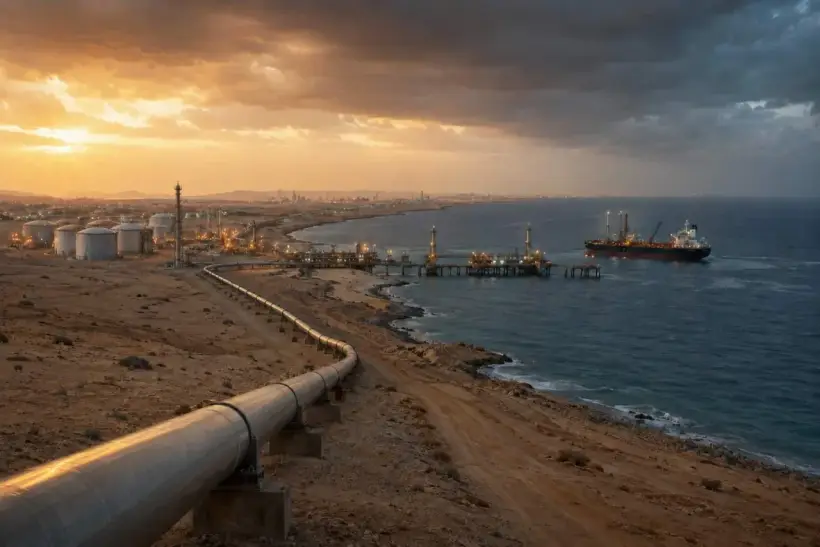
The disruption curtailed trade and oil exports while increasing shipping and insurance costs. Saudi Arabia redirected more crude through its East–West Pipeline, which carries oil from the eastern part of the country to Yanbu on the Red Sea.
The pipeline bypasses Hormuz, but the western route failed to maintain January export volumes. Wood Mackenzie estimated that Yanbu loadings peaked at about 4.07 million barrels a day in March before falling to 2.39 million in June. The June figure was 41% below the March peak and 66% below Saudi Arabia’s total January exports of about 7.96 million barrels a day.
Yanbu’s share of Saudi seaborne crude loadings rose from 86.7% in March to 98.6% in June. Almost all available shipments were redirected to the Red Sea, even as total volumes continued to fall.
Crude exports from the Middle East Gulf declined from 18.8 million barrels a day in January to approximately 3.4 million in June, an 82% drop. By early July, movements of very large crude carriers through Hormuz had partially recovered but remained 30% below pre-conflict levels. Freight rates were about three times higher.
Higher Oil Prices Support Fiscal Revenue
Lower physical exports did not produce an equivalent decline in oil revenue. Higher global prices allowed Saudi Arabia to earn more for each barrel delivered and helped protect public finances.
The International Monetary Fund estimated that the price increase had more than offset the loss of export volumes in revenue terms. The resulting windfall is expected to narrow the fiscal and current-account deficits.
The price effect does not eliminate the decline in real production. Real GDP measures changes in the physical volume of extraction and refining rather than only the export value of crude.
The fund expects Saudi growth to slow from 4.6% in 2025 to 1.7% in 2026, with non-oil GDP expanding by 2.6%. Overall growth could accelerate to 5.5% in 2027 if oil activity and maritime transport gradually normalize.
Average inflation is forecast at 2.2% in 2026. The fiscal deficit is projected at 3.7% of GDP, public debt at 32.1% and the current-account deficit at 0.3%. The outlook remains dependent on the duration of the conflict and the restoration of traffic through Hormuz.
Saudi Budget Growth Assumption Faces Revision
Saudi Arabia’s budget, approved before the transport crisis intensified, assumed real GDP growth of 4.6% in 2026. The IMF projection is 2.9 percentage points below that original estimate.
The Saudi Ministry of Finance projected revenue of 1.147 trillion riyals and expenditure of 1.313 trillion riyals. The planned deficit was approximately 165 billion riyals, equivalent to 3.3% of GDP. Public debt was expected to reach 1.622 trillion riyals, or 32.7% of GDP.
Higher oil prices may improve revenue and deficit figures relative to the original plan. Weaker real activity could simultaneously increase risks to non-oil receipts and government development programmes. The final outcome will depend on export volumes, crude prices and spending on Vision 2030 projects.
As International Investment experts report, the contraction exposes a dual reality for the Saudi economy: high oil prices support the budget but cannot offset lower physical production in real GDP. Redirecting exports to the Red Sea reduced reliance on Hormuz without eliminating logistical constraints. Annual non-oil growth of 0.6% also remains too weak to counter a 24.7% decline in oil activity.
FAQ on Saudi Arabia’s Economy
Why did Saudi Arabia’s economy contract?
The main cause was a 24.7% annual decline in oil activity. Restricted shipping through the Strait of Hormuz reduced export capacity, while the Yanbu route replaced only part of the lost flow.
How much did Saudi GDP fall?
Real GDP contracted 4.8% year on year in the second quarter of 2026. On a seasonally adjusted basis, output declined 4.9% from the previous quarter.
What is included in Saudi oil activity?
The statistical category covers crude oil and natural-gas extraction as well as refining. The flash estimate does not provide a separate contribution for each component.
Why did higher oil prices not prevent the contraction?
Higher prices increase export earnings, but real GDP measures physical production. Output can therefore decline even when each exported barrel generates more revenue.
What is the Saudi growth forecast for 2026?
The current projection indicates full-year real GDP growth of 1.7%. The outcome will depend on oil production, access to export routes and the performance of non-oil activity.