







 Covivio Hotels Revenue Grows 4.7% as European Markets Split
 Lithuanian Apartment Prices Accelerate Across Major Cities
 Georgia's Tourism Revenue Hits Record High
 Norway's Sovereign Fund Commits €1.5bn to European Warehouses
 Market Rout of October 2026: Can Branded Hotels Protect Capital?
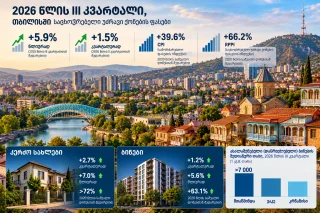 Residential Property Prices in Tbilisi Rise by 5.9% Year-on-Year
Middle Corridor in Georgia: $7 Billion for Transport Infrastructure Development
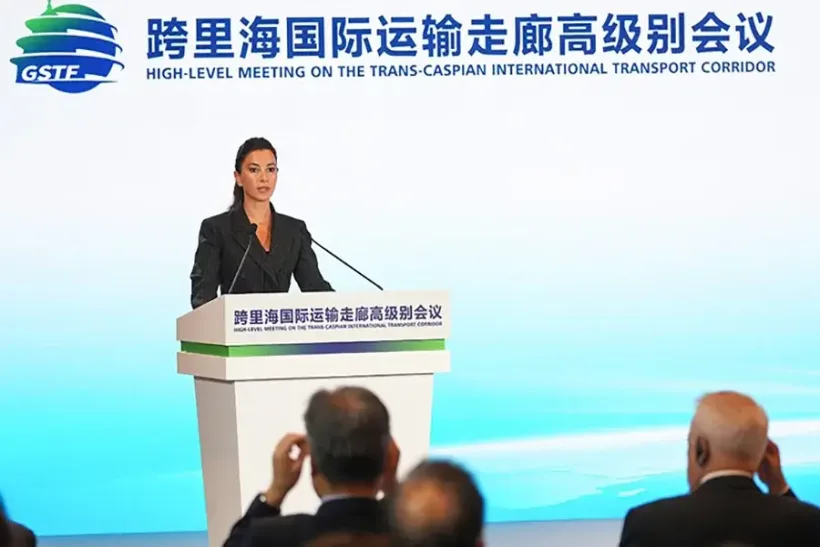
Georgia plans to double the capacity of its maritime and railway networks and triple the combined capacity of its airports. Around $7 billion is expected to be allocated to priority projects in this sector by 2032, Minister of Economy and Sustainable Development Mariam Kvrivishvili said at the Global Sustainable Transport Forum in China.
Development of the Middle Corridor: Between Asia and Europe
The Global Sustainable Transport Forum was held in China on September 22, with the development of the Middle Corridor among the issues discussed. Participants joined a common initiative aimed at improving the route’s reliability, efficiency and competitiveness.
The main areas of cooperation include coordinating transport policies, developing infrastructure, improving customs and border procedures, and introducing digital technologies. The countries also plan to increase business involvement and strengthen cooperation among the states along the route.
Georgia’s Minister of Economy and Sustainable Development Mariam Kvrivishvili noted that the Middle Corridor was previously viewed primarily as an alternative route between Asian and European markets. Its importance is now growing amid rising freight volumes, major infrastructure investment and expanding regional cooperation. Further development will require closer coordination between different modes of transport.
BM.GE notes that the Middle Corridor, also known as the Trans-Caspian International Transport Route, connects China and Central Asia with Europe via the Caspian Sea and the South Caucasus. China, Kazakhstan, Azerbaijan, Georgia and Türkiye are involved in the route’s development.
Georgia’s Transport Development Plan
$7 Billion for Infrastructure Development
In January–August 2026, Georgia’s ports and terminals handled 13.7 million tonnes of cargo, up 24% from 2025. Rail freight reached 9.7 million tonnes (+11%), while transit freight increased by 14%. Container throughput rose by 9% to 554,200 TEUs — standard units equivalent to a 20-foot shipping container. Mariam Kvrivishvili noted that this growth requires the country to prepare its transport system for further increases in traffic.
To address this, Georgia has developed a ten-year strategic roadmap. More than GEL 1 billion ($384 million) is being allocated in 2026 to upgrade railway infrastructure and rolling stock. Around $7 billion is earmarked for priority infrastructure projects through 2032. The country plans to double the capacity of its maritime and railway networks and triple the combined capacity of its airports.
Anaklia Deep-Sea Port
Mariam Kvrivishvili named the Anaklia Deep-Sea Port as one of the key projects along the Middle Corridor. The first phase is designed to handle 10 million tonnes of bulk and general cargo and 600,000 TEUs of containers. Operations are scheduled to begin in 2029.
A railway branch and a road are planned to connect Anaklia to the transport network. The design of the railway connection has already been completed, and a construction tender is expected to be announced by the end of October 2026.
The project is being implemented under the international landlord port model, which provides for the participation of private investors. The new port is expected to expand Georgia’s cargo-handling capacity on the Black Sea and strengthen its position as a transit hub.
Batumi–Sarpi Highway
Another Middle Corridor project is the Batumi–Sarpi highway, which will connect the Batumi bypass with the Georgian-Turkish border and complete the western section of the East–West Highway. The contract for construction of the 11.3-kilometre section was signed on September 9. The project includes a 7.6-kilometre tunnel and three bridges.
Once the new highway opens, international and transit traffic will be diverted from the coastal road running through densely populated areas of Adjara, including the resorts of Gonio and Kvariati. The project is valued at more than GEL 809 million ($311 million), with construction expected to take 48 months. It will be financed by the Asian Development Bank and Georgia’s state budget.
Coordinating the Middle Corridor
Azerbaijan, Kazakhstan and other Central Asian countries are also expanding their transport and logistics capacity. China is investing in railway, port and digital infrastructure and supporting the Belt and Road Initiative and the China-Europe Railway Express. Mariam Kvrivishvili described China as one of the main driving forces behind the development of the Middle Corridor. Georgia is ready to continue cooperation with Beijing and other countries along the route.
Infrastructure expansion across different countries requires coordinated action. Special mechanisms are therefore being established at ministerial and working-group levels to coordinate projects and address bottlenecks along the freight route.
Key priorities include reducing transit times, improving border and customs procedures, ensuring interoperability between digital systems, and introducing competitive and transparent unified tariffs. These measures are intended to make freight transportation more efficient and predictable from origin to destination. In the longer term, the Middle Corridor is expected to evolve from a transport route into a broader economic corridor connecting markets, attracting investment and creating new opportunities for the region.
The Importance of the Middle Corridor for Georgia
International Investment analysts note that the Middle Corridor is strengthening Georgia’s position in transport links between Asia and Europe. Increased capacity will allow the country to handle more transit traffic and integrate more deeply into international trade. Modernization of ports, railways, roads and airports creates additional opportunities for the logistics sector, improves access to regions and tourist destinations, and supports private investment.
These developments could also affect the structure of investment in Georgia, where foreign buyers have traditionally shown strong interest in real estate. As residential property yields decline, attention is gradually shifting toward the hospitality sector. Premium properties operating under international brands and managed by professional operators are attracting particular interest, offering a more resilient business model and potentially higher returns. Improved transport accessibility and stronger international connectivity could further increase the appeal of such projects.