







 Covivio Hotels Revenue Grows 4.7% as European Markets Split
 Lithuanian Apartment Prices Accelerate Across Major Cities
 Georgia's Tourism Revenue Hits Record High
 Norway's Sovereign Fund Commits €1.5bn to European Warehouses
 Market Rout of October 2026: Can Branded Hotels Protect Capital?
 Residential Property Prices in Tbilisi Rise by 5.9% Year-on-Year
Investment Fund Crisis in Turkey: 455,000 Fund Holders Await Payments

Turkey’s investment fund crisis has intensified: 131 funds are being liquidated, while more than 455,000 fund holders are awaiting payments. The problems began after a sharp outflow of capital and a shortage of liquidity needed to return money to clients. Asset sales accelerated the decline in stock prices, prompting regulators and law enforcement agencies to intervene. The authorities are also preparing changes to the rules governing the sector.
How Turkey’s Investment Fund Crisis Began
In late August 2026, Turkey’s Capital Markets Board (SPK) introduced new restrictions for investment funds with significant exposure to illiquid stocks. The regulator imposed limits on such investments and tightened requirements for asset management companies. The new rules forced some market participants to reassess their portfolio composition and liquidity needs, Reuters notes.
The problems escalated in mid-September. Pusula Portföy was the first to report that it was unable to meet some fund redemption requests. Tera Portföy soon reported similar difficulties. Funds began selling their most liquid securities to meet payments to clients because other assets could not be sold quickly without substantial losses in value. This intensified the decline in stock prices and triggered further redemption requests.
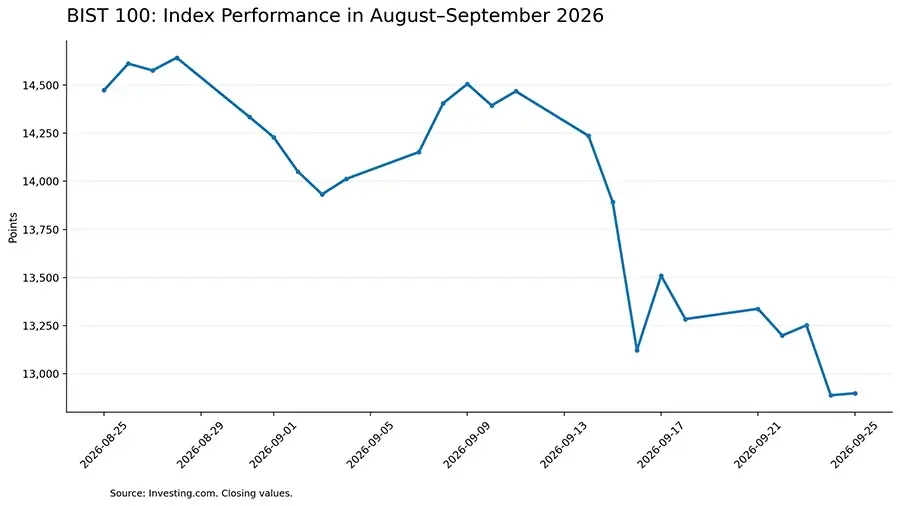
Over the course of a week, the BIST 100, the benchmark index of the Istanbul Stock Exchange, lost more than 8% — its worst weekly performance since March 2025. Following the sharp decline, the authorities began taking measures to stabilize the market, while the SPK ordered the liquidation of 131 investment funds managed by seven companies.
Turkey Liquidates 131 Investment Funds
On September 17, 2026, Turkey’s Capital Markets Board (SPK) decided to liquidate 131 funds managed by seven companies and suspended transactions involving them through the electronic TEFAS platform. According to the Central Securities Depository (MKK), the funds held assets belonging to 455,758 unique clients. Purchase and redemption orders submitted on the day of the suspension but not executed were cancelled.
The liquidation process was initially expected to take three months, but on September 21 the SPK extended the maximum period to six months. The regulator attributed the decision to the composition of the portfolios and the need to take market conditions into account when selling assets in order to limit potential losses. Six months is the maximum period, meaning that settlements may be completed earlier. On September 28, the SPK clarified that clients whose fund redemption requests remained unexecuted on September 17 retain their right to receive payments. Money will be distributed as fund assets are sold, in proportion to each participant’s share of the remaining assets.
Turkish Prosecutors Investigate Investment Fund Transactions
The Istanbul Chief Public Prosecutor’s Office received referrals from Turkey’s Capital Markets Board (SPK) and on September 17 requested information from the Financial Crimes Investigation Board (MASAK) concerning executives of Pusula Finans Holding, Tera Yatırım Menkul Değerler, Hedef Holding and Bulls Yatırım Menkul Değerler, as well as companies belonging to these groups, Anadolu reports.
By September 26, the investigation covered transactions involving 46 legal entities, 18 funds and 42 individuals. Turkish Justice Minister Akın Gürlek said investigators were examining possible violations of capital markets legislation, fraud and money laundering. Judicial control measures were imposed on 37 suspects. These remain allegations under investigation, with final conclusions to be determined by the courts.
On September 27, a court issued arrest warrants for Tera Yatırım CEO Emir Münir Sarpyener and Tera Portföy Chairman Erdin Özel. On September 28, prosecutors announced that precautionary measures had been lifted from 45 companies and 19 Turkish funds following a new assessment of information received from the SPK and other authorities. The investigation itself is continuing.
Turkey Prepares New Rules for Investment Funds
President Recep Tayyip Erdoğan said on September 24 that the authorities did not consider the situation a threat to Turkey’s financial system or economy as a whole. In his assessment, the problems were concentrated in a limited segment of the market. He also ordered a thorough investigation into the causes of the events and the preparation of legal and administrative changes aimed at reducing the likelihood of similar situations recurring.
Finance Minister Mehmet Şimşek said on September 28 that government agencies continued to take measures to protect the legitimate rights of market participants. The authorities are also providing the necessary liquidity and seeking to prevent the problems from spreading to the financial system and the real economy. Şimşek stressed that measures should not be applied to individuals or legal entities that were not involved in market-disrupting transactions.
The next stage will be a discussion of the situation at cabinet level. Habertürk reports that the investigation into Turkey’s investment funds will be one of the main topics at the September 28 meeting chaired by Erdoğan. The government plans to review the progress of the investigation and proposals for legal and administrative measures.
What This Means for Investors
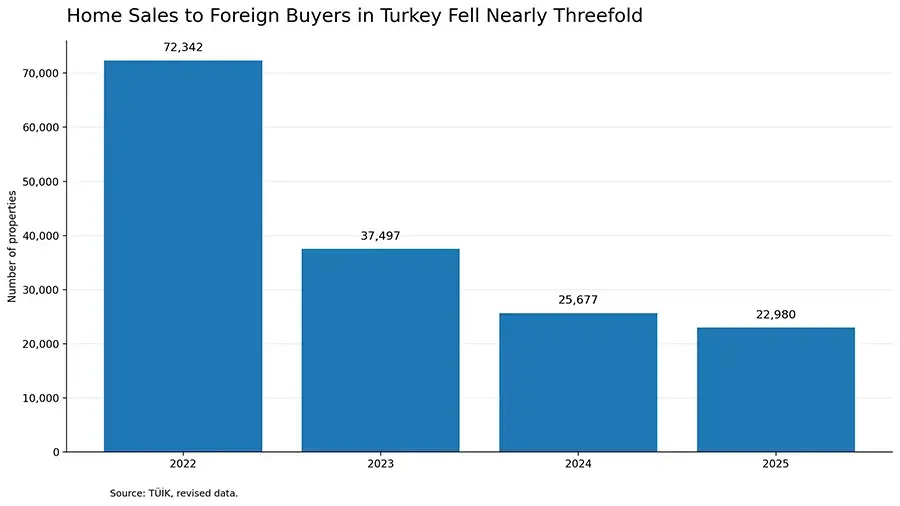
International Investment analysts note that the fund crisis adds new risks for foreign capital in Turkey, where overseas demand for real estate has already declined substantially. According to the Turkish Statistical Institute (TÜİK), foreign buyers purchased 72,342 residential properties in 2022, compared with 22,980 in 2025 — nearly three times fewer. In January–April 2026, the number of transactions fell by a further 11.6% year-on-year. Interest in real estate has been affected by the increase in the minimum property investment required for citizenship to $400,000, changes in conditions for foreigners, tighter short-term rental rules and the earthquakes.
The situation involving investment funds is increasing uncertainty for foreign investors. Currency and macroeconomic factors are now accompanied by concerns over the liquidity of individual instruments, the quality of asset management and the ability to withdraw funds in a timely manner. In the near term, this could lead to a more cautious approach to investments in Turkey.
Future investment dynamics will largely be shaped by the authorities’ actions. Tighter oversight could strengthen the sector, but frequent changes in requirements make long-term planning more difficult and may restrain new investment.