







 Covivio Hotels Revenue Grows 4.7% as European Markets Split
 Lithuanian Apartment Prices Accelerate Across Major Cities
 Georgia's Tourism Revenue Hits Record High
 Norway's Sovereign Fund Commits €1.5bn to European Warehouses
 Market Rout of October 2026: Can Branded Hotels Protect Capital?
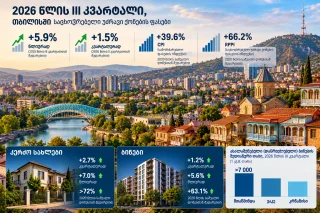 Residential Property Prices in Tbilisi Rise by 5.9% Year-on-Year
Georgia’s Hospitality Sector Outpaced Construction in Turnover Growth

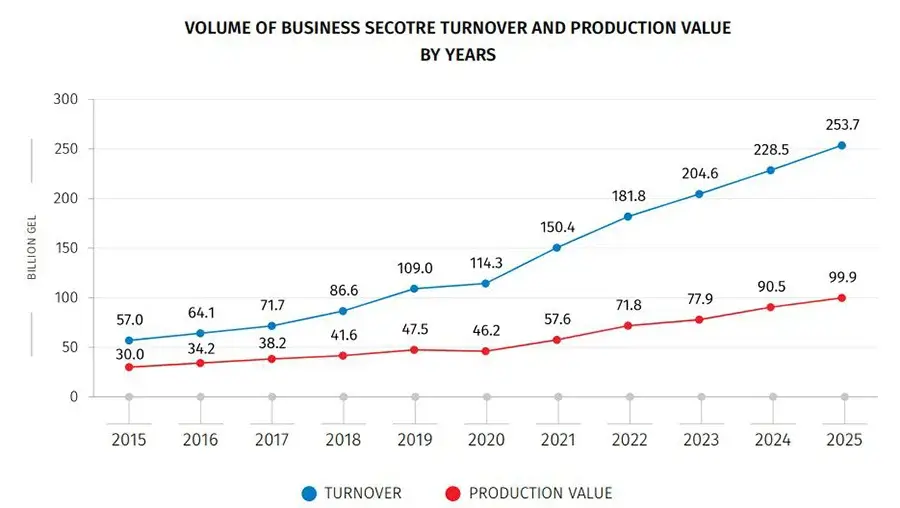
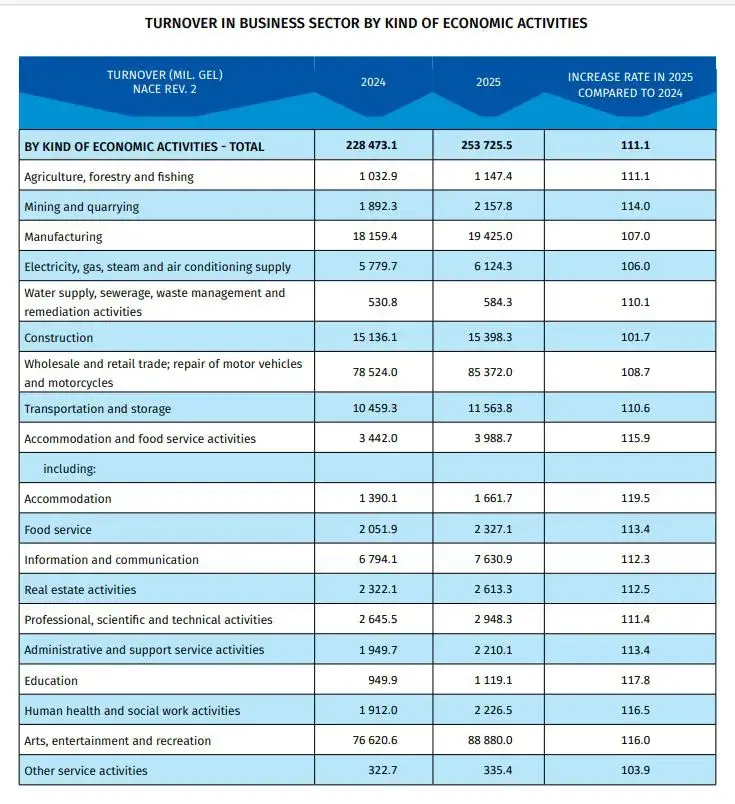
Georgia’s hospitality sector recorded significantly stronger turnover growth than construction in 2025. Real estate activities also expanded faster than the business-sector average, according to the National Statistics Office of Georgia (Geostat). Total turnover across the country’s enterprises rose by 11.1% to 253.7 billion lari. The expansion in business activity was accompanied by increases in employment and wages.
Key Business Indicators in Georgia
In 2025, total turnover across Georgian enterprises reached 253.7 billion lari, up 11.1% from 2024 (₾228.5 billion). The value of goods produced and services provided increased by 10.3% to ₾99.9 billion. Enterprises purchased goods and services worth ₾123.5 billion (+7.6%), including ₾76.4 billion intended for resale (+7%).
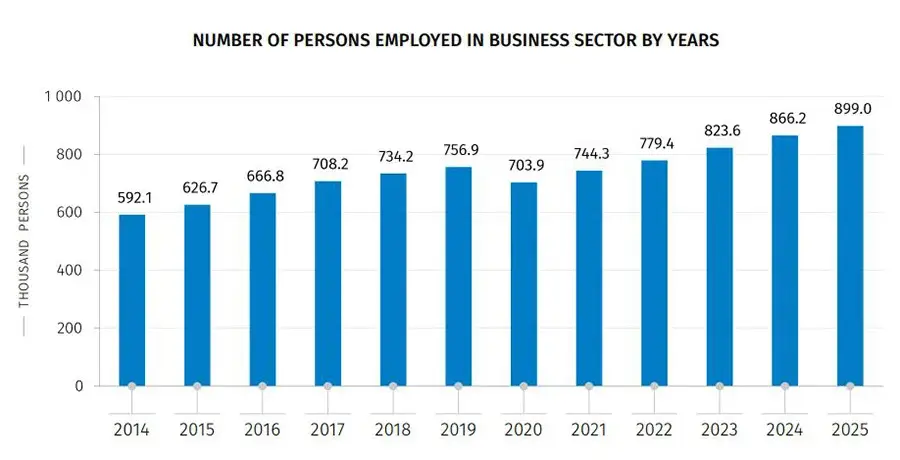
Average annual employment in the business sector reached 899,026, an increase of 3.8%. Personnel costs rose by 12.2% to ₾22.3 billion. Average monthly pay stood at ₾2,198.4, an increase of ₾173.9.
Turnover grew almost three times as fast as employment, although personnel costs increased at a higher rate. The monetary figures are not adjusted for price changes, so their movements do not directly reflect growth in physical production volumes.
Georgia’s Business Sector by Industry
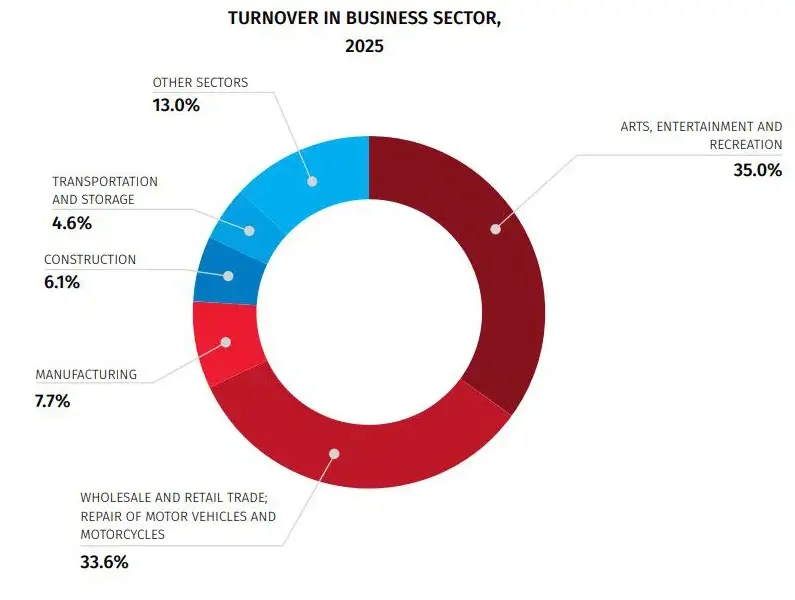
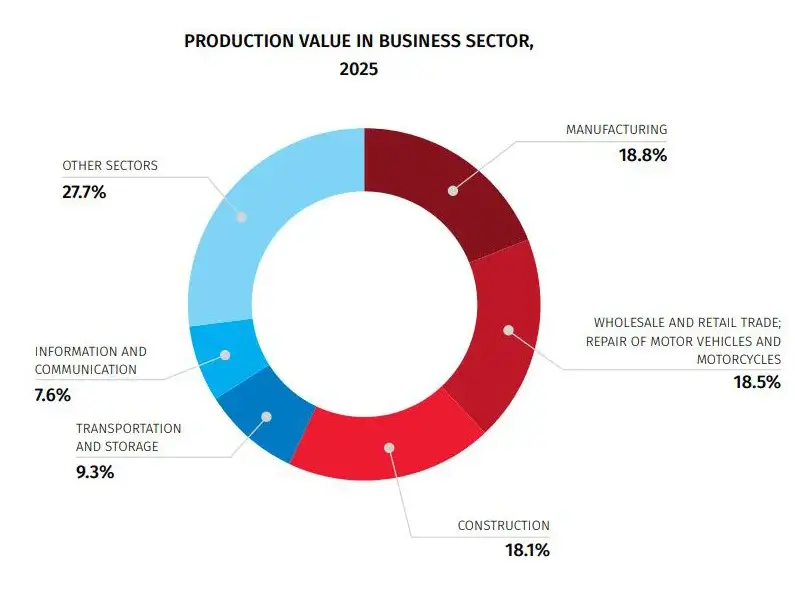
Arts, entertainment and recreation led in turnover, generating ₾88.9 billion (+16%), or 35% of the total. The value of goods produced and services provided in this sector reached ₾4.3 billion (+15.5%), equivalent to approximately 4.3% of total output. Its share of turnover was therefore considerably greater than its contribution to output.
Wholesale and retail trade, including the repair of motor vehicles and motorcycles, ranked second on both measures. Turnover increased by 8.7% to ₾85.4 billion, accounting for 33.6% of the business-sector total. Output rose by 10.2% to ₾18.5 billion, representing an 18.5% share. Together, trade and entertainment generated more than two-thirds of total business turnover.
Manufacturing ranked first by output value, at ₾18.8 billion (+9.5%), or 18.8% of the total. Its turnover amounted to ₾19.4 billion (+7%), giving it a 7.7% share. Construction showed a similar pattern, accounting for 18.1% of output and 6.1% of turnover.
Transportation and storage recorded turnover of ₾11.6 billion (+10.6%) and output of ₾9.3 billion (+12%). Their respective shares were 4.6% and 9.3%. In information and communication, both figures approached ₾7.6 billion, although their growth rates differed: 12.3% for turnover and 10.5% for output. This industry accounted for 7.6% of the total value of goods produced and services provided.
Construction and Real Estate in Georgia
Turnover among construction enterprises increased by 1.7% to ₾15.4 billion. This was the lowest growth rate among the industries covered in the report, compared with the business-sector average of 11.1%. The increase amounted to ₾262.2 million in absolute terms.
Output value rose by 6.5% to ₾18.1 billion, exceeding the 2024 figure by ₾1.1 billion. Construction ranked third on this measure, behind manufacturing and trade. It accounted for 18.1% of total output, compared with 6.1% of overall turnover. Employment remained almost unchanged at 70,031 (+0.4%), representing 7.8% of all persons employed by the surveyed enterprises.
Turnover in real estate activities reached ₾2.6 billion (+12.5%). The value of services provided increased by 14.9% to ₾2.7 billion. Both measures grew faster than the Georgian business-sector average. The increases amounted to ₾291.2 million and ₾348 million, respectively.
Employment in this industry expanded by 5.6% to 23,077. The absolute increase reached 1,221, almost four times the figure recorded in construction. However, construction employed approximately three times as many people as real estate activities and generated nearly six times the turnover.
Georgia’s Hospitality and Food Service Businesses
Geostat groups accommodation and food service activities into a single sector while also reporting their results separately. Combined turnover reached ₾3.99 billion (+15.9%), and output value amounted to ₾4.06 billion (+15.4%). Both growth rates exceeded the Georgian business-sector averages of 11.1% and 10.3%, respectively.
Turnover at hotels and other short-stay accommodation establishments increased by 19.5% to ₾1.662 billion. By comparison, construction recorded growth of just 1.7%. The value of accommodation services reached ₾1.673 billion (+19.2%). Average annual employment in this segment rose by 6.6% to 21,088.
In food service, which includes restaurants, cafés and other establishments, turnover amounted to ₾2.327 billion (+13.4%). Output grew by 12.8% to ₾2.385 billion. The industry employed 27,737 people (+5.1%). Food service therefore exceeded accommodation in business volume and employment but recorded slower growth across all three measures.
Together, the two industries employed 48,825 people, representing 5.4% of total employment in the surveyed business sector. This figure increased by 5.7%. Food service accounted for 56.8% of the sector’s workforce, while hotels and other short-stay accommodation establishments represented 43.2%.
Employment and Wages in Georgia
Wholesale and retail trade, including the repair of motor vehicles and motorcycles, was the largest employer in the business sector, with 265,423 people, or 29.5% of total employment. Its workforce expanded by 5.6%. The absolute increase reached 13,976, accounting for approximately 42.5% of the overall rise in employment across the surveyed enterprises.
Manufacturing employed 98,793 people (+1.3%), while human health and social work activities accounted for 81,560 (+1.2%). Their respective shares were 11% and 9.1%. They were followed by transportation and storage with 77,323 (+3.6%), construction with 70,031 (+0.4%), and information and communication with 53,577 (+5%).
Mining and quarrying recorded the only decline among the industries listed, with employment falling by 0.4% to 12,876. Overall, women represented 43.8% of those employed in the business sector, and men 56.2%. Geostat reports paid employees separately: their number reached 827,200 (+3.2%).
Personnel costs increased by 12.2% to ₾22.3 billion. Average monthly pay rose by approximately 8.6% to ₾2,198.4. For women, it reached ₾1,712.8, an increase of ₾111.4. This was 22.1% below the overall average for the surveyed business sector.
By enterprise size, medium-sized businesses recorded the highest average monthly pay, at ₾2,755.6. The figure was ₾2,497.3 at large enterprises and ₾1,507.4 at small businesses. The difference between the first two groups was 10.3%, while the gap between medium-sized and small enterprises reached 82.8%.
Large, Medium-Sized and Small Businesses in Georgia
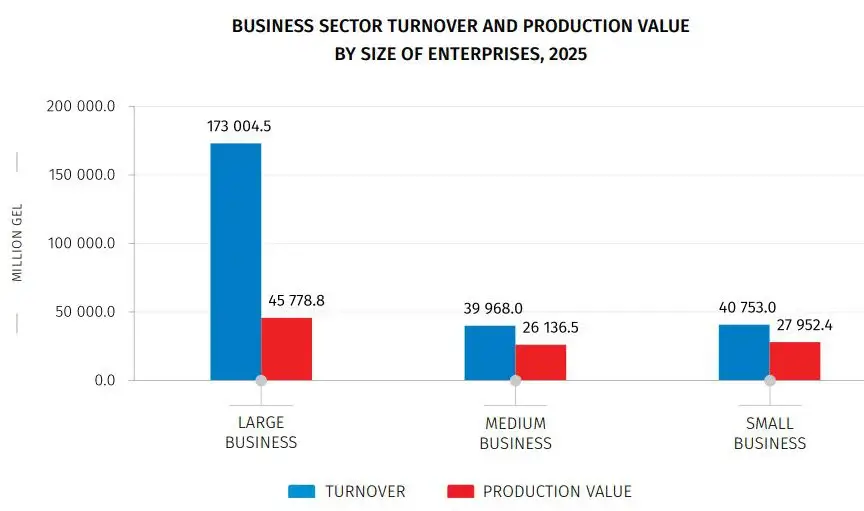
Large enterprises generated 68.2% of total business turnover in Georgia. Medium-sized companies accounted for 15.8%, and small businesses for 16.1%. More than two-thirds of turnover was therefore concentrated in the first group.
Output value was distributed more evenly. Large businesses accounted for 45.8%, medium-sized enterprises for 26.2%, and small companies for 28%. Together, the latter two categories generated 54.2% of total output, exceeding the contribution of large enterprises.
Small businesses led in employment, accounting for 40.9% of the total workforce. Large enterprises represented 39.4%, and medium-sized companies 19.7%. Small and medium-sized businesses together employed 60.6% of the total, highlighting their importance to the labour market.
Comparing the three measures reveals differences in the structure of the business sector. Large companies generated most turnover but contributed less than the other two groups combined to output and employment. Small enterprises, meanwhile, provided more than 40% of jobs despite accounting for just 16.1% of turnover. Medium-sized businesses occupied an intermediate position, with a greater share of output than of turnover.
Tbilisi and Adjara Lead in Business Activity
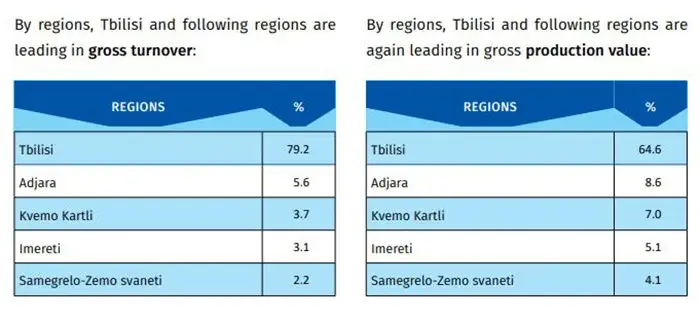
Tbilisi accounted for 79.2% of turnover across Georgian enterprises, 64.6% of output value and 62.1% of employment. The capital led on all three measures. Its share of turnover was substantially higher than its contribution to the production of goods and services or its proportion of the workforce.
Adjara ranked second, with 5.6% of turnover, 8.6% of output and 10.1% of employment. On the first two measures, it was followed by Kvemo Kartli at 3.7% and 7%, Imereti at 3.1% and 5.1%, and Samegrelo–Zemo Svaneti at 2.2% and 4.1%. Together with the capital, these regions generated 93.8% of total turnover and 89.4% of output value.
Imereti ranked third in employment after Tbilisi and Adjara, accounting for 7.1% of the total workforce. Kvemo Kartli represented 5.7%, and Samegrelo–Zemo Svaneti 3.6%. The regional ranking by employment therefore differed from the distribution of turnover and output.
Elsewhere, no region’s employment share exceeded Kakheti’s 3.1%. It was followed by Shida Kartli at 2.9%, Mtskheta-Mtianeti at 1.9%, Samtskhe-Javakheti at 1.8%, and Guria at 1.2%. Racha-Lechkhumi and Kvemo Svaneti recorded the lowest figure, at 0.4%.
What This Means for Investors
International Investment analysts note that investing in construction requires an assessment of the developer’s financial stability, funding sources and record of meeting deadlines on previous projects. An early-stage purchase is justified if the discount compensates for the waiting period and the risk of delayed completion. Renovation and furnishing costs should also be included in the calculation, as they increase the initial budget and postpone the start of income generation.
Apartment rental yields in Georgia have been declining in recent years. Rising purchase prices, combined with more moderate rental growth, extend payback periods, while maintenance costs and vacancies reduce profits. Such investments should be assessed on the basis of the owner’s net receipts after management fees, upkeep and taxes. Seasonality is particularly important for short-term rentals: strong summer revenue does not guarantee comparable performance over the full year.
The hospitality business appears more attractive to investors, especially in the premium segment, where professional management and high service standards create conditions for more stable and higher returns. Additional services diversify revenue streams, while year-round demand reduces reliance on the summer season. These advantages are most pronounced at properties with a strong operator and a well-developed concept.