







 Covivio Hotels Revenue Grows 4.7% as European Markets Split
 Lithuanian Apartment Prices Accelerate Across Major Cities
 Georgia's Tourism Revenue Hits Record High
 Norway's Sovereign Fund Commits €1.5bn to European Warehouses
 Market Rout of October 2026: Can Branded Hotels Protect Capital?
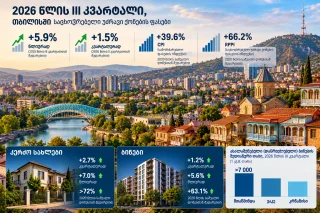 Residential Property Prices in Tbilisi Rise by 5.9% Year-on-Year
Israel’s GDP Surges After Early-Year Contraction
Calcalist
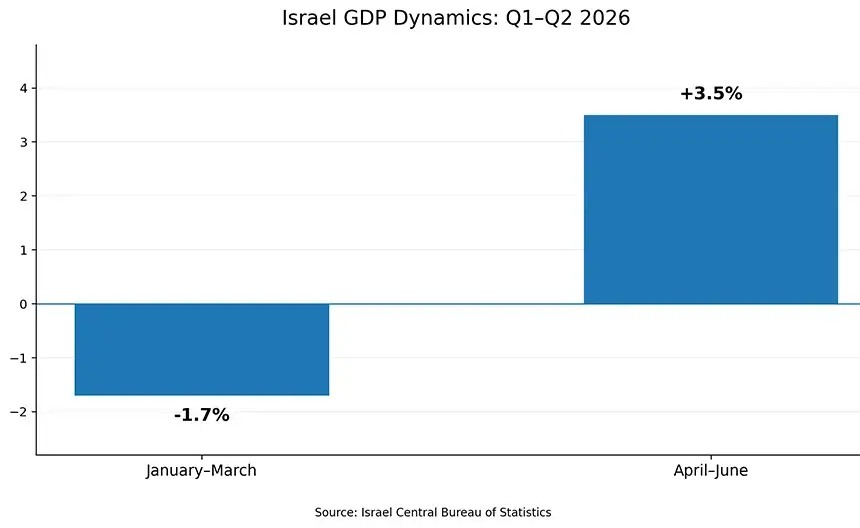
In the second quarter of 2026, Israel’s economy returned to growth after contracting in January–March. GDP increased by 3.5% compared with the first three months of the year. If this pace were maintained for 12 months, the figure could reach 14.9%. The main support came from domestic demand and government spending, Globes reports, citing Israel’s Central Bureau of Statistics.
Israel’s Economy in the First Half of the Year
In the first quarter of 2026, Israel’s GDP declined by 1.7%. The Central Bureau of Statistics initially estimated the contraction at 2.2% but later revised the data. This was the weakest period of the first half of the year.
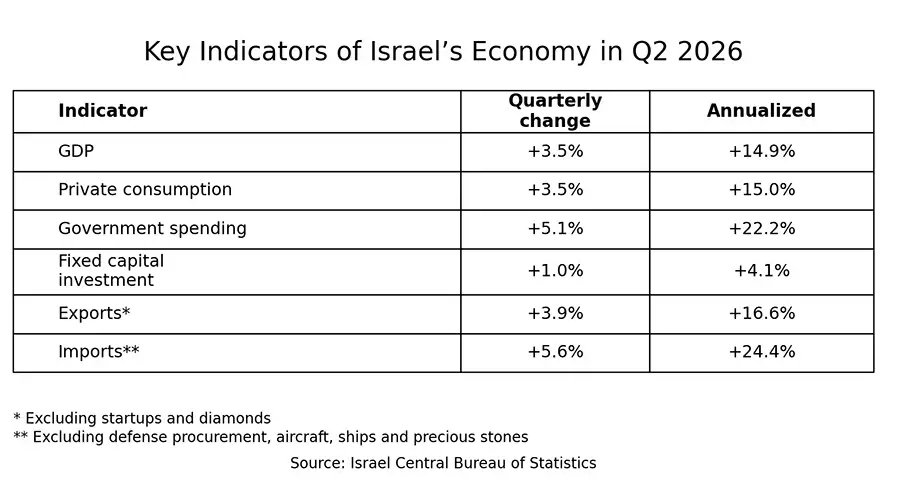
In the second quarter, the indicator rose by 3.5% compared with January–March and by 14.9% on an annualized basis. The initial estimate was slightly higher at 15.4%. Private consumption increased by 3.5% and 15%, respectively, government spending by 5.1% and 22.2%, and fixed capital investment by 1% and 4.1%. Exports of goods and services excluding startups and diamonds rose by 3.9% quarter-on-quarter and 16.6% on an annualized basis, while imports excluding defense procurement, aircraft, ships and precious stones increased by 5.6% and 24.4%.
In the first half of the year, GDP increased by 3.5% compared with the second half of 2025. Excluding the activity of Israeli-registered companies that produce and sell goods abroad, growth amounted to 1.1%. The difference shows that overseas operations made a significant contribution to the overall result.
Drivers of Israel’s Economic Recovery
One of the main reasons for the rebound in Israel’s economy was the recovery in business activity after the first-quarter contraction. During the operation against Iran, companies faced disruptions from missile attacks, school closures and the mobilization of reservists. These factors weighed on production, consumption and employment. As restrictions eased, businesses and households began returning to normal activity.
Government spending provided significant support. Revised statistics showed that its contribution was stronger than initially estimated, particularly due to military consumption. This component expanded faster than investment and several other areas, strengthening the overall pace of recovery.
A revival in domestic demand provided an additional boost. Household purchases, business activity and imports of goods and production inputs picked up. Exports and investment in Israel recovered more slowly, so the main momentum in the second quarter came primarily from the domestic market and budget spending.
Outlook for Israel’s Economy
Israel’s GDP is expected to increase by 4% in 2026, slightly above the March forecast of 3.8%. For 2027, the central bank projects an acceleration to 5.5%. The regulator expects this to be supported by a gradual easing of supply constraints, the return of reservists to the labor market and an increase in the number of foreign workers. Private consumption may rise by 3% in the current period and by 6.5% in the following one.
Even with improvements in key indicators, the economy could remain below its pre-war trajectory by the end of 2027, according to central bank estimates. The recovery continues to be constrained by labor shortages, prolonged reserve duty, the incomplete return to employment of some people affected by the fighting and a negative migration balance. In the second half of 2026, the broad unemployment rate may stabilize at around 3%, according to the regulator.
Key risks include fiscal pressure and a possible deterioration in the geopolitical environment. In the baseline scenario, Israel’s budget deficit is estimated at 4.9% of GDP in 2026 and 4.2% in 2027, while public debt is expected to remain at around 69% of the economy. Analysts at International Investment note that these projections assume there will be no new large-scale conflict and that defense spending will remain within the planned limits. Additional military expenditure could weaken public finances and increase inflationary pressure.