







 Covivio Hotels Revenue Grows 4.7% as European Markets Split
 Lithuanian Apartment Prices Accelerate Across Major Cities
 Georgia's Tourism Revenue Hits Record High
 Norway's Sovereign Fund Commits €1.5bn to European Warehouses
 Market Rout of October 2026: Can Branded Hotels Protect Capital?
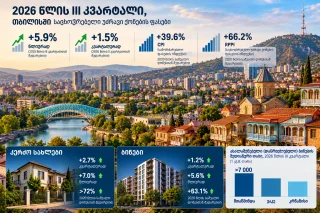 Residential Property Prices in Tbilisi Rise by 5.9% Year-on-Year
Investment in Russian Real Estate Declined in 2026

Investment in Russian real estate fell by 12–33% in the first nine months of 2026, depending on the assessment methodology. The sharpest decline was recorded in commercial property, including offices, warehouses and hotels. Residential real estate was the only segment to post growth, Kommersant reports.
Transaction Trends over Nine Months
Total investment in Russian residential and commercial real estate reached RUB 565 billion ($7.22 billion) in January–September 2026, according to IBC Real Estate. This was 33% less than in the same period of 2025. The number of completed transactions fell by 28% to 168.
Total investment over the same period reached approximately RUB 600 billion ($7.67 billion), according to CORE.XP. This represented a 12% decline from the 2025 figure of RUB 679 billion ($8.00 billion). Differences between the consultants’ estimates may reflect their transaction accounting methodologies and the assets covered. Both studies indicate a decline in buyer activity.
US dollar equivalents are calculated using average official exchange rates for January–September of the respective year: RUB 78.2637 per $1 in 2026 and RUB 84.8648 in 2025. The averages are based on daily Bank of Russia data and include all calendar days in each period.
Commercial property attracted RUB 421.3 billion, 25% less than in January–September 2025. It accounted for approximately 70% of the total. Of this amount, RUB 350 billion, or 83%, came from transactions for investment purposes. Purchases of premises for owner occupation totaled RUB 71.6 billion, with the previous year’s figure being 2.4 times as large. These preliminary estimates are provided by CORE.XP.
Investment in Russian residential real estate increased by 45% to RUB 178.6 billion, RBC reports, citing the same company. This was the only segment to record growth. The figure mainly covers professional transactions, including acquisitions of development projects and construction sites, rather than ordinary home purchases by individuals.
Russian Commercial Real Estate
Offices attracted RUB 195 billion in January–September 2026, retaining the lead among commercial assets, according to CORE.XP. This was 22% less than in the same period of 2025. Purchases of entire buildings fell by 26% to RUB 94.5 billion.
Sales of office units in Russia increased by 31% to RUB 63 billion. Companies acquire these premises for their own operations, while private buyers purchase them to rent out. Locations in established business districts support demand even as available space increases.
Industrial and warehouse property attracted RUB 109 billion, 14% less than in January–September 2025, according to CORE.XP. Meanwhile, the value of logistics park transactions more than doubled in the third quarter to RUB 123 billion, IBC Real Estate estimates. A single major acquisition of Raven Russia assets accounted for approximately 86% of the quarterly total.
Large acquisitions significantly affect warehouse market statistics. An increase in transaction value in a single quarter does not necessarily indicate a broader buyer base or a sustained recovery in demand. Experts identify the risk of property damage and rising insurance costs as additional constraints.
Retail property attracted RUB 89 billion, 23% less than in January–September 2025, according to CORE.XP. It trails offices and warehouses in capital investment. Buyers assess shopping center footfall, tenant stability, location and opportunities to increase revenue.
Investment by Segment in January–September 2026
|
Segment |
Volume, RUB billion |
Change from January–September 2025 |
|
Residential real estate |
178.6 |
+45% |
|
Commercial real estate — total |
421.3 |
−25% |
|
Offices |
195 |
−22% |
|
Industrial and warehouse property |
109 |
−14% |
|
Retail property |
89 |
−23% |
|
Hotels |
18 |
−60% |
Source: CORE.XP. Individual commercial segments are included in the overall commercial property figure.
Investment in Russian Hotels
Investment in hotels fell by 41% to RUB 35 billion in January–September 2026, according to Nikoliers. This was one of the steepest declines among the segments considered. Experts attribute it to the high base of previous years, operational risks and fluctuations in tourism demand.
Hotel investment totaled RUB 18 billion, down 60%, according to CORE.XP. The company uses a different methodology, so its result should be considered separately from the Nikoliers estimate.
The geography of investment in Russian hotels also changed. In 2025, the Moscow region led with a 44% share, while St. Petersburg ranked first in the initial nine months of 2026 with 59%, according to the same study.
Geography of Hotel Investment in January–September 2026
|
Region / city |
Share of investment |
|
St. Petersburg |
59% |
|
Krasnodar Krai |
13% |
|
Moscow |
9% |
|
Chelyabinsk |
7% |
|
Khanty-Mansi Autonomous Okrug |
1% |
Source: CORE.XP. Shares are shown for the listed regions and cities.
Acquisitions of operating hotels accounted for 77% of investment. New projects and properties intended for redevelopment made up the remaining 23%. This structure indicates interest in established businesses generating cash flow: construction and launch require additional expenditure and extend the capital payback period.
Reasons for the Decline
The high cost of borrowing remains one of the main reasons for the decline in investment. The key interest rate stands at 14% per annum in October 2026. Under these conditions, debt servicing increases the cost of acquiring and developing assets, while bank deposits compete with property for investors’ capital.
At the start of 2026, projected yields on Russian office property were 10.25–11.25%, compared with 11.25–12.25% for warehouses and 11.5–12.5% for shopping centers, according to CORE.XP. When comparing property with banking products, buyers also consider building maintenance costs, vacancy risk and the possibility of a subsequent sale.
A shortage of quality assets for sale is another constraint. Some owners prefer to retain properties generating stable rental income rather than sell during a period of uncertainty. Buyers, in turn, seek discounts to compensate for financing costs and investment risks.
The average project payback period has increased from nine to 12–15 years, NF Group notes. Buyers are attracted to discounted assets and buildings requiring renovation. The potential to increase rental income by changing management or property use helps offset the long capital payback period.
Investment Forecasts for Russia
Annual investment in Russian real estate could reach RUB 850–900 billion, according to IBC Real Estate. In 2025, the figure was RUB 1.2 trillion, implying an expected decline of 25–29%. The consultants do not anticipate a rapid recovery in activity.
CORE.XP experts give a wider range of RUB 800 billion to RUB 1 trillion. A limited supply of large assets offering buyers’ required yields makes the upper end harder to achieve. This estimate allows for either a further weakening of demand or an increase in major transactions toward the end of the year.
In 2027, lower interest rates could reduce borrowing costs and make property more attractive relative to deposits. More affordable credit would expand opportunities to acquire and develop projects. The pace of market recovery would also depend on buyers and sellers reaching agreement on prices.
International Investment analysts note that growth in residential development investment and a decline in purchases of completed commercial buildings reflect different capital allocation strategies. Development sites are expected to generate income after construction, while operating assets generate income through current operations. These areas cannot be assessed using identical criteria: project budgets and delivery schedules matter in the first case, while net operating income and tenant stability matter in the second. For hotels, occupancy, seasonality and management quality are key.
FAQ: Investment in Russian Real Estate
How much did investment in Russian real estate decline in 2026?
In January–September, investment fell by 33% to RUB 565 billion, according to IBC Real Estate. CORE.XP recorded a 12% decline to approximately RUB 600 billion over the same period. These are nine-month results, rather than figures for the whole of 2026.
Why do the IBC Real Estate and CORE.XP estimates differ?
The consultants may cover different transaction and asset types and use different valuation approaches. Figures should be compared within the research of a single company. Combining estimates from different consultants into one statistical series is inappropriate.
Which segment recorded investment growth?
Residential property attracted RUB 178.6 billion, 45% more than in January–September 2025, according to CORE.XP. The figure mainly relates to professional transactions involving development projects and construction sites. It does not reflect ordinary home purchases by individuals.
Why are investors reducing commercial property purchases?
The main reasons include expensive loans, a limited supply of quality assets and longer payback periods. Deposits compete with property for capital. Buyers seek discounts, while owners of income-producing buildings are not always prepared to lower prices.
Which exchange rates were used to convert the amounts into US dollars?
The main totals were converted using average official exchange rates for January–September of the respective year: RUB 78.2637 per $1 in 2026 and RUB 84.8648 in 2025. The calculation includes all calendar days in each period. Forecast amounts are stated only in rubles.
What investment volume is expected for the full year of 2026?
IBC Real Estate forecasts RUB 850–900 billion, while CORE.XP expects RUB 800 billion to RUB 1 trillion. These are forecasts rather than actual results. The final total will depend, among other factors, on the number and value of major transactions in the remaining months of the year.