







 This Year Has Been a Record-Breaker for Tbilisi Hotels — Shalva Alaverdashvili
 Friends, Shopping, and Leisure: Why and at What Age Do Georgian Residents Travel Abroad Most Often?
 Home Purchases by Foreigners in Armenia Rose 47%
 Gandagana: A Journey Through Adjara Without Leaving the City
 Hungary's Property Price Growth Comes to a Near Standstill
 Russia Proposes 30,000-Ruble Limit on Bank Transfers
Best Cities in Europe for Real Estate Investment

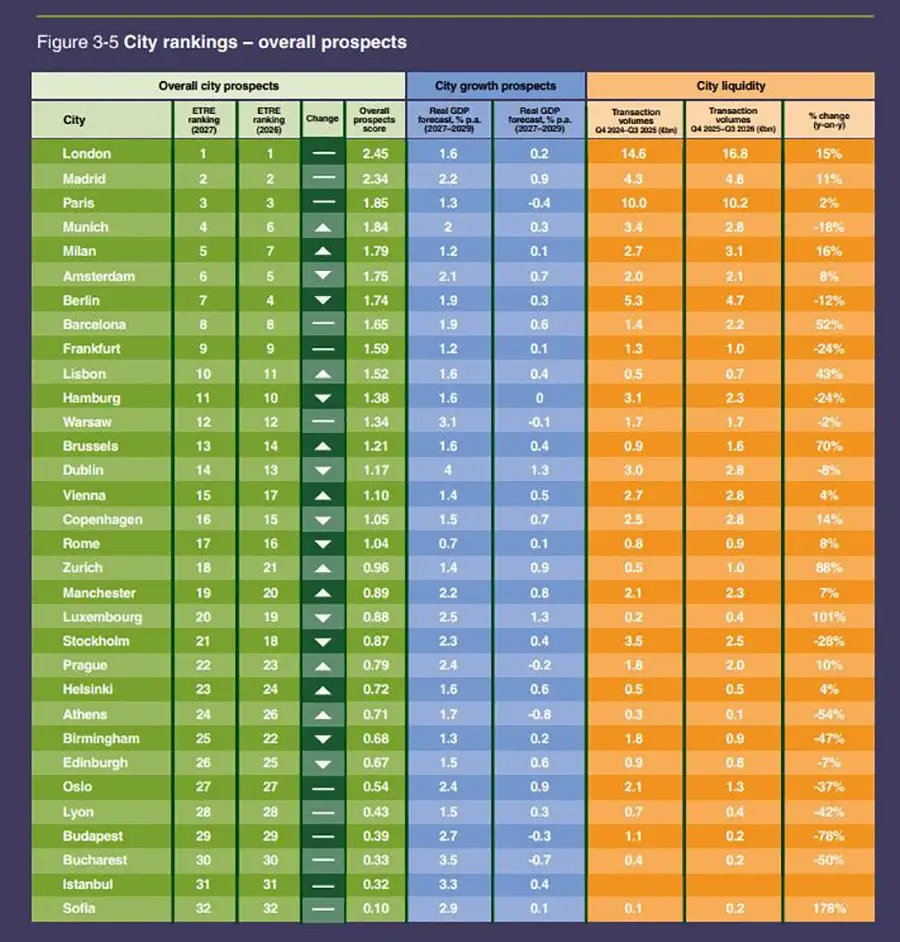
London, Madrid and Paris lead the ranking of European cities with the strongest prospects for real estate investment in 2027. Barcelona retained eighth place but recorded the fastest growth in investment among the top ten, according to a new study by the Urban Land Institute (ULI) and PwC.
Research Methodology
The study draws on surveys and interviews with 1,498 real estate professionals, including investors, fund managers, developers, lenders and consultants. Respondents assessed opportunities to acquire property and develop new projects in 32 cities.
The ranking considered market size and liquidity, economic indicators and development opportunities. Experts also assessed transport infrastructure, regulatory conditions and the quality of the urban environment. Particular attention was paid to demographic trends, housing demand and climate risks.
The findings of the real estate market study reflect industry expectations for 2027. A high ranking indicates that a city is attractive to investors, but it does not guarantee returns on individual properties or capital appreciation.
London: €16.8 Billion in Investment
London remains the top-ranked city for investment and development prospects in 2027. The UK capital attracts international capital thanks to the size of its market, transparent transactions and a broad pool of potential buyers. Even during periods of economic uncertainty, these advantages make it easier for investors to resell large assets.
According to MSCI, transactions in London's property market reached €16.8 billion between October 2025 and September 2026, up 15%. The city has also led Europe in actual investment volumes for six consecutive years. The level of activity confirms its role as a major hub for international capital.
Madrid: Investment Up 11%
Madrid held on to second place with an investment prospects score of 2.34. The Spanish capital appeals to buyers through resilient business activity, economic growth and opportunities across commercial property sectors. Rising demand for urban infrastructure and housing also supports its outlook.
Investment in Madrid's properties reached €4.8 billion over the past year, an increase of 11% compared with the preceding 12 months. Oxford Economics forecasts average annual real GDP growth of 2.2% for the city in 2027–2029, the highest projected rate among the ranking's top five cities.
Paris: €10.2 Billion in Transactions
Paris retained third place with a score of 1.85. As one of the continent's largest business centres, it benefits from extensive infrastructure and a broad range of market participants. These advantages support demand for high-quality properties, although conditions vary considerably between sectors.
Investment in the French capital rose 2% to €10.2 billion in the 12 months to September 2026. The recovery has been uneven: according to MSCI, office transactions in Paris during the first half of 2026 were at roughly half their long-term average. The city's strong overall position does not eliminate the risks associated with individual sectors.
Munich and Milan Move Up
Munich climbed to fourth place, overtaking Berlin to become Germany's highest-ranked city. However, actual investment fell 18% to €2.8 billion over the 12-month period. The difference between transaction activity and expectations for 2027 shows that respondents are assessing future opportunities as well as recent deals.
Milan rose from seventh to fifth place. Investment increased 16% to €3.1 billion. The Italian business hub's stronger position reflects growing interest in Southern Europe, where international capital is seeking alternatives to more expensive, mature markets.
Amsterdam and Berlin Lose Ground
Amsterdam slipped one place to sixth. The city recorded €2.1 billion in transactions, 8% more than in the previous period. Despite this increase in actual investment, its assessment of future prospects did not improve.
Berlin fell three places to seventh. Transaction volumes dropped 12% to €4.7 billion. Despite attracting substantial capital, the German capital ranked lower on future prospects, highlighting the difference between market size and appeal for new development.
Barcelona: Investment Surges 52%
Barcelona retained eighth place but recorded the strongest growth in transaction volumes among the top ten cities. From October 2025 to September 2026, real estate investment rose 52% to €2.2 billion. The sharp increase points to stronger buyer interest, although it does not necessarily imply comparable gains in property prices or rental yields.
Hotels, logistics properties and modern offices are attracting capital. Business and technology clusters support demand for high-quality space, while the city's international profile helps sustain demand for accommodation. Residential buyers should also assess local rental restrictions and other regulatory requirements.
Frankfurt and Lisbon
Frankfurt remained in ninth place despite a 24% fall in investment to €1 billion. Its established financial sector and developed infrastructure continue to underpin the market, but transaction figures indicate that buyers remain cautious.
Lisbon moved into tenth place, replacing Hamburg. The Portuguese capital attracted around €700 million, up 43% from the previous year. Rising activity and improved prospects confirm interest in Southern European destinations, although the city still trails most of the top ten in total investment volume.
Risks and Alternatives for Investors
Expectations for 2027 have become more cautious. Some 45% of respondents anticipate higher profitability, down from 50% in the previous survey. Key obstacles include high financing costs, inflation, rising construction expenses and international instability. Regulatory uncertainty was among the three leading risks for 38% of those surveyed.
Analysts at International Investment note that property investment in European countries requires substantial capital. High taxes, mandatory fees, maintenance costs and compliance with extensive regulatory requirements increase expenses for buyers and owners. These costs can significantly reduce net returns and encourage investors to seek more attractive destinations.
Georgia stands out among these markets, with relatively low taxes, straightforward entry rules and long visa-free stays for citizens of many countries. Foreign buyers can purchase apartments without restrictions, while potential residential rental yields may be higher than in many EU countries. However, yields in the housing sector have been declining in recent years as supply expands. At the same time, hotel real estate is gaining momentum, particularly premium projects operated by international brands and professional management companies.